What harm does iron deficiency in grapes cause?
What harm does iron deficiency in grapes cause? What causes iron deficiency in grapes? How do you prevent and treat iron deficiency in grapes? We would also like netizens with grape-growing experience to help explain. Grapes are perennial vines, generally cultivated in greenhouses or on trellises, which means the vineyard soil cannot be plowed for long periods, causing elements in the soil to deposit or leach away, thus producing deficiency symptoms. Today, Zhongdiwang has compiled the harm, causes and control methods of iron deficiency in grapes, listed in detail below for netizens' reference.
 What harm does iron deficiency in grapes cause? What causes iron deficiency in grapes? How do you prevent and treat iron deficiency in grapes? We would also like netizens with grape-growing experience to help explain.
Grapes are perennial vines, generally cultivated in greenhouses or on trellises, which means the vineyard soil cannot be plowed for long periods, causing elements in the soil to deposit or leach away, thus producing deficiency symptoms. Today, Zhongdiwang has compiled the harm, causes and control methods of iron deficiency in grapes, listed in detail below for netizens' reference.
Harm of iron deficiency in grapes:
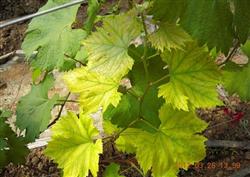
When grapes are deficient in iron, the tissue between the veins of new leaves loses its green color, gradually spreading until the entire leaf turns from yellow-green to yellow, but the veins remain green; when iron deficiency in grapes is severe, it starts from the leaves of the diseased shoots, and the leaves turn from yellow-white to white from top to bottom, sometimes with brown necrotic spots appearing, and the leaves look scorched, finally drying up and dying. New shoots grow slowly; when grapes are deficient in iron, the flower clusters turn pale yellow, fruit set is low, the fruit is pale in color and small, and development is poor, etc.
Causes of iron deficiency in grapes:
The element iron can promote the activity of various enzymes in plants, and when plants are deficient in iron, chlorophyll synthesis is affected. In the field, iron exists in the soil in forms such as oxides and salts, and after decomposition it releases a small amount of iron, which is generally absorbed by plant roots in the ferrous ion state.
Generally, soil is not lacking in iron; rather, soil conditions or other limiting factors hinder the plant's absorption of iron ions. For example, poor soil drainage and too-low soil temperature in clay soil, excessive salt content in saline-alkali soil, or trees being too old, the tree body aging, and the fruit load being too heavy, all easily cause difficulty for the plant in absorbing iron, and at the same time cause iron ions to have poor mobility within the plant body, so iron deficiency is commonly seen on new shoots or newly unfolded leaves.
Iron deficiency in grapes mainly occurs during cold, humid weather in spring.
Control methods for iron deficiency in grapes:
Method 1: Cover the ground of the vineyard and loosen the soil in time to raise the ground temperature. Also increase the application of organic fertilizer to adjust the soil pH to between 6~6.5, so as to reduce the soil salt content.
Method 2: Before grapes sprout, apply ferrous sulfate to the grapes, with 50~100 grams per mature grapevine, which can be applied in furrows or holes, but mixing it with organic fertilizer gives the best effect.
Method 3: Foliar spraying can be used, spraying the grapevines with a 0.1%~0.2% concentration ferrous sulfate solution, or with a 0.1%~0.2% concentration ferrous sulfate solution + 0.15% concentration citric acid solution, with an interval of 15~20 days between each spraying.
Method 4: After pruning the grapevines, use 179~197 grams of ferrous sulfate per liter of water to smear the parts above the grape terminal buds.
Control methods for magnesium deficiency in grapes
Control methods for boron deficiency in grapes
Control methods for calcium deficiency symptoms in grapes