What are the key technical points for summer management of red-fleshed honey pomelo?
How should red-fleshed honey pomelo be managed in summer? What mainly needs to be managed? We ask fellow growers to share their guidance. Summer is the period when red-fleshed honey pomelo develops roots, grows summer shoots, and sets young fruit and expands fruit. This period is an important time for fertilization throughout the year, and also a period when pests and diseases occur heavily. Zhongdi Web has compiled the detailed summer management...
 How should red-fleshed honey pomelo be managed in summer? What mainly needs to be managed? We ask fellow growers to share their guidance
Summer is the period when red-fleshed honey pomelo develops roots, grows summer shoots, and sets young fruit and expands fruit. This period is an important time for fertilization throughout the year, and also a period when pests and diseases occur heavily. Zhongdi Web has compiled the detailed summer management methods for red-fleshed honey pomelo, listed below for fellow growers' reference.
I. Apply fruit-swelling fertilizer to the trees in time:
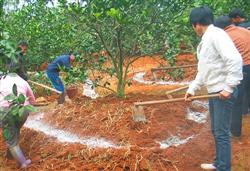
Timely application of fruit-swelling fertilizer to honey pomelo trees can strengthen shoots and fruit, and improve quality and yield. Generally, a tree producing 50 kg of fruit is given about 2.5 kg of NPK compound fertilizer, or alternatively 1 kg of urea and 0.25 kg of potash fertilizer, applied in 5 split applications. If conditions permit, a moderate amount of trace elements such as a mixture of 0.2% potassium dihydrogen phosphate and 0.2% borax can be sprayed on the leaves 1 to 2 times.
II. Fruit thinning, shoot thinning and summer pruning of red-fleshed honey pomelo:
Thinning shoots and fruit and summer pruning of honey pomelo trees serve to ensure nutrient accumulation, adjust tree vigor, and promote the shift from vegetative growth to fruiting reproductive growth.
1. Shoot thinning method for honey pomelo:
Shoot thinning is the removal of all summer shoots that emerge. Thinning summer shoots can reduce pest and disease damage, improve fruit set, and promote fruit expansion. For young trees, shoot thinning means wiping out the early summer shoots from "Lixia" to "Xiaoman", and keeping the later summer shoots; summer shoots should be pinched, leaving only 5 leaves. Bearing trees should not keep summer shoots, and the orchard should be visited frequently to wipe out shoots until before Dashu.
2. Fruit thinning method for honey pomelo:
Fruit thinning is especially important for balanced fruit growth and for improving quality and yield. More fruit should be kept on the inner canopy, where one bearing mother branch may keep 3 to 4 fruit; on the upper part of the canopy, keep a moderate amount of fruit, generally one fruit per bearing mother branch, at most 2, and all others should be thinned out.
3. Summer pruning method for honey pomelo trees:
Summer pruning refers to the moderate removal of water sprouts at the top of the canopy, relatively dense outer branches, dead branches and pest- or disease-damaged branches on trees that were lightly pruned in winter and whose spring shoots were not pinched in time. Summer pruning should be light. Reasonable pruning is especially important for adjusting tree vigor, improving ventilation and light penetration, reducing pest and disease damage, promoting fruit expansion and improving quality.
III. Pest control methods for red-fleshed honey pomelo:
1. Control method for red spider mite:
The first peak is in May to June, and in July to August high temperatures bring fewer occurrences, a low peak period. Control: in early May, pyridaben 2000-fold solution or fenpropathrin 2500-fold solution. In mid-June, 3000-fold solution of Kemante. In mid-July, 3200-fold solution of Kemante.
2. Control method for rust mite:
May, June and July are the key control periods. Control agents: 80% zineb 500-fold solution, pyridaben 2000-fold solution.
3. Control method for scale insects:
The main ones are: brown soft scale, arrowhead scale, wax scale, cottony cushion scale, etc. Control of the various scale insects should be timed to the initial hatching period of the first and second generation nymphs in early to mid-May, mid to late June, and early to mid to late July. Agents include: malathion 700-fold solution, 20% amitraz 1000-fold solution, Supracide 700-fold solution (used in autumn).
4. Control method for aphids:
Aphids are pests that damage young shoots in spring, summer and autumn. Control method: 50% malathion 700-fold solution, 80% dichlorvos 1000-fold solution, sprayed once each time before the young shoots reach 5 cm.
5. Control method for citrus leafminer:
The citrus leafminer is a major pest in nurseries and young trees. Control method: starting when young shoots are 0.5 cm, spray once every 5 to 7 days, for a total of 3 to 4 sprays. Fenvalerate 3000-fold solution or Kewobao 1500 to 2000-fold solution can be used.
6. Control method for swallowtail butterflies:
They produce 5 to 6 generations a year. The larvae first feed on the edges of young leaves, and when larger they eat the whole leaf. Control method: 80% dichlorvos 1000-fold solution, trichlorfon aqueous solution 1000-fold solution.
7. Control method for stink bugs:
Adult and nymph stink bugs insert their needle-like mouthparts into the fruit to suck sap. Control method: during the nymph occurrence period in May to June, use 50% malathion 700-fold solution or trichlorfon aqueous solution 1000-fold solution.
8. Control method for scarab beetles:
Scarab beetles mostly occur in pomelo orchards in mountain areas and cause relatively great damage to newly planted trees. Control method: spray trichlorfon 1000-fold solution, 80% dichlorvos 1000-fold solution, malathion 700-fold solution.
9. Control method for longhorn beetles: newly hatched longhorn beetle larvae bore into and feed on the bark, then move on to bore into the xylem and roots, and after September they move to the upper part of the trunk.
Method one, catching adults:
After early May, adults of the various longhorn beetles emerge from their holes one after another to cause damage, mate and lay eggs. Growers should be mobilized in time to catch adults around the trunks at noon on sunny days; before Dashu some adults are still emerging from their holes.
Method two, scraping off eggs:
After Lixia comes the adult egg-laying period. Patrol the orchard frequently and check the trunk below 30 cm above the ground. If saliva-like gum secretion is found, that is where eggs were laid. Use a small knife to dig out and destroy the eggs, plug the hole with pesticide or inject it, or hook out and kill the larvae: frequently locate boreholes in the trunk, clear the frass from the holes, then plug the hole with a cotton ball soaked in 10-fold dichlorvos solution, and seal the hole with wet mud to kill the larvae.
IV. Disease control methods for red-fleshed honey pomelo:
1. Control method for canker:
Canker damages branches, leaves and fruit. Control method: 0.3% to 0.5% double-strength Bordeaux mixture, sprayed 10, 25 and 50 days after petal fall. Be careful to wipe out summer and autumn shoots to eliminate the citrus leafminer; for young trees, spray streptomycin once before the summer and autumn shoots mature.
2. Control method for greasy spot:
Greasy spot damages leaves and late-season fruit. Control method: when spring buds are 0.5 cm long, spray copper-ammonium mixture, 80% zineb 500-fold solution plus Jinggangmycin 500-fold solution; from May to July, apply control once each month.
3. Control method for anthracnose:
Anthracnose damages leaves, shoots and fruit during the expansion period. Control method: spray 0.5% double-strength Bordeaux mixture on spring shoots, and thiophanate-methyl 500-fold solution at other times.
4. Control method for scab:
Scab damages leaves, shoots and fruit. Control method: control during the young leaf stage of spring shoots and the young fruit stage is more important; use copper-ammonium mixture or Bordeaux mixture at 0.5% double strength.
5. Control method for ring rot:
It damages branches and fruit. Control method: when spring shoots are about 0.5 to 3 cm long, spray copper-ammonium mixture or thiophanate-methyl 500-fold solution; for fruit, spray carbendazim 500-fold solution plus Jinggangmycin 500-fold solution, twice each in late April, mid-May and early to mid-August.
Click to get more pomelo cultivation techniques
Click to get more fruit cultivation techniques