DIY Method for Turning Kitchen Waste into Organic Fertilizer
In many European countries, when dealing with kitchen waste and yard weeds and fallen leaves, people often use their own yards for natural composting, and some use machines for high-speed fermentation. In the early days, farming families in Taiwan, China all had compost sheds and manure pits, and these can provide us with space for reflection and thought.
There are many kinds of household organic waste, such as vegetable trimmings sorted out before cooking, kitchen waste, fruit peels, expired food, animal-based waste, yard weeds, fallen leaves, tea dregs, eggshells, dairy products… and other carbohydrates. Any organic matter that will rot, decompose, and stink belongs to this category. In the past, we treated it as general non-recyclable waste. However, precisely because organic matter has the characteristics of rotting, decomposing, and stinking, the waste gas, wastewater, and foul odors it causes are the main players in garbage wars, and can even cause secondary pollution. With the rise of environmental awareness, the attitude of people only sweeping the snow in front of their own doors has brought the garbage problem more into the open, forcing us to think faster about solutions.
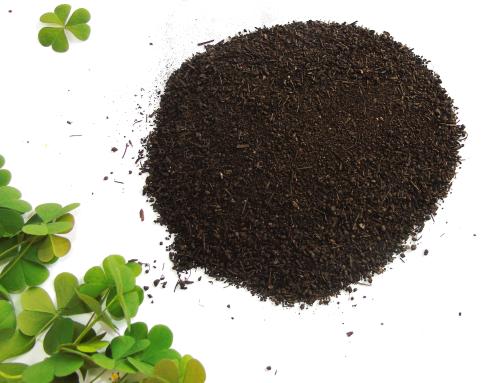
Note: The biggest trouble in kitchen waste treatment lies in its high moisture content and the instability of the materials, such as animal-based waste and high protein, so it is more prone to breeding insects and giving off foul odors. Because of the high moisture content, anaerobic conditions easily form during fermentation and produce odors. In particular, the special dietary habits of people in this country further increase the difficulty of treatment.
In general, when treating kitchen waste, microorganisms (solid or liquid are both acceptable) can be used as an accelerator for fermentation, but the treatment methods currently promoted mostly use microbial strains imported from abroad. Whether long-term use causes aftereffects is worth tracking and discussing by relevant scholars. Furthermore, because the process of using household kitchen waste bins and similar methods to treat kitchen waste and make compost cannot achieve high-temperature fermentation to reach a disinfecting effect, it only has the function of multiplying microorganisms, which also affects compost quality. Of course, from the standpoint of environmental protection it is still acceptable, but from the standpoint of fertilizer, there is room for dispute.
Production method: Take a bucket as shown in the figure. A discarded plastic bucket can be used. The separation net is about 3-5 cm from the bottom of the bucket, and the mesh openings are about 5 mm or less. Commercial products are already available on the market.
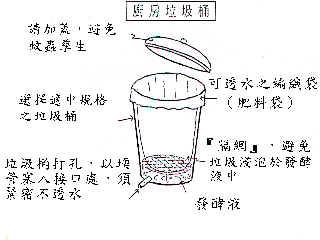
1. After removing the liquid from household organic waste, draining it, and cutting it finely (about 2-3 cm), pour it into a household kitchen waste bucket and spread it evenly.
2. Spray liquid microbial stock solution 3-5 times, or thinly apply solid microbial strains on the upper layer of the kitchen waste. The amount depends on how much is put in each time.
3. After about 3 days, a relatively large amount of liquid (fermentation liquid) will flow out at the drainage pipe. After that, discharge this liquid once every 2-3 days. The fermentation liquid smells like sour swill water. When taking it out, please be careful not to let it touch clothing. If it touches the fermentation liquid, the smell will take about four hours to fade completely.
4. Treatment after the household kitchen waste bucket is full:
As shown in the figure, when a water-permeable woven bag is placed in the bucket, the whole bag can be taken out and piled up for subsequent fermentation.
a. If no woven bag is placed, the bucket can be sealed and fermentation continued for 2-3 months, and it will then be good-quality compost. During the fermentation period, the fermentation liquid must also be drained regularly.
b. Put it into a vegetable garden and mix it thoroughly with the soil, spray water and turn it once about every 10 days, and it can be used after about one month.
c. Community neighbors can jointly agree to set up household kitchen waste buckets at home, and after the buckets are full, drain the contents and pour them into a shared community collection bucket. For the collection buckets, several large buckets can be used (the one in the figure enlarged to about 300 liters), and then microbial strains can be thinly applied once more. After the collection bucket is full, the procedure is the same as treatments a. and b. above, or the treatment in e. below can be used.
d. Use collection buckets that are easy to transport (50-100 liters) for shared use by community neighbors, and discuss with a farm that after the buckets are full, the farm will take them back to make compost.
Advantages and disadvantages:
Advantages: 1. Low cost. 2. Easy to implement.
Disadvantages:
1. It is difficult to obtain space in metropolitan communities, and it is not easy to prepare several household kitchen waste buckets at home.
2. Because there is no aerobic high-temperature fermentation, pathogenic insect eggs and weed seeds cannot be killed.
3. The compost produced still has high moisture content and is relatively inconvenient to use.
4. Because it is difficult to obtain space and land, when placed outdoors it must be appropriately shaded, and typhoons and heavy rain must also be taken into consideration.
5. Whether kitchen waste fermentation buckets are set up at home or in the community, they will produce odors and make people dislike them.
Use
Compost use
For the fertilizer needs of one's own vegetables, potted flowers, and other plants.
For greening and fertilizing communities, schools, and residences.
Provide farm fertilization.
Use of fermentation liquid fertilizer
For cultivation: dilute 100-200 times for foliar use, and 30-50 times for soil irrigation.
For cleaning: it can be poured into a toilet to clean the toilet and then flushed into a septic tank, using the microorganisms in the liquid to decompose organic matter in the septic tank and prolong the life of the septic tank.
For environmental protection: it can be poured into smelly ditches (not standing water), using the microorganisms in the liquid to decompose the organic matter causing odors, reducing odors and mosquito breeding.