-

What potato varieties are suitable for double-season cropping?
What potato varieties are suitable for double-season cropping? There are quite a few potato varieties suitable for double-season cropping, all of the early-maturing type, with a short growing period and features such as disease resistance and good quality. Examples include Lu Potato No. 1, Lu Potato No. 2, Fengshoubai, Zheng Potato No. 2, Dongnong 303, Luyin
-
How to grow double-season water bamboo? The latest planting technique and method tutorial is here
Water bamboo has two types: autumn-producing single-season water bamboo and autumn-summer double-season water bamboo. Both are propagated by division. In the Yangtze River basin, single-season water bamboo is divided into clumps and planted from Qingming to Guyu, while summer-autumn double-season water bamboo can be planted in two seasons, spring and autumn, with spring planting around Guyu and autumn planting around Liqiu. Below, let us take a look together
-
Summary and Sharing of Experience in Double-Season Sweet Potato Cultivation
I. Variety Selection: Choose virus-free early-maturing varieties, which can be harvested just over 3 months after planting, allowing off-season marketing and yielding considerable economic benefits. Early-maturing varieties can include Japanese Yellow Sweet Potato, Yushu 10, Sushu 8, etc. These early-maturing varieties have vines 50-70 cm long and are suitable for close planting.
-
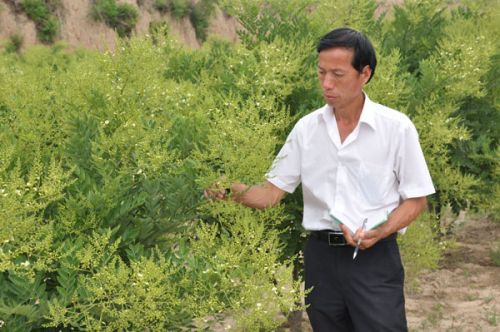
Deepening the Double-Season Huai industry for 20 years: Lei Maoduan forges a path to prosperity
20 years of hard work carving out a path to prosperity: a chronicle of Lei Maoduan developing the Double-Season Huai industry
-
Double-season pagoda tree helps the Loess Plateau retain soil and water while generating income
Double-season pagoda tree on the Loess Plateau retains soil and water and brings income
-
To raise the per-unit yield of double-season rice in Jiangxi, the key lies in changing the "six mores and six lesses" phenomenon
Rice is the most important food crop in Jiangxi, and increasing the per-unit yield of double-season rice is an important way to ensure Jiangxi's position as a major grain-producing region and to ensure that Jiangxi makes a greater contribution to the country's food security. In recent years, although the per-unit yield of double-season rice in Jiangxi has risen steadily, the phenomenon of a relatively low per-unit yield level has still not improved much. Compared with neighbouring Hunan, it is 50-60 kg lower per 667 sq m. Analysis shows that the "six mores and six lesses" phenomenon is the main reason for Jiangxi's low rice per-unit yield. 1. More seeding rate, less seed used. Cultivating
-
Two-crop Double-season Garlic Cultivation Techniques
I. What is two-crop (double-season) garlic. So-called two-crop (double-season) garlic means planting one season of early green garlic and one season of plastic-film garlic (also called harvest garlic, harvested for scapes and bulbs) within the year. II. Benefits of two-crop garlic 1. It can effectively raise land utilization and realize a "three plantings, three harvests" or "four plantings, four harvests" cropping system in one year, namely "corn → green garlic → harvest garlic" or "corn → watermelon or winter melon → green garlic → harvest garlic". Every year 4-5 days before the "Qingming" solar term, plant 2 rows of corn along the edge rows of the garlic (planting waxy fresh corn is best), and leave the corn stalks to cover the garlic; interplant early watermelon or winter melon in the wide rows of the garlic (harvest garlic) (watermelon or winter melon is grown by the seedling transplanting method), and harvest garlic bulbs in batches while the watermelon or winter melon grows; plant green garlic around mid-July, and lift and market the garlic from late September to early October; plant plastic-film harvest garlic in mid-to-late October.
-
Detailed Explanation of Key Techniques for Super-High-Yield Cultivation of Double-Season Rice in South China
(1) Sow at the right time and cultivate strong seedlings. For early rice, use dry-raised seedlings, with a seeding rate generally of 90 g/m2 and a sowing period in mid-to-late March; for late rice, use sparse sowing for strong seedlings or two-stage seedling raising, with a seed rate of about 1.0 kg per mu. (2) Ridge and bed cultivation. Bed width 3-4 m, ditch width 0.2-0.25 m, and open surrounding ditches well to facilitate water management and field operation management. (3) Wide-row close planting. The planting density is 30-40 hills/sq m, with a row spacing of about 25 cm. Generally, early rice has 3-4 seedlings per hill, and late rice is transplanted as single seedlings or double seedlings, ensuring
-

Differences in Planting Techniques and Seedling Propagation Methods Between Double-Season Pagoda Tree and Fragrant Flower Pagoda Tree
Double-season pagoda tree is suitable for seed propagation, while fragrant flower pagoda tree is suitable for root burial propagation. The most suitable cultivation techniques are not entirely the same for different varieties, and growers can choose according to their own needs
-
Double-season super rice early-season yield reaches up to 738.5 kg per mu
On the 18th, an expert panel invited by the Guangdong Provincial Department of Agriculture conducted an acceptance evaluation in Xingning City, Guangdong Province, of the research project on annual per-mu yield of 3,000 jin for South China double-season super rice, led by "father of hybrid rice" Yuan Longping's team. After on-site yield measurement, the expert panel announced that the project's early-season average
条件筛选