Deepening the Double-Season Huai industry for 20 years: Lei Maoduan forges a path to prosperity
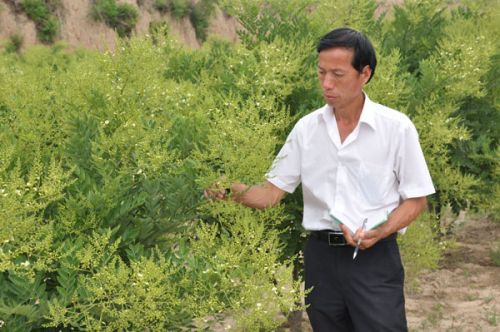
On May 24, Wang Rulin, Secretary of the Shanxi Provincial Party Committee, specifically mentioned the Double-Season Huai at the province's teleconference on poverty alleviation. What is the Double-Season Huai? And why would it draw such attention from a provincial party secretary?
A landmark contribution, born of more than 20 years of diligent research
Goudong Village is located at the northernmost tip of Yanhu District, Yuncheng, Shanxi Province, with Jiwang Mountain to the north and Huoyan Mountain to the east. All the land lies on mountain ridges, and there is no water at all. One mu of wheat yields only just over l00 jin, and even feeding the family is a problem. By 1980, electricity had already reached Goudong Village, but because residents could not afford the electricity bills, nearly half of the households were still lighting their homes with oil lamps.
To change this situation, in 1981 Lei Maoduan quit his job as a minban teacher and contracted more than 100 mu of land in the village, planting apple, pear and hawthorn trees. Unexpectedly, these fruit trees died in large numbers from drought before they could bear fruit, and Lei Maoduan lost a great deal of money. But this failure made Lei Maoduan understand one principle: for the people of the dry plateaus to prosper, a new economic tree species had to be found.
After a painstaking search, Lei Maoduan accidentally discovered the Chinese scholar tree (Sophora japonica), which "stands tall on cliffs, thrives for a century without decline, fears no drought, and fears root rot even less." He then carefully analyzed the market situation for huaimi (scholar tree flower buds) and found that huaimi prices always remained high, and that huaimi had unique uses in medicine, chemicals and health care. If the Chinese scholar tree, used for ecological greening, could be turned into a mi-huai that specifically produces huaimi, it would certainly become an excellent economic tree species for dry plateau areas. Lei Maoduan had a sudden inspiration: breed a new mi-huai variety and blaze a trail of innovation for dry plateau agriculture!
Lei Maoduan resolved to turn this dream into reality and fill a gap that no domestic research institute had studied.
He began by investigating and studying the large number of Chinese scholar tree varieties across the country. From Shanxi, Hebei, Henan, Guangdong and Guangxi, he collected seeds of more than 700 varieties of Chinese scholar tree from more than 200 regions and more than 1,500 types of scion, grafting and planting them respectively in his experimental garden of more than 50 mu. He earnestly studied the theory of artificial hybridization and repeatedly carried out all kinds of experiments. But 3 years passed, then 5 years, and one experiment after another ended in failure. He sank into the agony of having nowhere left to turn.
Lei Maoduan truly wanted to give up this research, which perhaps could never succeed. But when he was really about to give up, looking at the barren mountains and earthen ridges of his hometown and recalling the vow he had made, he decided to endure every hardship and press on.
Hard work pays off. After more than 20 years of every kind of effort, in 1999 a unique new dry plateau crop variety - the Double-Season Huai - was finally born. The Double-Season Huai can harvest huaimi twice a year, shows results in two years, gives a bumper crop in three years and full production in five years, fears no drought and no barren soil, and brings in six to seven thousand yuan per mu in hilly dry plateau areas, with per-mu returns dozens or even hundreds of times those of traditional crops. In April 2012, the Double-Season Huai passed the scientific and technological achievement appraisal of the Shanxi Provincial Department of Science and Technology; in May of that year, it passed the "improved forest tree variety appraisal" of the Shanxi Provincial Forest Tree Variety Approval Committee. On August 13, 2013, the Shanxi Provincial Forestry Department held a provincial symposium on Double-Season Huai development in Yuncheng. The leaders and experts present unanimously agreed: "The Double-Season Huai has solved the social problem of low economic output in dry plateau areas, filled a domestic gap, and is a milestone in the history of forestry development in Shanxi and even China. Lei Maoduan's contribution is enormous and historic."