-

What are the latest methods for weed control in wheat fields?
Wheat is a staple food in northern China and, after rice, another major grain crop grown in our country. Wheat is highly resistant, but it still requires proper field management to achieve high yields, and weed control management within field management is a very important step. So
-
Herbicide Selection and Use in Corn and Wheat Fields, and How to Identify and Remedy Herbicide Damage
Herbicides are chemicals that can kill weeds completely or selectively; also called weedkillers, they are a class of substances used to eliminate or inhibit plant growth. So which herbicide is best for corn and wheat fields? How should it be used? What are the methods for identifying and remedying herbicide damage?
-
What are the control methods and available herbicides for wild weeds in wheat fields?
Weeds are important pests that harm wheat yields, so they must be removed in time, and experience shows that removing field weeds before winter can increase yields. So how should wild weeds in wheat be controlled? Which herbicides can be used? 1. How to control wild weeds in wheat
-
What are the control methods for wheat powdery mildew?
In recent years, with the improvement of fertilizer and water conditions in wheat fields and the increase in plant density in high-yield fields, wheat powdery mildew has become increasingly severe year by year. After the powdery mildew pathogen parasitizes wheat, the plant's respiration increases, transpiration intensity rises, and photosynthetic efficiency decreases, seriously affecting the normal
-
The best time for winter weed control in wheat fields and how to control wild oats
Abstract The best time for weed control in winter wheat fields is from mid-November to early December, that is, when wheat seedlings have grown to 4 leaves. Generally, 30-45 days after wheat sowing is the best time to control wild oats, that is, the control effect from November 1 to 20 is relatively good, because
-
5 Major Methods for Weed Control in Winter Wheat Fields to Help Wheat Overwinter Safely and Increase Yield
Wheat belongs to the genus Triticum in the grass family (Poaceae). It is one of the earliest cultivated crops in the world, and through long-term development it has become one of the food crops with the widest distribution, the largest area, the highest total production, the largest trade volume, and the highest nutritional value in the world. So how do you control weeds in winter wheat
-
-
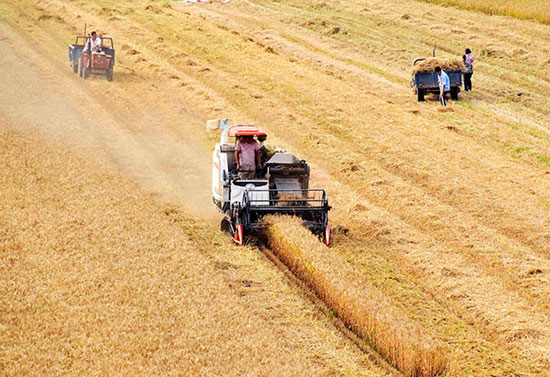
Combine harvesters enter the wheat fields, devouring whole stretches of wheat
Combine harvester: the wheat is eaten up, eaten up
-
Hybrid wheat brings good harvests even to medium- and low-yield fields
Hybrid wheat brings good harvests even to medium- and low-yield fields
-
Does applying chlorsulfuron to wheat fields affect cotton?
Chlorsulfuron is a sulfonylurea herbicide with high herbicidal activity, mainly used in wheat and flax fields to control annual monocotyledonous and dicotyledonous weeds. In China, it is currently restricted to use only in wheat fields in the wheat-rice rotation areas of the Yangtze River basin. It is not easily decomposed in soil, and its residual effect lasts up to 6 months. Crops such as cotton, peanut, soybean and vegetables are sensitive to this herbicide. When chlorsulfuron is applied to wheat fields and sensitive crops such as cotton are planted in the following crop, phytotoxicity of varying degrees will occur. In wheat fields where chlorsulfuron has been applied, it is best not to transplant cotton; other crops with strong tolerance can be planted instead.
条件筛选