-

Repotting rhododendrons after flowering has its particularities; only by mastering the method can they survive well
When choosing a pot, select a suitable pot according to the size of the plant, with clay pots being best; generally the pot diameter (inner diameter) should not exceed half the crown diameter. Rhododendrons prefer acidic soil, requiring a pH of 4.25-5.5; without maintaining this acidity, potted rhododendrons are very difficult to keep alive, and the potting soil must be loose, well-draining and rich in humus; never use heavy clay soil. When using soil, it is best to prepare it according to the original root-ball soil of the rhododendron; plants previously grown in pine-needle soil should still use pine-needle soil, which can be mixed with a small amount of decomposed horse manure and bone meal, and
-
Symptom Identification and Control Methods for Cotton Angular Leaf Spot
Symptoms: This disease not only damages cotton seedlings but also harms the stems, leaves, and developing bolls of mature plants. When seedlings are infected, the cotyledons develop water-soaked irregular or round lesions that are dark brown; in severe cases, the cotyledons wither and drop off. When true leaves are infected, small dark green spots first appear on the underside of the leaves, then expand into oil-soaked lesions; on the upper surface of the leaves, the lesions are mostly angular, and sometimes the lesions extend along the veins in irregular streaks, causing the leaves to turn yellow and drop off. When stems are infected, water-soaked main lesions appear, then expand and turn black or rot, the diseased area becomes sunken, and the pathogen bends to one side. When the terminal bud is infected, it forms a "rotten top," causing the entire plant to die.
-
How to effectively prevent and control cotton angular leaf spot
Cotton angular leaf spot is a bacterial disease. Cotton can be affected from the cotyledon stage to the mature plant stage. After infection, dark green small spots first appear on the underside of the leaves, and later the spots gradually expand, restricted by the leaf veins to form polygonal oil-soaked lesions. When the bacterial fluid is moist, it is a yellowish-brown sticky substance, and after drying it becomes a white scab-like substance. In severe cases, it can cause the leaves to dry up and fall off. If diseased leaves are held up to the light, the lesion areas look like oiled paper. The causes are, first, continuous cropping on the same land, with the disease developing from bacteria carried by diseased residues in the soil; second, poor light, high humidity and high temperature, with damaged cotton branches and leaves, which favors
-
Rabbits Have Particular Water Needs: A Full Breakdown of Scientific Watering Methods
As the saying goes, "Better to lack a handful of grass than a mouthful of water," which fully illustrates the importance of drinking water for rabbits. So, what exactly does water do for a rabbit's growth, what happens after a rabbit is short of water, and how do you give rabbits water scientifically? 1. The role of water in rabbit growth. In the various tissues of a rabbit's body, water accounts for 70%, and in the blood it can reach 80%; the water content of bones, muscles and internal organs is 45%-75%. Not only is water indispensable for the digestion, transport and absorption of nutrients from all kinds of feed, the excretion of waste products and toxins produced by metabolism is also inseparable from water.
-
The fireworks tree bonsai is a spectacular sight when in full bloom.
The fireworks tree (Clerodendrum quadriloculare) is a small shrub in the genus Clerodendrum of the family Verbenaceae, native to Africa and the Pacific Islands, and is also found scattered in China. The fireworks tree has an attractive plant form, beautiful foliage, and brilliant, colorful flowers with dancing stamens. It blooms continuously from June to November, with a flowering period lasting as long as half a year. The flowers are terminal, long-tubular, in spreading clusters, with dense inflorescences and purple-red floral tubes; the front end bursts open into 5 pure white, colorful, long strip-shaped petals, like twinkling stars, as if they were clusters of fireworks set off during a festival. The exposed stamens are like golden threads and silver willows, bouncing and dancing nonstop when the breeze blows, and the fruit after flowering is colorful.
-
How is swine vesicular disease diagnosed and treated?
A cow's ocular conjunctiva is covered by the eyelids. To examine the conjunctiva, there are generally two methods: first, press open the lower eyelid with your thumb to expose the conjunctiva. Second, grasp the cow's horns with both hands and forcefully turn the head to one side; the cow will then look sideways, exposing the conjunctiva. In a healthy cow, the ocular conjunctiva is pale pink. Redness of the conjunctiva is a sign of circulatory disturbance and may indicate eye trauma, conjunctivitis, or various acute febrile infectious diseases. A blue-purple conjunctiva may indicate pneumonia or heart failure
-
The golden fruits of the golden-and-silver eggplant are brilliant and particularly endearing.
Golden-and-silver eggplant, also known as ornamental eggplant, is a perennial fruit-ornamental plant of the Solanum genus in the Solanaceae family, cultivated as an annual, suitable for both eating and ornament. The golden-and-silver eggplant is a variation of the edible eggplant, shrub-like, and can be grown in pots or in the ground. Leaves alternate, elliptical. Flowers purple, with five petals and a yellow center, resembling a five-pointed star flower. The plant has a sturdy form, and flowers in all four seasons can set fruit, with 30-50 fruits per plant and a single fruit weight of 30-50 grams. The fruit is elliptical; the berry is white when first formed and gradually turns golden yellow as it matures, bearing abundant fruit and dazzling to the eye, like gold and silver treasures hanging all over the branches, hence the name "gold
-
Pig-and-chicken circular farming model boosts feeding efficiency
The new technology of efficient circular pig-and-chicken farming is a practical technique particularly suited to rural farmers. The method is as follows: ferment chicken manure by the lactic acid method to feed pigs. There are many ways to feed pigs with chicken manure, such as drying it, feeding it fresh, and conventional fermentation, but the lactic acid fermentation of chicken manure is best. This is because this method can turn chicken manure into a high-quality pig feed with good palatability. The fermentation method is: first dry the chicken manure to 70% dryness, then mix an appropriate amount of lactic acid bacteria and 10 kg of wheat bran or rice bran into every 100 kg of chicken manure, put it into non-toxic plastic bags or other containers
-
What are the control methods for the peach globular scale?
In recent years, the peach globular scale has occurred severely in the nectarine orchards of our town. In mild cases, tree vigor weakened and yields declined; in severe cases, there was total crop loss and even tree death. To address this, we carried out two consecutive years of pesticide screening and control, with very good results. We summarize them as follows: 1. Strengthen comprehensive fertilizer and water management measures, keep the trees vigorous, ensure ventilation and light penetration, and pay attention to protecting natural enemies. 2. Before bud break, in early to mid-March, when overwintering nymphs emerge from dormancy, their body surface wax is still sparse, so timely control can achieve good results. Choose 5-degree lime sulfur
-
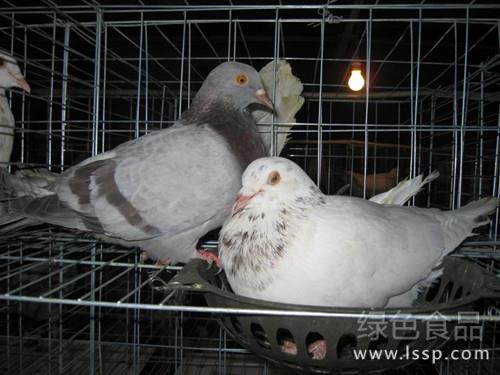
Pollution-free squab farming and management methods make green food more popular with the public
Green food is more popular with the public: pollution-free squab farming and management methods
条件筛选