-

Technology Gives Wings to Agriculture, Helping Modern Agriculture Soar
Editor's Note: As the primary driving factor safeguarding our country's food security and sustained agricultural growth, science and technology's contribution rate to agricultural growth has reached 55.2%. How can the role of science and technology be better leveraged to give agriculture wings? In 2013, the Ministry of Agriculture launched and implemented the "National Agricultural Science and Technology Innovation Capacity Conditions Construction Plan (2012-2016)". With strong support from the National Development and Reform Commission, during the "12th Five-Year Plan" period, the central government allocated a cumulative investment of 3.43 billion yuan, supporting the construction of 14 national agricultural science and technology innovation platforms and the Ministry of Agriculture key laboratories (stations) of 28 disciplinary groups. Proceeding from the actual needs of agricultural research institutions at the central, provincial, and municipal levels, a coordinated design and systematic deployment were carried out for the layout, construction content, project management, and operating mechanisms of our country's agricultural science and technology innovation capacity conditions construction, promoting collaborative research, co-construction and sharing among research institutions, and forming a virtuous operating mechanism with functional linkage and mutual support.
-
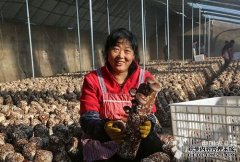
Qinhuangdao, Hebei Promotes Edible Mushroom Production to Help Farmers Increase Income
Recently, the shiitake mushrooms cultivated by the Nühanzi Edible Mushroom Cooperative in Funing District, Qinhuangdao City, Hebei Province, entered the harvesting period, and in recent days the cooperative members have been picking shiitake mushrooms in the greenhouses. It is understood that the current edible mushroom production scale in Qinhuangdao City has reached 39 million sticks, with an annual output of 32,000 tons,
-
Developing the vegetable industry to help poverty alleviation: Qianjiang Municipal Agriculture Bureau assists Congjia Village
[Introduction China Vegetable Network] Since the launch of the targeted poverty alleviation work, the poverty alleviation task force of the Qianjiang Municipal Agriculture Bureau quickly stationed itself in Congjia Village, Yuyang Town, to advance the targeted poverty alleviation work. In late December 2015, all 64 cadres from the Qianjiang Municipal Agriculture Bureau were assigned to households under their responsibility and carried out
-
Internet Expected to Help China's Agriculture Leapfrog Ahead
The recently released Proposal for the 13th Five-Year Plan devotes considerable space to elaborating on agricultural modernization, proposing to advance agricultural informatization during the 13th Five-Year Plan period. Reporters learned through interviews that internet applications have penetrated into every link of agricultural production, circulation and services, and the booming
-
Circular agriculture elevated to a national strategy, helping transform the agricultural development model
On November 10, at the seminar on the implementation effects of circular agriculture among smallholder farmers, jointly organized by the College of Humanities and Development Studies of China Agricultural University and ActionAid (China), Sun Yufang, director of the Resource Protection Division of the Agricultural Ecology and Resource Protection Station of the Ministry of Agriculture, said that developing ecological circular
-
State encourages farmers to use scientific grain storage bins, reducing grain storage losses every year
Recently, experts from the Institute of Agricultural Economics and Development of the Chinese Academy of Agricultural Sciences and the State Administration of Grain explained knowledge about grain production and grain saving and loss reduction to Lu Tingzhan (center), a large-scale grower at the Tingyuan Family Farm in Fugou County, Henan Province. During the 25th National Grain Love and Grain Saving Publicity Week
-
Develop One Village One Product to help farmers get rich and increase income
In recent years, General Secretary Xi Jinping has repeatedly pointed out: we should develop modern breeding, forestry and fruit farming, and horticulture according to local conditions, and develop advantageous leading industries such as one village one product, multiple villages one product, one township one industry, and one county one industry. Several No. 1 Central Documents have also repeatedly stressed: support the development
-
The citizenization of farmers must be advanced steadily; never try to help the seedlings grow by pulling them up.
To advance the building of a new type of urbanization, the central government proposed further advancing reform of the household registration system and advancing in an orderly manner the citizenization of the agricultural population that has moved to cities. However, in recent years the author found in Xiangyang City in northwestern Hubei that although farmers yearn for urban life, most of them do not have a strong willingness to completely "leave farming," and many hover in an amphibious state of "both city and countryside, both worker and farmer." All localities should take account of actual conditions, carefully analyze the obstacles to farmer citizenization, respect farmers' wishes, avoid pulling up seedlings to help them grow, and refrain from forcibly pushing it forward by administrative means. The reason "agricultural to non-agricultural" conversion is difficult to make attractive to many farmers lies in the following: <p><P> To advance the building of a new type of urbanization, the central government proposed further advancing reform of the household registration system and advancing in an orderly manner the citizenization of the agricultural population that has moved to cities. However, in recent years the author found in Xiangyang City in northwestern Hubei that although farmers yearn for urban life, most of them do not have a strong willingness to completely "leave farming," and many hover in an amphibious state of "both city and countryside, both worker and farmer." All localities should take account of actual conditions, carefully analyze the obstacles to farmer citizenization, respect farmers' wishes, avoid pulling up seedlings to help them grow, and refrain from forcibly pushing it forward by administrative means. The reason "agricultural to non-agricultural" conversion is difficult to make attractive to many farmers lies in the following:</P><P> First, there are many worries about the future: the elasticity of urban-rural amphibiousness is great. The vast majority of migrant workers who enter cities lack technology and skills, cannot compete for good jobs, earn little throughout the year, feel uncertain about life in the city, and fear that after being laid off they will return to the countryside with no land to farm. Farmers worry most that after "agricultural to non-agricultural" conversion they will lose contracted land and homestead land. Many young and middle-aged people choose urban-rural amphibiousness, retreating to the countryside when going out is difficult and going out to seek opportunities whenever possible. Farmers say that although farming does not bring much income, at least there is food to eat and a house to live in, which is at least a form of security. The city may be good, but without a job one cannot live there.</P><P> Second, real pressure is great: the threshold for settling down in the city is high. In 2014, the average monthly income of migrant workers in the cities and counties of Xiangyang was about 2,000 yuan, and those with monthly wage income exceeding 3,000 yuan accounted for about 15 percent, while in the same period the average sales price of commercial housing in the cities and counties was 3,800 yuan per sq m. Commercial housing prices continued to rise, urban village redevelopment led to a reduction in rental housing supply, and rental housing rents also rose by 20% to 30%. Migrant workers find it difficult to rely on wage income to support a family in the city, pay for their children's schooling, let alone buy a house. A 26-year-old young man surnamed Huang from Wuzhen in Nanzhang County knows how to install water and electricity, so finding work is not difficult, but he can save only 20,000 to 30,000 yuan a year. At this income level, even if he neither ate nor drank, buying an apartment would take one or two decades. Among the several young migrant workers the author surveyed, when buying a house in the city was mentioned, their first reaction was "I wouldn't even dare to think about it." But they have eager expectations about buying a house; in their view, without a house they cannot put down roots in the city. Most of the new generation of migrant workers have a certain amount of education and skills. Unlike their parents' generation, they have a stronger willingness to stay in the city and more employment choices, but buying a house is often a high threshold they cannot cross.</P><P> Third, the imprint of previous experience is deep: "washing one's feet" and entering the city is full of setbacks. From the mid-1980s to the early 1990s, the policy of "selling household registration" was implemented successively in the cities and counties of Xiangyang. A farmer could convert from agricultural to non-agricultural status by spending 5,000 to 10,000 yuan, and those of working age could even be recruited into factories, which led many people to empty their family savings or even borrow money everywhere to "buy household registration." But within a few years, many people were laid off and unemployed before they had earned back the money they spent on buying household registration, and had no choice but to take a "non-agricultural household registration" paper back to the countryside to farm or go out to work. This situation is still fresh in many farmers' memories. Many farmers say, we have contracted land and self-built houses, and can also enjoy the new rural cooperative medical care and the new social security. Now rural water and electricity supply is normal, transportation conditions have improved, housing standards have risen, the living environment is good, and with more and more national beneficial policies for farmers, rural household registration is also very "precious."</P><P> Farmer citizenization involves too many issues and cannot be achieved overnight. Its implementation requires a fairly long process; haste makes waste. Before farmers can obtain a higher level of employment and social security, the process of farmer citizenization cannot be fast. This requires the government to do careful and meticulous work in theoretical argumentation, planning guidance, institutional improvement, and public opinion guidance, and even more requires the government to gradually eliminate farmers' distant worries and immediate anxieties in the process of farmer citizenization, so that farmer citizenization comes about naturally, and it must never transcend reality by using administrative force to pull up seedlings to help them grow.</P></p>
-
Drones May Become the Next Generation of Agricultural Tools, Helping Farmers Herd Cattle
Drones have become one of the most frequently used terms in the past two years, because in theory they may have very broad application prospects in the future. Logistics companies want to use drones to speed up parcel delivery, oil companies want to use drones
-
Crop cultivation must adhere to the conditions; one must not pull up seedlings to help them grow.
The pilot program for mortgage loans on the "two rights" has drawn attention from both urban and rural society, and all localities have a strong desire for reform. However, the complex legal issues and potential risk pressures of rural land system reform determine the strict conditions for selecting pilot areas. It is unworkable to "create conditions even when there are none." According to the guidance
条件筛选