-
What medicinal herbs to plant this spring for good prospects? These five are recommended
Which medicinal herbs are suitable for planting this spring? These five have great prospects!
-

What are the propagation methods for Euodia rutaecarpa? Read this article to find out
Propagation methods for Euodia rutaecarpa
-

What are the top ten anti-aging medicinal herbs? Keep this list handy
Top Ten Anti-Aging Medicinal Herbs Traditional Chinese medicine is the weapon used in TCM to fight disease and to maintain and strengthen health. China's earliest pharmaceutical monograph, the Shennong Bencao Jing (Divine Farmer's Materia Medica), recorded 365...
-

What are the precautions for growing motherwort? Read this article to understand
Precautions for growing motherwort
-

What is Asarum? Get to know this medicinal flowering plant
1. Source: it comes from the Aristolochiaceae plant Asarum heterotropoides Fr. Schm. var. mandshuricum (Maxim.) Kitag., also known as tobacco-pipe flower and xishen. The whole plant is used as medicine. It is mainly produced in Jilin, Liaoning, Heilongjiang and other provinces. This herb is the most important among the aromatic orifice-opening medicines and is a commonly used clinical drug. However, there are too few production areas and the yield is not high, so it cannot meet market demand. 2. Botanical characteristics: perennial herb. The rhizome grows horizontally
-
What varieties and types of Angelica sinensis are there? This article explains in detail
The whole Angelica sinensis root is roughly cylindrical. The upper end of the root is called the "gui tou" (head), the main root is called the "gui shen" (body) or "cun shen," the branch roots are called the "gui wei" (tail) or "gui tui" (leg), and the whole is called "quan gui" (whole root). The whole root is 15-25 cm long, with a fine, dense outer skin, yellow-brown to dark brown, with longitudinal wrinkles and transversely elongated lenticels; the upper end of the root is swollen, 1.5-4 cm in diameter, bluntly rounded, with residual leaf sheaths and stem bases; the main root is thick and short, l-3 cm long, l.5-3 cm in diameter, with 3-5 or more branch roots below, thick at the top and thin at the bottom, mostly twisted, with a few fibrous root scars. The texture is flexible and tough, and the cut surface is yellow-white
-
What is the difference between Panax notoginseng and Gynura segetum? This article teaches you to tell them apart
Also known as red-backed sanqi, soil sanqi, and blood-breaking elixir. The source is the root of the Asteraceae plant Gynura segetum (Lour.) Merr. Plant morphology: perennial herb, 1-1.5 m tall. Stem erect, somewhat succulent, with fine longitudinal ridges. Basal leaves clustered, spoon-shaped, entire or serrate or pinnately divided, purple-green beneath; cauline leaves alternate, oblong, 10-25 cm long, 5-10 cm wide, pinnately divided, lobes ovate to lanceolate, margin shallowly
-
What are the excellent varieties of honeysuckle? This article introduces them in detail
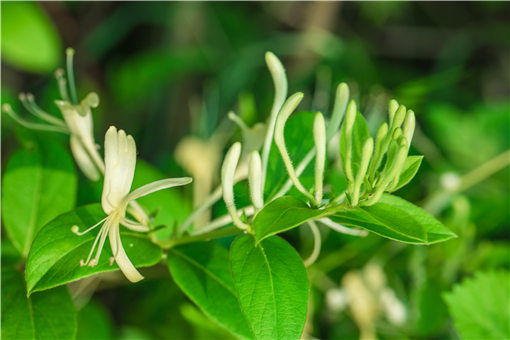
Currently, Pingyi County has 21 varieties of honeysuckle, planted throughout the county. Due to the long history of cultivation and long-term propagation by cuttings and sexual reproduction, many varieties or strains have naturally formed, with the good and the poor mixed together and difficult to distinguish. The currently common varieties include the Mao Hua (hairy flower) series: Da Mao Hua, Xiao Mao Hua; the Ji Zhua (chicken claw) series: Da Ji Zhua Hua, Xiao Ji Zhua Hua, Shan Yin Hua, Xian Hua Zi, Zi Jing Zi, Da Ma Ye, Xiao Ma Ye, E Ling Tong, Hong Hua Zi, Ye Li Cang, Ye Li Qi, etc. In recent years, the center has, through multiple rounds of purification and rejuvenation and seed verification of the Mao Hua series and Ji Zhua Hua series, bred excellent varieties and named them "Menghua No. 1 and No. 2". Their main advantages are: 1. Many branches when seedlings 2. Where there are branches, there are flowers 3. Fewer seedlings needed for planting 4. Fast development of branches and leaves 5. Large flower buds, high yield 6. 1-2 years earlier entry into the high-yield period. The excellent varieties are mainly developed as economic forests, and the mixed varieties are mainly developed as ecological forests.
-
What is Madeira vine? Get to know this health-giving vegetable
Madeira vine [Anredera cordifolia (Tenore.) Steen], originally named heart-shaped Madeira vine, also known as Madeira vine, foreign mallow vine, etc., has medicinal effects similar to those of Panax notoginseng and is an important ingredient of Yunnan Baiyao, so some people simply call it "Yunnan Baiyao". It is mainly distributed in China's Yunnan, Sichuan, Taiwan and other provinces, among which Taiwan has a relatively large area of artificial cultivation. 1 Medicinal and health value. Madeira vine is warm in nature and slightly bitter in taste, and has the effects of nourishing yin, strengthening the waist, strengthening the knees, reducing swelling and dispersing blood stasis.
-
What are the culinary uses of Gastrodia elata? Read this article to find out
Gastrodia elata not only has high medicinal value, but also has considerable value as a medicinal dish, health tonic, nourishing food and edible ingredient. In folk practice, Gastrodia elata is commonly used to steam eggs, boil eggs, cook pig brain, steam sheep brain, steam pork, stew chicken, roast duck and so on. Its features are: convenient to eat, pleasant in taste, rich in nutrients and unique in flavor. It satisfies people's enjoyment of tasting Gastrodia elata while also strengthening the body, resisting wind and cold, and can also treat dizziness, migraine and tension headache, high blood pressure and many other conditions. Through centuries of practice and recent years of research and development, dishes using Gastrodia
条件筛选