-

What to Do When Jasmine Leaves Turn Yellow: Causes and Solutions
Jasmine, also known as moli, xianghun, molihua, meili and so on, is an upright or climbing shrub of the genus Jasminum in the family Oleaceae. Its flowers are a famous raw material for scented tea and an important raw material for fragrances, and its flowers and leaves are used medicinally to treat red, swollen and painful eyes and have a cough-relieving and phlegm-clearing effect, but in actual cultivation the leaves often turn yellow
-
Reasons and Solutions for Yellowing Leaves of Potted Cyclamen
Cyclamen is a perennial herbaceous plant of the genus Cyclamen in the family Primulaceae. It likes light but fears strong light, so weak light exposure every day is enough. Exposure to direct sun will cause the leaves to turn yellow. When the flowers bloom paler and paler, it is related to insufficient light and insufficient fertilization. Fertilizer must be a specialized fertilizer, otherwise it will also cause the leaves to turn yellow
-
What to Do About Root Rot in the Money Tree? Causes and Solutions
The money tree (Zamioculcas zamiifolia) placed in a fairly spacious living room, study, or family room has an elegant, simple style with a tropical feel. It is a world-famous new-generation indoor foliage plant with a beautiful, neat plant shape, but root rot can occur during cultivation. Below, let us take a look at what to do about root rot in the money tree.
-
What to Do When a Radermachera sinica Drops Its Leaves? Causes and Solutions for Indoor Potted Plants
Radermachera sinica is a green plant widely grown in pots indoors. It is very popular for its emerald green color and beautiful leaves, but sometimes when we care for it improperly, we find that it drops its leaves, and in severe cases the leaves basically all fall off, leaving only a dry, bare trunk.
-
Reasons and Solutions for Yellowing Leaves on Monstera
There are many reasons why Monstera leaves turn yellow. If you notice yellowing leaves, you can cut off the yellow leaves and place the plant in a well-ventilated spot. Generally, the causes of yellowing Monstera leaves include unsuitable soil, overwatering or underwatering, too much or too little light, low temperatures, insufficient fertilizing, poor ventilation, and so on.
-
What to Do When Orchid Leaves Turn Yellow? Cause Analysis and Solutions
Orchid leaves turning yellow or leaf tips scorching is a common phenomenon, mostly a physiological disorder. It not only damages the integrity and ornamental value of the leaves, but also seriously affects the healthy growth of the orchid plant, and can even cause the whole plant to decline prematurely. The occurrence of yellowing orchid leaves and scorched tips is complex, and the overall cause is improper cultivation and care.
-
What to do when Kalanchoe leaves turn yellow? Cause analysis and solutions
Kalanchoe (Kalanchoe blossfeldiana) has a long flowering period, many flower colors, is easy to grow, and easy to propagate, so it is quite widely popular. However, during the process of growing Kalanchoe, yellowing leaves, soft leaves, and leaf drop often occur. Below, let us take a look at what to do when these situations arise.
-

Blue plumbago leaves have wilted, what should I do? Common causes and solutions
There are many reasons why blue plumbago leaves wilt: if it is caused by too dark lighting, it needs to be placed in an environment with sufficient light. If it is caused by excessive drought or waterlogging, you first need to determine whether too much or too little water is the cause, and then control water management. If it is caused by temperatures that are too low, it needs to be adjusted to the ideal temperature value. You must first determine the cause, then take the corresponding measures.
-

Reasons and solutions for dry, withered leaves on the areca palm
There are many reasons that cause the leaves of the areca palm to dry up and wither. If it is caused by dry air, then increase the air humidity; if it is caused by too strong sunlight, then give it diffused light and provide appropriate shade when the sunlight is intense; if it is caused by insufficient watering, then appropriately increase the frequency of watering; if it is caused by fertilizer that is too concentrated, then appropriately reduce fertilizing, and be careful to apply dilute fertilizer.
-
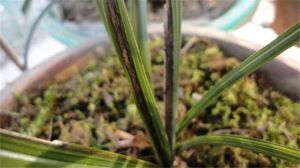
What to Do When Orchid Leaf Tips Turn Black: Causes and Solutions
There are many reasons orchid leaf tips turn black: if it is caused by low temperatures, it needs to be kept indoors in winter and the temperature raised appropriately. If it is caused by strong light exposure, it needs to receive diffused light, and be shaded at midday in summer. If it is caused by improper watering, it needs moderate watering, and can be watered daily when temperatures are high. If it is caused by improper fertilizing, it needs nitrogen fertilizer, and when fertilizing, stay ten cm away from the roots, not too close.
条件筛选