-

Detailed guide to Gymnadenia conopsea planting techniques, from site selection to field management
Gymnadenia conopsea planting techniques
-

Detailed Explanation of Methods for Site Selection, Land Preparation, and Transplanting of Angelica sinensis
(1) Site selection and land preparation The seedling-raising plot should be chosen as a cool, fertile, and moist virgin wasteland or previously cultivated land, with loose, fertile sandy loam being preferable; the cultivation plot should be chosen as fallow land or secondary wasteland with deep soil layers. In mid-July, first cut down shrubs and weeds, spread them on the ground, and burn them, then deep-plow the land more than 25 cm, and let it weather and mature under the sun. Then, before planting, while preparing the land, apply 37,500 kg of decomposed stable manure per hectare and plow it into the soil as base fertilizer. Before sowing, shallow-plow once more and make raised beds 1.3 m wide, with furrow width 30 cm and bed height about 25 cm
-
How to Choose and Prepare the Site for Licorice Cultivation? Detailed Technical Points
Licorice has a very strong rhizome sprouting ability, extending horizontally beneath the soil surface around the old plant; one licorice plant can produce dozens of new plants within a few years. Under artificial cultivation, 3 years after sowing, new plants can be seen growing 3-4 meters away from the mother plant. Its vertical rhizome can also develop roots. The depth of the root system varies with soil texture and the depth of the groundwater table, generally within the range of 1-2 meters, sometimes reaching more than 10 meters, using the deep root system to absorb groundwater and adapt to arid environmental conditions.
-
Detailed Explanation of Key Technical Points for Site Selection and Land Preparation in Goji Berry Cultivation
(1) Choose a nursery site with convenient irrigation, flat terrain, ample sunlight, deep soil layers, and well-drained sandy loam. In late autumn or early winter of the year before sowing, plow deeply 25-30 cm. While preparing the land, apply 2500-3000 kg of barnyard manure per 667 sq m, irrigate with winter water, and wait until the soil thaws 10 cm in the following spring. Then prepare the land again and harrow it fine, form raised beds 120-130 cm high, level the bed surface and break up the soil clods, ready for sowing or cutting propagation. (2) For the planting site, it is advisable to choose light loam or sandy loam with convenient drainage and irrigation, and a salt content below 0
-
Key Technical Points for Site Selection and Land Preparation in Honeysuckle Cultivation
(1) For the seedling nursery, it is advisable to choose sandy loam soil close to a water source, convenient for irrigation, loose and fertile, and well-drained. After selecting the site, plow the soil deeper than 30 cm, harrow it fine and level it, and apply 1500-2000 kg of decomposed barnyard manure or compost per 667 sq m as base fertilizer. Then shallow plow and harrow once, and form beds 100-200 cm wide and 20 cm high. Use these as seedbeds for cutting propagation and sowing propagation. (2) For the planting site, use wasteland slopes, field edges, ditch edges, and in front of and behind houses
-
How to choose a site for Schisandra chinensis? Master these key points for site selection
Schisandra chinensis prefers neutral or slightly acidic loam or sandy loam with a thick soil layer, abundant humus, a loose and fertile texture, year-round moisture retention, and a low groundwater table, on flat land or shady slopes. It requires good ventilation and light, along with irrigation and drainage conditions. Schisandra chinensis is not drought-tolerant; it likes moisture but cannot withstand waterlogging. On waterlogged low-lying land or soil that stays excessively wet for long periods, its growth vigor is relatively weak. Therefore, when cultivating Schisandra chinensis artificially, plots with good drainage that do not easily accumulate water should be chosen. Sloped land should preferably not exceed l0 degrees.
-
Methods for Site Selection and Land Preparation for Angelica sinensis Cultivation
1. Seedbed site: According to the growth habits of Angelica sinensis seedlings, choose a plot surrounded by mountains on all sides, with loose, fertile soil, high humus content, sheltered from the wind, with short sunlight duration, and cool and moist conditions for raising seedlings. Angelica sinensis seeds are small, and the young sprouts have weak soil-breaking strength, so fine land preparation is required to ensure normal emergence. Plow the land in the previous year to allow the soil to fully weather, or plow in April to May of the current year, preferably three times. The first and second plowing should be 24-30 cm deep, and the third shallow plowing 9-15 cm. Dry and burn the weeds, spread them out and plow them into the soil, pick out all stones and unburned weeds, break up clods, level the ground, and then apply 5000 kg of farmyard manure per mu as base fertilizer. Then level and make beds along the mountain contour, with a bed width of 100-120 cm and a bed height of about 25 cm. Dig drainage ditches around the perimeter to facilitate drainage, with a ditch width of 18-24 cm and a depth of 15 cm. Raising seedlings under such conditions results in dense plant growth, mutual shading, leaves growing upward, less sugar accumulated through photosynthesis, more nitrogen absorbed from the soil, and a low bolting and flowering rate. If a site with abundant sunlight and dry, barren soil is chosen for seedling raising, even with sufficient manure and fine land preparation, the strong sunlight and dry soil will result in fewer seedlings emerging, leaves spreading flat, a large nutritional area for plants, high sugar accumulation through photosynthesis, drier soil, less nitrogen absorbed from the soil, and consequently a higher bolting and flowering rate. This should be given serious attention.
-
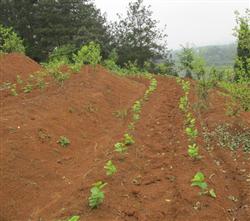
What are the methods for choosing a ginseng planting site?
How should a ginseng planting site be chosen? How should the soil be treated before planting ginseng? We ask knowledgeable readers to help explain. The fleshy root of ginseng is a famous tonic and restorative medicine, suitable for regulating blood pressure, restoring heart function, neurasthenia and physical weakness, and it also has expectorant, stomachic, diuretic and stimulant effects, which has led to...
条件筛选