-

Key Technical Points for Site Selection and Land Preparation in Lily Cultivation
Well-drained, deep sandy loam soil should be chosen. For cultivation in hilly areas, gentle slopes with a gradient below 5 degrees should be selected. Continuous cropping is taboo. Continuous cropping of lilies leads to severe pests and diseases and reduced yield. After selecting the site, soil chemical treatment should be carried out in conjunction with soil plowing to reduce pests and diseases. Use 2.5-5 kg of Jialiu powder or 2-2.5 kg of carbofuran per mu to kill underground pests. Use 1 kg of 50% carbendazim wettable powder diluted in 500 kg of water per mu to spray the soil for sterilization. Deep plow and prepare the land, adapt to local conditions, and apply sufficient base fertilizer. Per
-
Site preparation and planting measures for mixed forests of strip mulberry and black locust in converting farmland back to forest on the plains
Black locust uses pit-shaped site preparation, with a specification of 80 cm by 80 cm by 80 cm, a plant-to-row spacing of 3 m by 5 m, and a planting density of 45 trees per 667 sq m; plant in spring and autumn, apply sufficient base fertilizer before planting, and water after planting; strip mulberry is planted between the black locust, using pit-shaped site preparation, and planted in spring, the rainy season, or autumn.
-
How to make azalea bonsai more exquisite? Sharing of practical tips
Azalea, also known as yingshanhong or zhaoshanhong, is a deciduous shrub of the genus Rhododendron in the family Ericaceae. It has many branches, which are slender and straight, with simple papery leaves; the flowers grow in clusters of 2-6 at the tips of the branches and are rose-colored, bright red or deep red, with purple spots, and in horticulture there are many other varieties with even richer colors. Its flowering period is from April to June, and the fruit ripens in October. Azalea likes a warm, humid environment, is not cold-tolerant, and is relatively heat-tolerant; it likes acidic soil and grows poorly in alkaline soil and in sticky soil with poor drainage. Its bonsai production and cultivation methods are as follows: (1) Seedling sources
-
Miniature bonsai are petite and exquisite, revealing the beauty of nature within a tiny space.
For the selection of small stumps, choose plants with strong vitality that are easy to tame into trunks and twisted, varied forms. Also pay attention to selecting varieties with small leaves, strong sprouting ability and shade tolerance. 1. Seek out old trunks and small branches of varied forms on a certain tree stump for air layering (that is, sleeve propagation), mostly carried out in early to mid-March during the plum rain season. 2. Seek out tree stumps with well-developed bare roots, and near their root area select crooked, ancient-looking, robust ones with small branches and bare roots, and separate them from the tree stump (best done in late autumn), but do not transplant them immediately; wait until the following spring when the separated plants sprout and grow branches.
-
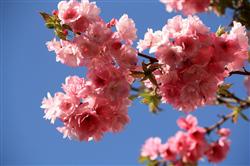
Where is it suitable to plant cherry blossoms? Key points for choosing a planting site
Where is it suitable to plant cherry blossoms? Please explain that cherry blossoms prefer a warm, moist-leaning environment. They require plenty of sunlight, are not tolerant of shade and dampness, are not tolerant of saline-alkaline soil, and dislike waterlogging; they are cold-hardy and drought-tolerant, but during the flowering period they fear strong winds and smoke and dust. They are suited to growing in loose, fertile, well-drained slightly acidic or neutral sandy loam. Light...
条件筛选