-

Preparation method of secondary spawn and production spawn of straw mushroom
Secondary spawn is the spawn made by transferring primary spawn into secondary spawn substrate. Secondary spawn can be used directly as production spawn. Generally, secondary spawn is transferred to the same kind of substrate for expanded culture to become production spawn. Secondary spawn is generally placed in 750 ml mushroom bottles or plastic bags. (1) Preparation of substrate. Formula 1: rice straw 90%, bran (rice bran) 9%, gypsum powder 1%. The preparation method is to select golden-yellow, non-moldy dry rice straw, cut it into 3 cm lengths, soak it in clean water for about 12 hours to
-
Key Technical Points of Indoor Secondary Fermentation for Agaricus bisporus Production
The compost that has undergone outdoor pre-fermentation is moved indoors, and through artificial temperature and air control, the compost is sterilized and fermented under specific environmental conditions, further enhancing the specificity and selectivity of the compost, so that the compost is fermented into a substrate more suitable for mushroom growth. This process is called indoor secondary fermentation. (1) Principle: Secondary fermentation is a biochemical reaction process in which the activities of various types of thermophilic microorganisms promote changes in the physical and chemical properties of the compost. Secondary fermentation can be divided into two stages. Stage one: raise the pile temperature
-
The Second of the Six-Part Series on Autumn Production of Edible Mushrooms
First, select good spawn. The main varieties used this autumn are: 1) Oyster mushroom: "8359" and "Nongke 12" -- suited to fruiting in spring and autumn; spawn-running temperature 5-36°C, optimum 24-28°C; fruiting temperature 5-25°C, best 18-20°C; clustered or imbricate overlapping growth, small thick caps, large clusters, cap grey to dark grey, stipe slender and short, gills white and fine, cluster shape compact, flesh firm, good market quality; these two strains have strong resistance to contaminants and diseases, and in general production they do not become infected with diseases such as yellow mushroom disease
-
Secondary bagging of edible fungi can effectively prevent infection
In the production of shiitake mushrooms (Lentinula edodes), lion's mane mushrooms (Hericium erinaceus), wood ear mushrooms (Auricularia heimuer) and others, the secondary bagging technique is applied (that is, when the mushroom logs come out of the sterilization chamber, an extra layer of thin film bag is put on, so that the mushroom logs inside the bag do not come into direct contact with the ambient air), which effectively solves the problem of cross-infection during the log production process and keeps the strain survival rate above 97%. The technique is described below: 1. Preparation of the outer bag The outer bag should preferably be a low-density polyethylene film bag with a circumference 2 cm larger than the inner bag, a length 5 cm longer than the inner bag, and a thickness of 0.2 silk, with one end tied and sealed for later use.
-
What to do if the second flush of mushrooms does not appear? Causes and solutions
Normally, after the first flush of mushrooms is harvested, the second flush will begin to appear in about 10 days. In some cases, no mushrooms appear for a long time. The main reasons are, first, a high yield in the first flush and too long a growing period, causing a serious shortage of water content in the growing medium; second, temperature that is too low or too high, affecting the timing and yield of the next flush. The solution is to soak the growing medium bags in clean water for 1-2 hours, adding to the water 1% white sugar, 0.3% potassium dihydrogen phosphate, 0.5%-1% magnesium sulfate, 0.1% urea, and 0.1% zinc sulfate
-
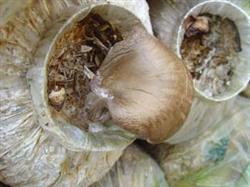
Spent oyster mushroom substrate can be reused, turning waste into treasure through secondary use
Experts point out that oyster mushroom soft rot is mainly manifested by the white mycelium of the oyster mushroom growing in a spider-web pattern on the surface of the bed, spreading rapidly, covering the bed surface, and surrounding the fruiting bodies. Once the base of the fruiting body is surrounded by mycelium, it becomes infected; the pathogen spreads upward along the stipe, ultimately resulting in the fruiting body stopping growth, with its color turning dark, and rapidly...
条件筛选