-

Analysis of the Reasons for the High Economic Returns of Winter Cultivation of Straw Mushrooms
Straw mushrooms (Volvariella volvacea) are a type of fungus that thrives in high temperature and high humidity, suited to growing in an environment of constant temperature and stable moisture. Therefore, moving the heat-loving straw mushroom to winter cultivation requires growing it in greenhouses with good insulation capacity, which increases cost inputs such as heating. However, straw mushrooms produced in winter sell for 2 times the price of those conventionally cultivated in summer, so appropriate adjustments should be made to the substrate formula and cultivation management, among other aspects, in order to increase the input-output ratio and improve economic returns. The main techniques for winter cultivation of straw mushrooms are introduced as follows: 1. Select a suitable substrate formula, build a pile and ferment the straw mushrooms.
-
High returns from intercropping mushroom cultivation in citrus orchards
The author succeeded in growing mushrooms between the rows of a densely-canopied citrus orchard, achieving a double harvest of both citrus and mushrooms. Large-scale promotion has shown that generally each mu of orchard produces more than 3000 kg of citrus per year, worth 4000 yuan; and 800 kg of fresh mushrooms, worth 3200 yuan. After deducting production costs of 1500 yuan, the total net income is more than 5700 yuan, which is more than 2000 yuan higher than growing citrus alone. Intercropping mushrooms in the orchard also helps to increase humidity, retain warmth and improve the soil. 1 Raw material preparation Each mu requires 1500 kg of dry wheat straw (rice straw or sawdust may also be used), 20 kg of lime and 15 kg of urea
-
Four-spored mushroom cultivation in summer is difficult, but mastering the techniques brings high returns
Summer cultivation of the four-spored mushroom (Agaricus bisporus) is more difficult than that of the common button mushroom. If cultivation techniques are careless, or if the temperature during the fruiting period is too high or too low, failure will result. The high-yield secrets for summer cultivation of the four-spored mushroom are described below: 1. Plant early at the right time. Planting too early means low temperatures in the early stage, which is unfavorable for the growth of summer mushroom mycelium; planting too late means that timely feeding for the autumn mushroom will shorten the harvesting period of the summer mushroom. Therefore, after cleaning the spring mushroom growing room in late April, the summer mushroom compost can be pre-wetted and stacked. 2. Compost fermentation. 1. Compost formula (calculated for 110 sq m). Rice straw 2000 kg, gypsum 7
-
New organic ecological cultivation technique for returning mushrooms to nature
The traditional technique for mushroom production uses rice and wheat straw as the main raw material, but in our area, with the expansion of mechanized harvesting and straw return to the field, the supply of rice and wheat straw is becoming less and less, which has limited mushroom production. In order to solve the problem of raw material shortage in the mushroom production process, over the past few years, through continuous exploration, we have successfully developed a new organic ecological nature-returning cultivation technique for mushrooms. This technique resolves the contradiction between the supply and demand of rice and wheat straw, simplifies the operating procedures, and changes mushroom cultivation from autumn cropping to year-round production in both spring and autumn. The cultivation cost is reduced by 30%-50%. If
-
Growing button mushrooms (Agaricus bisporus) in winter-fallow rice fields delivers good returns
In 2004, our county carried out cultivation demonstrations of growing button mushrooms (Agaricus bisporus) in winter-fallow rice fields across 16 townships. After the late rice harvest, rice straw and other materials were used as the main raw materials and composted and fermented into growing substrate, making use of the winter temperature and light resources and the idle winter season of the rice fields; open-field cultivation of button mushrooms achieved notable returns. Chen Yeru, a farmer at the Lixian Institute of Agricultural Sciences, is a button mushroom cultivation demonstration household, with a family of 4 people and 2 laborers, and had never previously cultivated edible fungi. After technical training at the Lixian Edible Fungi Research Institute, he set up on his own contracted field
-
Semi-underground three-dimensional cultivation of oyster mushrooms yields high output and good returns
Semi-underground three-dimensional bed-frame cultivation of oyster mushrooms is a new approach explored in recent years to achieve high yields and improve economic returns. According to trials, on an area of 20 sq m, with 2000 kg of substrate, the annual output of oyster mushrooms is about 2500 kg, with a biological efficiency of over 120%. The key technical points are as follows: 1. Building the greenhouse: first dig a pit 1.8 m to 2 m deep and 4 m to 5 m wide, with the length determined as needed, and place the three-dimensional bed frames inside. On top, use bamboo poles and plastic film to build an arched shed, pack the surrounding edges firmly with soil, and cover with straw mats. Leave ventilation openings of about 30 square cm on all four sides, east, west, north and south, and build a small door on the west side for workers to enter and exit.
-
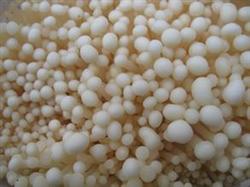
New cultivation method for enoki mushrooms yields high economic returns
Homemade growing medium. Take 84% cottonseed hulls, 14% wheat bran, 1% gypsum, 0.2% monopotassium phosphate, 0.25% magnesium sulfate, and 0.55% carbendazim, mix them evenly, then add water at a material-to-water ratio of 1:1.3 and stir well to make the growing medium. Filling and sterilization. Put the growing medium into wide-mouth bottles or bags; when filling, be sure to keep it moderately firm...
-
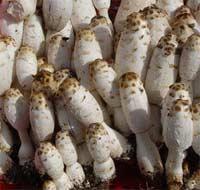
Hanging Bag Cultivation of Black Fungus (Wood Ear) and Stropharia rugosoannulata in a Multi-Layered Three-Dimensional Setup Doubles Returns
Distiller's grains are an excellent substrate for cultivating edible fungi. Their nutrient composition suits the growth of Stropharia rugosoannulata mycelium, and using them can both lower the production cost of Stropharia rugosoannulata and prevent environmental pollution. Distiller's grains contain a small amount of ethanol and active yeast that are harmful to mycelial growth, and they are highly acidic, with a pH of 3-5. Therefore, fresh distiller's grains should be selected...
条件筛选