Hanging Bag Cultivation of Black Fungus (Wood Ear) and Stropharia rugosoannulata in a Multi-Layered Three-Dimensional Setup Doubles Returns
Distiller's grains are an excellent substrate for cultivating edible fungi. Their nutrient composition suits the growth of Stropharia rugosoannulata mycelium, and using them can both lower the production cost of Stropharia rugosoannulata and prevent environmental pollution. Distiller's grains contain a small amount of ethanol and active yeast that are harmful to mycelial growth, and they are highly acidic, with a pH of 3-5. Therefore, fresh distiller's grains should be selected...
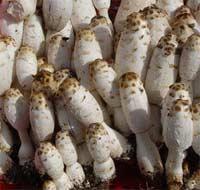 Building the shed and preparing materials. Build a semi-underground shed. Dig 60 cm down from the ground surface, and build up adobe bricks on three sides, higher on the north and lower on the south. Inside the shed, dig beds 80 cm wide and 35 cm deep. Sun-dry corncobs and crush them to the size of soybean grains. Sun-dry corn stalks, remove the roots, and crush them into 3-5 cm lengths.
Substrate formulas. Black fungus formula: 45% corncobs, 30% broadleaf tree sawdust (or cottonseed hulls), 15% wheat bran, 5% cornmeal, 1% phosphate fertilizer, 2% lime, 2% gypsum, a little sugar, and 0.1% monopotassium phosphate. Soak the corncobs in 2% lime water for more than 10 hours. Then mix with the other materials and fill into 17 x 35 cm low-density polyethylene bags, sterilize at normal pressure for 8 hours, and inoculate under sterile conditions after cooling. After inoculation, place them in the incubation room for mycelial running, keeping the room temperature at about 23 degrees C.
Stropharia rugosoannulata formula: 3.5 kg crushed corn stalks, 5 kg wheat bran, 2 kg lime, 0.5 kg gypsum, a little sugar, 2.5 kg dry chicken manure, 0.5 kg phosphate fertilizer, 1.5 kg cake fertilizer, 50 g monopotassium phosphate, 100 g urea, and 50 g prochloraz. Soak the corn stalks in water with 3% lime and 0.1% prochloraz for 10 hours, drain the water, then mix with wheat bran and dry chicken manure, and build a pile for fermentation. When the material temperature reaches 60 degrees C, maintain it for 8 hours, then turn the pile, repeating the turning three times. Add the other auxiliary materials at the third turning. The well-fermented material surface is coffee-colored with no off odor, has a moisture content of 65%, and is placed into the beds after the material temperature drops below 28 degrees C. The spawn is added to the material using a combination of layer sowing and hole sowing (7.5 kg of spawn per 50 kg of dry material), with a material thickness of 30 cm, then patted firm. Cover the material surface with newspaper and agricultural film, and keep the shed temperature at about 20 degrees C to allow mycelial running.
Management. (1) After the black fungus bags are fully colonized, begin moving them into the shed for hanging; hang 8 bags per rope. Wash the bags with Lysol water for disinfection. Cut 8 cross-shaped openings in each bag in a staggered arrangement to induce fruiting. (2) After Stropharia rugosoannulata is fully colonized, insert a 3 cm deep hole every 30 cm and add nutrient solution. Spray triacontanol and gibberellin on the material surface to increase yield and speed up the flush cycle. For black fungus, 50 kg of dry material produces 5 kg of dried fungus; for Stropharia rugosoannulata, every 50 kg of dry material produces about 60 kg of fresh mushrooms. Using corncobs and corn stalks to produce black fungus and Stropharia rugosoannulata offers a wide source of raw materials, a simple method, and low cost.