-
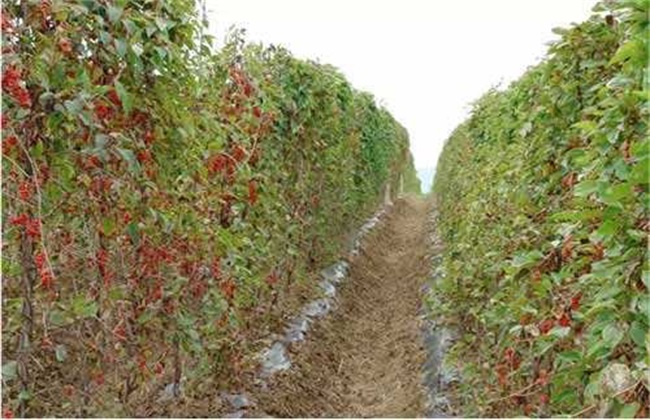
Detailed Explanation of Key Points of High-Yield Pruning Techniques for Schisandra chinensis
High-Yield Pruning Techniques for Schisandra chinensis
-

How to prune Schisandra chinensis? Detailed pruning methods and techniques
If you want stable and high yields from cultivated Schisandra chinensis, pruning is the key. The author has been engaged in artificial cultivation of Schisandra chinensis since 1997, and has summarized pruning methods in practice. They are written out here for fellow farmers' reference. 1. Row direction The best row direction for Schisandra chinensis cultivation is a north-south orientation, which gives good light exposure and good ventilation, laying the foundation for stable and high yields. 2. Trunk determination In the summer of the year of transplanting, Schisandra chinensis seedlings grow rather vigorously. For each plant, select and keep 3-4 strong lateral vine branches and train them onto the poles. One seedling gets two poles, and each pole carries two
-
The correct method for winter pruning of honeysuckle branches
Honeysuckle (Lonicera japonica) is a semi-evergreen twining shrub with a well-developed root system and tolerance to drought and poor soil, making it an ideal plant for soil and water conservation. The pruning of honeysuckle varies depending on the planting form, site conditions, and management level. Its winter pruning techniques are introduced as follows: 1. Pruning period. Winter pruning of honeysuckle is best carried out from December each year to early March of the following year. 2. Pruning methods. 1. Pruning of young plants. Pruning of young plants focuses on shaping, with emphasis on developing primary, secondary, and tertiary scaffold branches to form a sturdy framework and lay the foundation for future high yields.
-
Pruning honeysuckle can increase yields; mastering the method is key
Experiments have shown that pruning aging honeysuckle in early autumn can achieve a bumper harvest of honeysuckle the following year. In the production of Chinese medicinal materials, pruning honeysuckle, especially pruning it in early autumn, is an effective technical measure for regulating stem and vine growth, promoting flower bud differentiation, extending plant lifespan, and ensuring stable, high yields. Pruned honeysuckle can generally increase yields by 35-45%, with some reaching more than double. After pruning measures are taken for honeysuckle plants entering the aging stage, their flowering period can also be extended by 5-6 years. When honeysuckle enters the aging stage
-
Detailed Explanation of New Key Techniques for Pruning the Stems and Vines of Japanese Honeysuckle
Pruning Japanese honeysuckle is an effective technical measure for regulating the growth of stems and vines, promoting flower bud differentiation, extending the plant's lifespan, and maintaining stable high yields. Pruned Japanese honeysuckle generally increases yield by 35-45%, with the highest reaching more than double. For Japanese honeysuckle plants entering the aging stage, pruning measures can extend the full-bloom period by 5-6 years. When Japanese honeysuckle enters the aging stage, its characteristics are sparse and pale leaves, many dead branches and weak flowers, and a shrinking canopy. At this stage, heavy pruning is mainly used for renewal and rejuvenation, to extend the plant's lifespan and maintain stable yields. Pruning should be strictly
-
Detailed Explanation of Key Cultivation and Pruning Techniques for Honeysuckle
Honeysuckle, also known as double flower or silver flower, has a long history of cultivation in the Linyi area of Shandong. Honeysuckle has a wide range of uses, possessing functions such as clearing heat and detoxifying, reducing inflammation and relieving cough, and is widely used in clinical practice and the pharmaceutical industry. It is a commonly used traditional Chinese medicinal material, and in Southeast Asian countries it is used as a tea substitute in summer to relieve heat, with very large market demand. In recent years, people have discovered that its branches and leaves have high medicinal value, and many new products have been developed. In particular, it has been found that honeysuckle has a preventive and inhibitory effect on epidemic and infectious viruses, and the price has consequently soared, from the original
-
Detailed Explanation of the Key Points of Honeysuckle Pruning and Shaping Techniques
For honeysuckle plants that have grown for 1-2 years, the vine stems grow irregularly and chaotically, so pruning and shaping are needed, which is beneficial to the growth of the crown and flowering. Specific shaping and pruning method: within 1-2 years after planting, mainly cultivate an upright and thick main trunk. When the main trunk height is 30-40 cm, cut off the top shoot to promote lateral buds to sprout into branches. After sprouting in the spring of the second year, select and keep 4-5 thick branches on the upper part of the main trunk as main branches, arranged in two layers, and among the first-level branches growing from the main branches, retain 5-6 pairs of buds and cut off the upper terminal buds. Later, from the second-level branches growing from the first-level branches,
-
How to prune honeysuckle? Detailed pruning methods and techniques
Pruning honeysuckle is the key to increasing yield, and can raise production by more than 40%. The main pruning time is winter, generally carried out during the period from Lidong (Start of Winter) to Lichun (Start of Spring), that is, from mid-November to early February of the following year. Winter pruning can only be delayed, not advanced. Through pruning, 2-3 harvests of flower buds can be gathered per year in mountainous areas with poorer site conditions. Pruning should follow the principles of training the main trunk into shape, lightly pruning strong branches, heavily pruning weak branches, and cutting back old branches. 1. Formative pruning. That is, for seedlings, focusing on shaping, combined with pruning, 1-2 year old seedlings are cultivated into thick, upright main trunks.
-
Detailed Explanation of the Key Points of Winter Pruning Techniques for Honeysuckle (Japanese Honeysuckle)
Winter pruning mainly involves cutting off the branches that grow from the main trunk, and selecting and keeping a small number of mother branches on the main branches that can flower the following year. For young plants, select 4-5 robust branches on the main branches and cut off the upper ends at 3-7cm. Winter pruning can only be delayed, not advanced. Pruning of adult trees is mainly carried out in winter. In addition to mastering the essentials of removing the weak and keeping the strong, removing the curved and keeping the straight, and thinning out the overlapping ones, the number of mother branches should also be determined according to water and fertilizer conditions. After pruning, apply fertilizer once and water thoroughly with freezing water.
-
Schisandra Pruning and Training Methods and Key Technical Points
The principles of training and pruning are: keep strong main vines to ensure rational use of space; remove old canes and keep few; keep medium and long branches, remove short branches and basal branches; remove diseased, weak, overcrowded and senescent branches. (1) Trunk heading: after transplanting, the trunk must be headed. The standard for trunk heading is: select and keep 2-3 plump buds, and cut back at 3-5 cm from the ground diameter. The time for trunk heading is the following spring, after the snow melts and before the plant begins to grow. After the plant sprouts, keep 2 strong vines, and no more than 3. After trunk heading, use 2 strands of acrylic wool, tie one end together and fasten it to a wooden stick about 10 cm long,
条件筛选