-
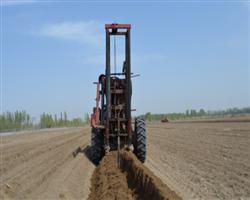
Why Are Yam Trench Loosening Machines Popular with Vegetable Growers
Why are yam trench loosening machines popular with vegetable growers, and what advantages do they have? First, using a loosening machine to dig trenches ensures a consistent depth for the yam trench and saves both labor and time. When using a yam trench loosening machine to dig yam trenches, you only need to drill the soil-loosening sprocket into the ground and then fix the sprocket's soil-loosening depth, and...
-

Never neglect agricultural machinery maintenance after the wheat harvest
Before the combine harvester goes out to the field, service the machine well so that it stays in good technical condition. Then it will have fewer breakdowns in use, run stably, reduce failures, raise work efficiency and extend the machine's service life. 1. Self-propelled combine harvesters (l) Add lubricating oil to each lubrication point every day as specified. (2) After a period of use, tighten the front wheel and rear wheel nuts; check and adjust the tension of all V-belts; check and adjust all drive chains; when the indicator light comes on, clean the dry air filter; clean
-
Timely Maintenance and Repair of Agricultural Machinery After Wheat Harvest
Combine harvesters should be well maintained before heading to the field, so that they stay in good technical condition, run with fewer breakdowns, perform reliably, reduce faults, improve work efficiency, and extend service life. 1. Self-propelled combine harvesters (l) Add lubricating oil to each lubrication point daily as specified. (2) After a period of use, tighten the front wheel and rear wheel nuts; check and adjust the tension of all V-belts; check and adjust all drive chains; when the indicator light comes on, clean the dry air filter; clean the rotating wind hood and radiator; check the coolant level and top it up; check and clean the water collector; check the fuel filter, drain the accumulated water and sediment, clean the hydraulic oil tank filler port and check the oil level. Park the combine harvester on level ground, check the engine oil in the oil pan, and add oil as needed; tighten the grain unloading auger wire rope; clean the hydraulic drive oil tank filler port and check the oil level. If necessary, clean the cab filter. (3) After one quarter of use, replace the fuel filter element and replace the engine oil filter. Check the specific gravity of the battery electrolyte, and charge or top up with distilled water as needed. Check the coolant level and top it up. Clean the fuel transfer pump, check and adjust the traveling clutch clearance, check and adjust the foot brake, and adjust the hand brake cable.
-
How is the TP stainless steel garlic peeling machine?
Before using the machine, the garlic roots must first be removed (if the roots are not removed, the time will be longer), and the de-rooted garlic should be soaked in water. When peeling, pour about 30 kg of garlic into the machine at one time; after it runs for about 5 minutes, open the discharge outlet and the garlic cloves will come out on their own. After the garlic cloves have been fully discharged, close the discharge outlet, then repeat the above process and pour the garlic into the machine. The feature of this machine is that it has the function of breaking apart garlic bulbs and can be used continuously without stopping. If it is not peeled clean the first time, it can be put through the machine a second time to peel it clean.
-
Introduction to the Features of the Dry Garlic Peeling Machine
1. It adopts a specially designed peeling principle. During the peeling process, the garlic cloves do not pass through blades or undergo hard friction at all, so the integrity, freshness and freedom from contamination of the processed product are ensured. 2. It features automated continuous operation of drying and peeling, and is practical, power-saving, small in size, high in production efficiency, easy to maintain and clean, and low in failure rate. 3. It is equipped with automatic temperature control and automatic feeding devices, and the garlic kernels and skins are separated automatically. The product meets hygiene standards, and because the garlic kernels are not easily damaged, they can be stored for many days, which is an advantage.
-
Rice direct seeding machine successfully developed, efficient and versatile, boosting rice sowing
Recently, a "Multifunctional Soil-Covering Direct Seeding Machine Rice Mechanical Direct Seeding Field Demonstration" organized by the China National Rice Research Institute was held in Buqiao Village, Fuyang City, Zhejiang Province, with more than 40 experts from home and abroad attending the field observation event. In recent years, China's rice mechanical transplanting technology has developed rapidly, and a number of different types of transplanters suited to China's rice production have been developed and produced. However, the development and research of rice direct seeding machines and mechanical direct seeding technology have lagged relatively behind, and no mainstream rice mechanical direct seeding technology has yet taken shape. To overcome the problems of poor seedling establishment, easy lodging, premature aging, and difficult and costly weed control
-
What types of potato planters and planting machinery are there?
1. 2BMF-2 potato planter: This machine is matched with an 8.8 kW to 12 kW (12 hp to 16 hp) small four-wheel tractor, and can complete multiple operations such as furrowing, fertilizing, sowing and soil covering in one pass. It has the features of saving labor and effort and being convenient to adjust and use. Main technical parameters: seed breakage rate <= 1%, double-seed rate <= 8%, empty-hole rate <= 2%, productivity 4 mu/hour. 2. 2BXSM-1B potato fertilizing planter: This machine is an ideal potato planter for dryland flat-cultivation areas.
-
Detailed Explanation of Key Techniques for Raising Strong Seedlings for Machine-Transplanted Rice
With the improvement of the level of intensification in rice production, mechanical transplanting has become an inevitable trend. One of the keys to machine-transplanted rice production is raising strong seedlings. The following measures can produce strong seedlings: 1. Apply strong seedling agent. The strong seedling agent is usually mixed with the subsoil. First mix a small amount of fine soil with the strong seedling agent evenly, scatter it on the bottom of the seedling tray, and then add the subsoil. This avoids uneven mixing and scattering due to too much subsoil, which leads to uneven distribution of the strong seedling agent, causing seedling dwarfing and failure to emerge where too much strong seedling agent is present, resulting in seedlings pulling loose during transplanting and affecting the quality of mechanical transplanting. 2. Cover with plastic film.
-
Key Cultivation Techniques for Machine-Transplanted Rice at the Transplanting Stage
I. Make a Good Start and Manage the Seedling Nursery Well 1. Apply the "standing-up fertilizer" according to seedling appearance. This is generally done 3-4 days before transplanting; the amount and method of application should depend on seedling color. For weak seedlings with faded leaf color, use 4-4.5 kg of urea per mu diluted in 200 kg of water, and spray or splash evenly in the evening; after application, sprinkle clean water once to prevent fertilizer burn to the seedlings. For seedlings with normal leaf color and upright leaves that do not droop, use 1-1.5 kg of urea per mu diluted in 60-70 kg of water for foliar spraying. For seedlings with dark green leaves and drooping leaves, do not apply fertilizer at all; water control measures should be taken to improve seedling quality.
-
Detailed Explanation of Key Points of Fertilization Technology for Machine-Transplanted Rice
The total amount of fertilizer applied to machine-transplanted rice is roughly equivalent to that for manually transplanted rice. However, how it is applied at each stage differs between machine-transplanted rice and ordinary hand-transplanted rice. The main reason is that machine-transplanted rice has lower tillering node positions and a longer tillering period. To keep the number of panicles in the population within an appropriate range, the focus of fertilizer management should be on improving the timing of tillering fertilizer application, so as to regulate and utilize the optimum tillering node positions and control the mid-season population, while increasing the application of panicle fertilizer to promote spikelet differentiation and strive for large panicles. The characteristics of machine-transplanted rice and hand-transplanted rice determine that among the basal and tillering fertilizers for machine-transplanted rice, the basal
条件筛选