-

How to prevent and treat tulip leaf blight? A few practical methods to teach you
Symptoms: Infected leaf buds develop poorly, appearing deformed and curled; once young buds are affected, the leaves that grow from them become curled. If the environment is humid, a large number of gray mold-like conidia are produced on the diseased tissue, spreading to nearby healthy plants and causing leaf infection, so bulb growth is greatly affected. After flowers are affected, white or light yellowish-brown lesions first appear, then rapidly expand and cause the flowers to wither and drop, or turn brown and dry up. Ring-like bands also appear on the flower stalk, sometimes with a layer of conidia on them. At every stage of the disease
-
Occurrence Patterns and Control Methods of Lily Leaf Blight
Lilies originate from the eastern and central regions of China. They are relatively cold-tolerant, prefer strong light, and do not tolerate shade. Insufficient light will affect growth and flowering. A well-drained sandy loam rich in organic matter is suitable. Their disease resistance is poor, and they are susceptible to disease under high temperature and high humidity conditions. Lily plants are upright and elegant, with large, brightly colored flowers and many varieties. They are suitable for planting in patches or clumps at the edges of lawns or for forming flower borders, creating a quiet and harmonious effect. Lilies are also treasures for potted flowers and cut flowers. Lily leaf blight, also known as lily gray mold, affects the plant's photosynthesis, hinders growth, and reduces ornamental value. When the disease occurs severely,
-
Lily Leaf Blight: Control Methods and Key Technical Points
Symptoms: Circular or oval lesions form on the leaves, varying in size, with a length of 2 to 10 mm or more. They range from pale yellow to light brown. In some varieties, the spots are light brown, surrounded by a distinct reddish-purple margin, and under humid conditions the spots quickly become covered with a layer of gray mold. When dry, the lesions become thin, easily crumble, are transparent, and generally appear grayish-white. In severe cases, the entire leaf dies. When the stem is infected, it rots and breaks at the point of infection, and the buds turn brown and rot. Spots on the flowers are brown and, when moist, quickly become a sticky mass covered with a gray
-
Symptoms and Control Methods of Lily Leaf Blight
Lilies are native to the eastern and central regions of China. They are relatively cold-tolerant, prefer strong light, and do not tolerate shade. Insufficient light will affect growth and flowering. They do best in well-drained, organic-rich sandy loam. They have poor disease resistance and are susceptible to disease in hot, humid environments. Lily plants are upright and elegant, with large, brightly colored flowers and many varieties. They are suitable for planting in patches or clumps at the edges of lawns or in flower borders, creating a serene and harmonious effect. Lilies are also prized as potted flowers and cut flowers. Lily leaf blight, also known as lily gray mold, affects the plant's photosynthesis, hinders growth, and reduces ornamental value. When the disease occurs severely
-
What are the control techniques for azalea leaf blight
1. Main symptoms: It occurs on the leaves, mostly at the leaf tips. In the early stage, the lesions are chlorotic yellow spots, and the lesions spread from the edges inward, taking an irregular shape; in the later stage, the lesions are yellowish-brown, and in severe cases the diseased leaves dry up. 2. Causes of the disease: It is a fungal disease. The pathogen survives on diseased plant debris and spreads through watering, insects, human activities, etc. In indoor environments, it can occur year-round, and high temperature, dryness, and poor ventilation easily trigger the disease. Plants that are weak in growth or affected by pests (especially aphids, scale insects, and whiteflies)
-
Symptoms and Control Methods of Leaf Blight in Hybrid Magnolia
The main symptoms occur on the leaves, and in severe cases can spread to the petioles and flower buds. The lesions mostly occur at the leaf margins. In the early stage, they are chlorotic yellow spots, water-soaked in appearance. Numerous lesions merge into patches, expanding outward in a fan shape, with dark brown edges and grayish-yellow centers, which can cause early defoliation. In humid environments, black-gray granular bodies appear on the fallen leaves. Causes of the disease: This disease is a fungal disease; the pathogen survives in leaf buds and on diseased plant residues, spreads via air currents, and can directly infect and damage through the stomata of leaves that are weak in growth or physiologically injured. Injured plants and environmental conditions with high wind speed
-
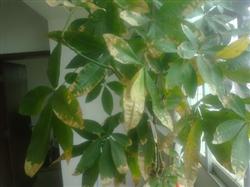
How to Prevent and Treat Root Rot and Leaf Blight in Money Trees
How do you prevent and treat root rot and leaf blight in money trees? Please explain. Symptoms of root (stem) rot in money trees: the stem base down to the roots turns dark brown, rots, and the young leaves lose vigor and wither. Prevention and treatment methods: (1) Ventilate promptly and keep the growing environment dry. (2) Pay attention to disinfecting the growing medium and flower pots. (3) After transplanting, remove the bruised and rotted tissue at the top of the roots, then spray the wounds with procymidone, let them dry, and plant...
-

What to Do When Osmanthus Trees Get Leaf Blight? Detailed Guide to Prevention and Control Methods
What propagation methods are there for osmanthus trees? Please advise, thank you. Osmanthus trees have the following propagation methods: 1. Grafting propagation. The rootstock for grafting osmanthus is generally privet (Ligustrum) or Ligustrum obtusifolium; side grafting or approach grafting is mostly used, and in recent years some have experimented with the tear grafting method. Tear grafting is simple to perform, and the survival rate can reach about 93%. The specific method is: on the spring buds...
-
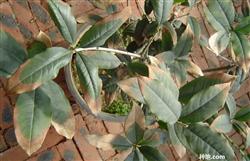
What are the control methods for leaf blight of osmanthus trees?
How to control leaf blight in osmanthus trees? Please introduce and guide. Leaf blight is a common disease in osmanthus cultivation. Its symptoms: it occurs at the leaf margins and leaf tips. It starts as small light brown spots, then gradually expands into irregular large patches. If several lesions connect, the entire leaf dries up by 1/3-1/2. The lesions are grayish brown to reddish brown,...
-
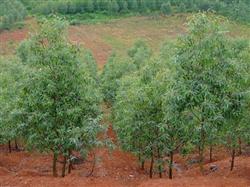
How to prevent and control eucalyptus leaf blight? Detailed control methods
How to prevent and control leaf blight in eucalyptus? What does eucalyptus leaf blight look like after it develops? Eucalyptus leaf blight is distributed throughout South China. It damages Eucalyptus exserta, Eucalyptus grandis, Eucalyptus rudis, and Eucalyptus torelliana, among others. Symptoms: The disease often occurs at the leaf tip and leaf margin. In the early stage of the disease, chlorotic spots appear on infected leaves, then gradually expand into...
条件筛选