-

Detailed Explanation of the Processing Technology and Production Method of Candied Dwarf Lilyturf Root
Candied dwarf lilyturf root is not only sweet and palatable with a unique taste, but also has health benefits such as nourishing yin and promoting fluid production, moistening the lungs and relieving cough, and preventing and treating lung deficiency. The raw materials for candied dwarf lilyturf root are widely available, and the processing technology is simple. The key technical points are as follows. 1. Raw material selection: Select mature, well-developed dwarf lilyturf roots with larger grain shapes as raw materials. 2. Cleaning and peeling: Place the selected dwarf lilyturf roots into a washing tank, wash them clean with running water, remove and drain. Remove the outer skin by abrasion peeling or chemical peeling, wash clean, and place in a concentration of
-
Planting Methods and Key Technical Points for Dwarf Lilyturf (Ophiopogon japonicus)
Generally, planting is carried out on cloudy days from mid-April to early May each year. Trench planting and hole planting are usually adopted. For trench planting, open trenches 5 cm deep at a row spacing of 15 cm, first apply diluted pig manure water in the trenches, then plant seedlings at a plant spacing of 6-8 cm, with 3 plants per clump; after planting, cover with soil and firm it so that the seedlings stand upright and stable, achieving a level ground surface and upright seedlings. In some areas, for trench planting, trenches 5-6 cm deep are opened on the surface of the bed at a row spacing of about 20 cm, and 1-2 seedlings are planted in the trenches at a plant spacing of 15 cm; after planting, cover with soil and firm it. Use 700 kg of seed seedlings per 667 sq m.
-
Dwarf crape myrtle is truly a remarkable tree species for bonsai
Dwarf crape myrtle is a perennial deciduous small shrub. It has a dwarf, sturdy and full plant form, bright and rich flower colors, peculiar and beautiful flower shapes, and a flowering period lasting as long as half a year, making it deeply loved by people and truly a rare gem among bonsai. Dwarf crape myrtle is generally propagated by seed, and can be sown in spring, summer and autumn. After the seeds are sown, seedlings emerge in about 10 days. When the seedlings grow to 10 cm tall, they can be transplanted into flower pots. What is surprising is that buds and flowers appear when the seedlings are only 20 cm tall. Flower colors include bright red, peach red, light purple, pinkish white and so on. Bright red is like fire, peach red is like vermilion, light purple
-
Harvesting, Processing Methods and Key Technical Points for Dwarf Lilyturf (Ophiopogon japonicus)
Dwarf lilyturf is harvested in the first or second ten days of April of the second or third year after planting. Choose a sunny day, first plow the soil to a depth of 25 cm so that the dwarf lilyturf is turned up, shake off the soil, cut off the tuberous roots and fibrous roots, put them separately into bamboo baskets, and place them in running water, trampling and rubbing them with the feet to wash away the mud and sand. Spread the washed dwarf lilyturf on a drying mat or in a drying yard to sun-dry; once the water has dried, rub it gently with the hands, then sun-dry again after rubbing, repeating this several times until the fibrous roots are rubbed off, then sun-dry until completely dry, and sieve out impurities to finish. If rainy weather occurs, use a gentle heat of 40-50°C to dry for 15-20 hours
-
Occurrence and Control Methods of Rice Dwarf Disease in Japonica Rice
I. Damage Symptoms The rice plant becomes stunted, with increased tillering, dark green leaves, and transparent yellowish-white dashed line streaks on young leaves and leaf sheaths. When the disease occurs at the seedling stage, tillering is reduced and the plant cannot head; when it occurs after booting, yellowish-white streaks appear only on the flag leaf or other leaf sheaths, and late-onset plants mostly produce neck-enclosed heads, small heads, many empty and shriveled grains, and a low seed-setting rate. II. Preventive Measures Once japonica rice contracts dwarf disease, it is very difficult to cure, so comprehensive preventive measures should be actively adopted. 1. Select disease-resistant
-
What kind of ground cover plant is dwarf lilyturf?
Dwarf lilyturf, ophiopogonjaponicus, is a plant of the genus Ophiopogon, native to eastern and southern Asia. The plant is 5-10 cm tall, with clustered, sessile, narrowly linear, dark green, leathery, arching leaves. In summer it bears small pale blue flowers in racemes. Dwarf lilyturf is evergreen all year round and highly shade-tolerant, suitable for border planting, pot culture, or embellishing rockery and rock walls, and it is also an elegant indoor plant. The greatest feature of dwarf lilyturf is its relatively low stature, and in gardens it can be arranged to form an ornamental lawn. Dwarf lilyturf is propagated by division, and division and seedling raising can be done throughout the year, but
-
Cultivation Techniques and Management Methods for Dwarf Four-Season Chrysanthemums
Dwarf four-season chrysanthemums have a low, compact growth habit and relatively thick, stiff stems that resist lodging, making them suitable for pot cultivation or planting along the front edges of flower beds. They bloom early, have a long flowering period, and are highly tolerant; they are also suitable for year-round cut-flower (cutting) use (for vase arrangements), and are much welcomed for their large blooms, beautiful form, brilliant colors, and strong chrysanthemum fragrance. 1. Variety selection: In recent years, the Dutch Richi series of dwarf four-season chrysanthemums has performed well; when cultivated outdoors in open ground, the flowering period is over 200 days in the north and over 300 days in the south, and they may even bloom year-round, which is why they are also called year-round flowering chrysanthemums.
-
How to choose and prepare the land for planting dwarf lilyturf (Ophiopogon japonicus)? Detailed explanation of key cultivation techniques
For dwarf lilyturf (Ophiopogon japonicus) and Hubei dwarf lilyturf, choose sandy loam soil that is loose, fertile, moist and well-drained; for Sichuan dwarf lilyturf, moist sandy soil and moist soil are usually chosen for planting. After the previous crop is harvested, plow the land promptly, with deep plowing of 20-25 cm, and carry out multiple plowings and harrowings to make the soil loose and fine. At the last plowing and harrowing, apply 2000 kg of barnyard manure or 2000-2500 kg of compost, and 50-75 kg of superphosphate or 100-150 kg of phosphate rock powder per 667 sq m. After application, carry out one shallow plowing and harrowing, and form high beds 100-130 cm wide.
-
Detailed Explanation of Key Cultivation Techniques for Dwarf Dahlia
Dahlias are deeply loved for their rich colors, large blooms, and easy cultivation. Below is a cultivation method for dwarf dahlias, for everyone's reference: Dwarf dahlias are mainly propagated by cuttings. From June to July, cut stem sections with 2 to 3 buds (stem nodes) for cuttings. The cutting medium should be a material with good aeration that does not hold water, such as perlite, vermiculite, etc. When cutting, first use a thin bamboo stick about the same thickness as the cutting stem section to poke a hole in the medium, then place the stem section into the hole
-
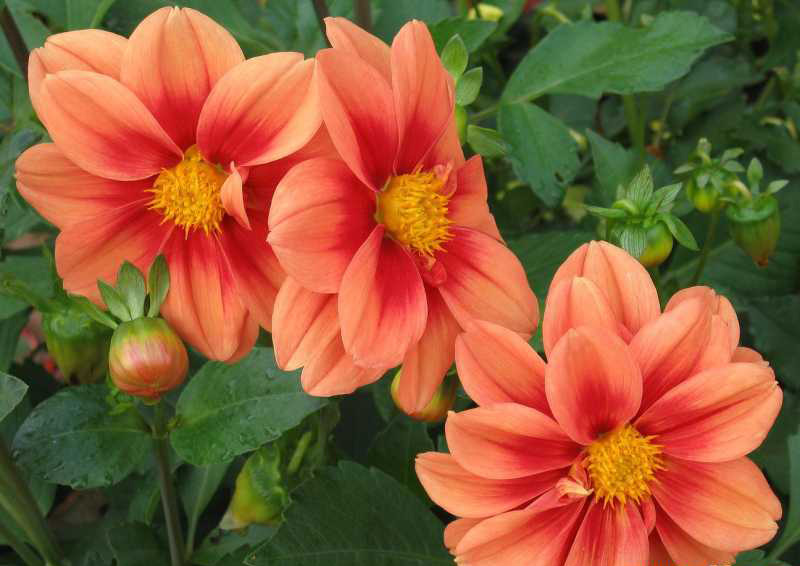
How to grow dwarf dahlia? Detailed planting methods and care tips
Dwarf dahlia is a perennial herbaceous plant of the Asteraceae family and belongs to the same genus as the dahlia. It resembles the dahlia in shape, only with a shorter plant, more branches, and more flower heads. It is mostly single-petaled small flowers, and each plant can bear several flowers that open at the same time
条件筛选