-

Cotton-lily intercropping: a commonly used cotton field intercropping and relay cropping pattern
Cotton-lily intercropping is a cotton field intercropping pattern widely used in dryland sandy loam areas along the coast and along rivers. The two crops have little mutual influence and are mutually beneficial in fertilizer use, but note that lilies cannot be continuously cropped and must be rotated to a different crop. This intercropping pattern generally has a bed width of about 3 m, with cotton planted in wide and narrow rows, wide row spacing 140 cm, narrow row spacing 50 cm, and 4 rows of cotton per bed. In the wide cotton rows, 6 rows of lilies are planted, with row spacing 20 cm and plant spacing 20-25 cm, 5000-6000 plants per mu. Cotton is raised as seedlings and transplanted, planted separately on both sides of the bed, per mu
-
Black locust is a commonly used landscaping tree species
Black locust, also called false acacia, belongs to the genus Robinia in the Fabaceae family. Native to North America, it has spread throughout vast areas of North China, Northwest China, and the southern part of Northeast China. The black locust has a tall crown and bright green leaves; when it blooms, the green and white complement each other, elegant and fragrant. It can be used as a street tree or shade tree. It is a pioneer tree species for greening industrial and mining areas and for greening barren hills and wastelands. Black locust wood is hard and resistant to water and moisture. It can be used for mine props, railway sleepers, vehicles, and agricultural timber; the leaves contain crude protein and are good feed for many livestock; the flowers are an excellent nectar source plant, and black locust honey is white and transparent, deeply welcomed by consumers
-
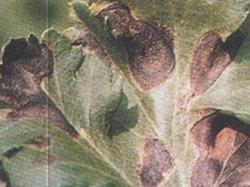
What pesticides are commonly used for controlling pests and diseases in chrysanthemums?
I. Main symptoms: They occur on the leaves, mostly on the lower leaves. The lesions begin as chlorotic yellow spots; after expanding, the lesions become round to irregular in shape, with dark brown edges and grayish-brown centers; in the later stage the lesions dry up and black granular bodies appear. II. Cause of the disease: It is a fungal disease. The pathogen survives in the soil...
条件筛选