-
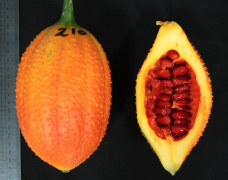
Is Taiwan Momordica cochinchinensis a fruit? Detailed explanation of nutritional value and uses
Is Momordica cochinchinensis a fruit? How should it be eaten? In order to promote the native specialty crop Momordica cochinchinensis, the Taitung District Agricultural Research and Extension Station of the Council of Agriculture, Executive Yuan (hereinafter referred to as the Taitung Station) held the "Native Specialty Crop Momordica cochinchinensis Multifunctional Application Presentation," presenting the research and development results of "Excellent Seedling Propagation Technology for Native Momordica cochinchinensis," "Creative Cuisine with Momordica cochinchinensis," and "Simple Juice-Making Technology for Momordica cochinchinensis." It is hoped that through multifunctional technological development and application, from primary agricultural production, combined with secondary crop processing and tertiary product promotion, and integrating indigenous cultural experiences and tourism, the added value of the emerging crop Momordica cochinchinensis can be created.
-
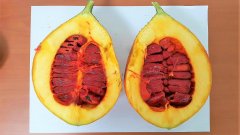
Taiwan, China's Momordica cochinchinensis fruit is rich in lycopene. How does this unusual plant reproduce?
What an unusual fruit! The fruit surface is spiky, and when mature it becomes a bright red-orange berry that looks like rows of lanterns from afar. Up close, the green unripe fruit looks like an oversized spiky passion fruit. It turns out that not only is its fruit shape unusual, but because its seeds look like a soft-shelled turtle,
-
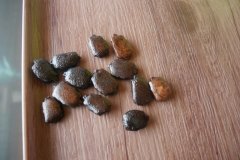
Taiwan Specialty Plant and Fruit: Gac (Momordica cochinchinensis) - Morphological Characteristics, Nutrients, and Can the Seeds Be Eaten?
The fruit from heaven - "Heaven Fruit" - its appearance gives no hint of heaven at all, yet it is a good friend to the eyes. People in Vietnam and South Asia call gac (Momordica cochinchinensis) the "fruit from heaven," and it is a treasure for young women to keep their skin rosy and radiant.
-

What is the difference between Potentilla discolor and Potentilla chinensis?
Potentilla discolor is Potentilla discolor of the Rosaceae family, because the genuine Potentilla discolor is relatively rare both on the market and on the mountains. What is more commonly seen is the same genus Potentilla chinensis used as a counterfeit, because Potentilla chinensis is extremely widely distributed, being abundant in both plains and mountainous areas. But passing it off as the medicinal material Potentilla discolor is absolutely unacceptable! Mixing in
-
How much is Schisandra chinensis per jin in 2019? With key cultivation techniques
Schisandra chinensis, also called mountain prickly ash, Xuanji, or Wuwei, is a top-grade Chinese medicinal herb with high medicinal value. Schisandra chinensis is further divided into northern Schisandra chinensis and southern Schisandra chinensis, and it is generally harvested after autumn, dried, and then used. Schisandra chinensis is mainly cultivated in Jilin, Liaoning
-
What is the difference between Fanbaicao (Potentilla discolor) and Jucai (Potentilla chinensis)?
Fanbaicao, also known as Jituigen, Jibatui, Tianou, Yexiabai, Jizhuashen, and Fanbaiweilingcai, is cultivated in most parts of our country. Where is the difference between it and Jucai? 1. Where is the difference between Fanbaicao and Jucai? 1. Different roots. The root of Fanbaicao is thick and robust
-
What is the difference between Anemone tomentosa and Anemone chinensis?
Both Anemone tomentosa and Anemone chinensis are perennial herbaceous plants of the Ranunculaceae family, so what is the difference between the two? 1. What is the difference between Anemone tomentosa and Anemone chinensis? 1. Different flower color. Anemone tomentosa has 5 sepals, pale pink or white, obovate, broadly obovate or broadly elliptic.
-
How much is Asparagus cochinchinensis selling for per jin right now, and what are the benefits of drinking it as an infusion?
Asparagus cochinchinensis, also known as Tian Dong Cao, is a perennial herbaceous plant that grows on the edges of mountain forests. Its tuberous roots have high medicinal value, and regular consumption can clear internal heat, relieve coughs, nourish yin and moisten dryness. So how much is Asparagus cochinchinensis bought for per jin? What are the benefits of drinking it as an infusion? 1. Asparagus cochinchinensis
-
Asparagus cochinchinensis yields 6,000 to 8,000 jin of fresh roots per mu, and 600 to 800 jin of dried roots.
Abstract The yield per mu of Asparagus cochinchinensis is mainly determined by its growing environment and cultivation techniques. Generally, Asparagus cochinchinensis needs to be grown for 2-3 years before it can be dug up. The yield of fresh Asparagus cochinchinensis roots per mu is about 6000-8000 jin, and the yield of dried Asparagus cochinchinensis roots per mu is about 600-800 jin. I. Yield per mu of Asparagus cochinchinensis
-
What are the growing conditions for Schisandra chinensis? A detailed explanation of its climate requirements
Summary Climate: It requires plenty of sunlight and can grow in colder and humid places. Soil: Schisandra chinensis likes fertile soil and is suitable for growing in humus soil or sandy soil that is deep, loose in texture and well drained, with slightly acidic soil being best. Terrain: Suitable for slopes
条件筛选