-

What are the latest control measures for grape black pox?
Grape black pox, also known as scab, and in some areas called bird's eye disease, can damage most of the green tender tissues of the grapevine, mainly affecting the fruit, fruit stalks, leaves, petioles, new shoots and tendrils. Black pox is a common disease in the grape growing process
-
Detailed Explanation of Grape Black Pox (Anthracnose) Control Techniques
Grape black pox, also known as grape scab and grape bird's eye disease, occurs in all production areas and is an important disease in grape production. The disease mainly damages the green, tender parts of the grape; leaves, petioles, fruit stalks, young shoots and young fruit can all be affected, and it can occur from bud break through the late growth stage.
-
Which fungicides are effective for controlling grape black pox?
Before grape flowering, spray 75% chlorothalonil wettable powder at 600-700 times dilution, 80% propineb wettable powder at 800-1000 times dilution, and other fungicides for control. After flowering, in the early stage of disease occurrence, spray 70% thiophanate-methyl wettable powder at 800-1000 times dilution and other fungicides for control.
-
How to prevent and control grape black pox disease? Key points for disease prevention when growing grapes
Grape black pox disease is also known as scab and bird's eye disease. Common names include toad's eye, liulong, and black spot. This disease is an important disease of grapes. It generally begins to occur in mid-to-late April, with the peak period from mid-to-late May to early June, and it is severe in rainy seasons. Throughout Shanxi Province
-
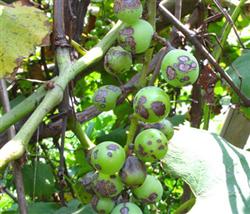
What are the control methods for grape black pox?
1. Eliminate the source of the pathogen. After the grapes drop their leaves in autumn, remove the fallen leaves and diseased clusters and bury them deep in a centralized pit. The old bark scraped off must be burned immediately. When the grape buds begin to swell in spring, spray with 3-5 degrees Baumé lime sulfur plus 0.3% sodium pentachlorophenate. 2. Strengthen cultivation management. In combination with summer pruning, carefully prune out diseased branches, diseased leaves and diseased fruit to reduce...
-
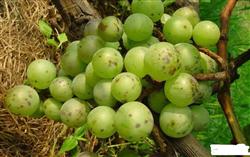
Detailed Explanation of the Occurrence Characteristics of Grape Black Pox (Elsinoë ampelina)
The pathogen mainly overwinters as sclerotia on the lesions of new shoots and tendrils. In the following spring, when the temperature rises above 2°C and high humidity persists for more than 24 hours, a large number of conidia are produced from the sclerotia and spread by rain to the young green parts of the grapevine. In water, the conidia produce germ tubes, quickly attach to the substrate, and after germination cause primary infection. This...
-

-
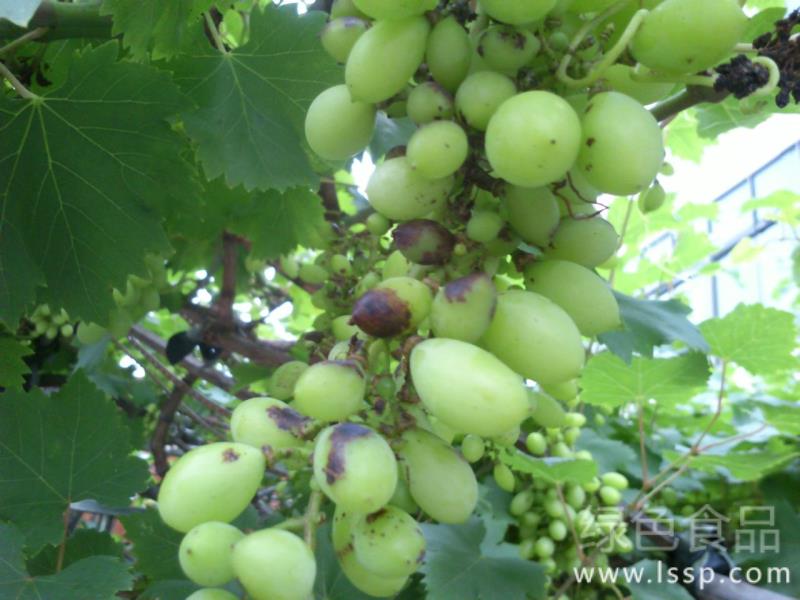
Grape black pox disease is prone to occur in rainy weather, detailed explanation of control methods
Grape black pox disease is prone to occur in rainy weather, control methods for grape black pox disease
-

How to prevent grape black pox? 2017 expert method for high-yield grape growing from ten years of experience
2017 high-yield grape growing: how to deal with grape black pox, a method from a grape-growing expert with 10 years of experience
条件筛选