-

Which tree species in stump bonsai are suitable for leaf pruning?
Q: Which tree species in stump bonsai can have their leaves pruned, and what should be noted? A: There are many bonsai tree species suitable for leaf pruning, including Chinese elm (Ulmus parvifolia), Japanese bush cherry (Sageretia thea), ginkgo, Chinese wolfberry (Lycium chinense), red maple, pomegranate, Chinese hackberry (Celtis sinensis), banyan (Ficus microcarpa), and Chinese chaste tree (Vitex negundo), etc. The main benefits of leaf pruning on stumps are: 1. It can make the leaves smaller, which helps display the artistic effect of bonsai in shrinking a dragon into an inch. For example, after leaf pruning on Chinese chaste tree, the newly sprouted leaves can shrink to 1/5 the size of the original leaves; when the banyan has all its leaves and buds removed in early summer, under controlled water and sufficient sunlight, the new leaves can grow
-
Dwarf crape myrtle is truly a remarkable tree species for bonsai
Dwarf crape myrtle is a perennial deciduous small shrub. It has a dwarf, sturdy and full plant form, bright and rich flower colors, peculiar and beautiful flower shapes, and a flowering period lasting as long as half a year, making it deeply loved by people and truly a rare gem among bonsai. Dwarf crape myrtle is generally propagated by seed, and can be sown in spring, summer and autumn. After the seeds are sown, seedlings emerge in about 10 days. When the seedlings grow to 10 cm tall, they can be transplanted into flower pots. What is surprising is that buds and flowers appear when the seedlings are only 20 cm tall. Flower colors include bright red, peach red, light purple, pinkish white and so on. Bright red is like fire, peach red is like vermilion, light purple
-
The creeping juniper is a suitable material for making bonsai
The creeping juniper generally has no upright main trunk, with dense branches and leaves, distinct layers, small emerald-green leaves, evergreen throughout the year, elegant posture, a long lifespan, and is easy to shape. The creeping juniper has strong adaptability and can grow well in both the south and the north, making it a good material for making bonsai. 1. Tree shape creation The branches of the creeping juniper are thin and long, and soft, suitable for making cascade style, curved trunk style, lying trunk style, and various bird, animal and other animal forms. When shaping the creeping juniper, one should do more wiring and less pruning. The wiring material can be metal wire or palm fiber. After the general outline is wired into shape, according to the needs of the shape, one should
-
Which peach and apricot varieties are suitable for courtyard planting?
Okubo Okubo originated in Japan and is now the main peach cultivar in North China. The fruit is nearly round, with an average single fruit weight of 220 g. The fruit apex is round and slightly concave, the suture is shallow and fairly distinct, the two sides are fairly symmetrical, and the fruit shape is uniform. The ground color of the skin is light greenish yellow, with red streaks. The flesh is milky white, with red on the sunny side, fine and soft in texture, juicy, with few fibers, aromatic, and freestone. The soluble solids content is 12%, and the quality is excellent. In the Beijing area, the fruit is harvested in late July. The fruit development period is 100 days. This
-
Xingguang Fuqiu Eggplant is an eggplant variety suitable for cultivation in summer and autumn
Xingguang Fuqiu Eggplant was developed by the Jiangsu Nanjing Xingguang Vegetable Research Institute. It is a mid-early maturing variety with long, thick club-shaped fruit and ink-black skin, generally about 30 cm long and about 8 cm thick, with a single fruit weight reaching up to more than 500 g. It has good market quality, strong disease resistance and adaptability, and is especially tolerant of heat, moisture, aging, and storage and transport. Because its benefits are extremely notable during the off-season for summer and autumn vegetable supply, it was named Xingguang Fuqiu Eggplant. Sow at the proper time and stagger the harvest for market. In the Yangtze River basin region, Xingguang Fuqiu Eggplant can be sown from mid-to-late September of the previous year to July of the current year
-
Start soil moisture preparation for cotton early and seize favorable opportunities
Although there is still one to two months before cotton seedling raising and sowing, the current situation of consecutive drought across autumn, winter and spring has already posed a great threat to cotton planting this year, and based on past years, there is also very little precipitation in our province in March-April. In view of the current situation, Dong Hezhong, deputy director and researcher of the Cotton Research Center of the Shandong Academy of Agricultural Sciences, suggests that cotton farmers: this year's cotton planting should start early and prepare early, seize the opportunity for soil moisture preparation according to weather conditions, actively prepare and conserve soil moisture, fight drought and protect seedlings, and strive for full seedlings from one sowing and early development of strong seedlings. Selected
-
Detailed Explanation of High-Yield and Stable-Yield Cultivation Techniques for Tea Tree Mushroom
Tea tree mushroom has a certain cultivation area in Gaochun, Jintan and other places, but in recent years, affected by resources, technology, market and other factors, the cultivation area of tea tree mushroom has continued to decrease. From a technical perspective, the main factors affecting the high and stable yield of tea tree mushroom are: first, strain degeneration. The breeding work of tea tree mushroom is relatively lagging, the source of strains is single, and obvious degeneration has occurred. Second, the formula is unreasonable. In tea tree mushroom production, the substrate formula is highly arbitrary, especially the proportion of nitrogen nutrition is not properly grasped, which seriously affects the yield of tea tree mushroom. Third, the finished bag rate is low. Tea tree
-
What is the most suitable body weight for snakes used for breeding
Like other poultry and livestock, snakes that are too heavy or too light in body weight cannot be used for breeding. Snakes used for breeding must be in their youth, and the same species also has specific weight limits, so as to ensure the quality of the breeding snakes. Generally speaking, the body weight specifications of breeding snakes must be controlled as follows: small snake species about 100-150 g each; medium snake species 150-350 g each; large snake species about 250-700 g each. Those that are too large or too small cannot be included in the range of breeding snakes.
-
Why Reasonable Water Intake for Pigs Cannot Be Ignored
1. The Harms of Insufficient Drinking Water for Pigs Currently, in pig raising, there is a widespread phenomenon of only valuing feeding while neglecting drinking water, not realizing that drinking water for pigs is equally important as feeding, or even more important. The main harms of insufficient drinking water are: 1. Insufficient drinking water leads to an increased incidence of intestinal diseases in pigs. In rural household pig farming, most use the traditional feeding method of supplying water and feed all at once, and between meals, regardless of weather conditions or feed type, no drinking water is provided. After pigs become thirsty due to insufficient drinking water, especially in hot summers, they often drink dirty water and similar things.
-
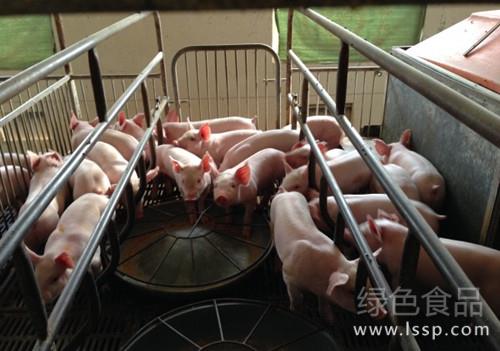
Piglet weaning stress is considerable, and the feeding method after weaning must be mastered
Piglet weaning stress is considerable, and the feeding method after weaning must be mastered
条件筛选