-

Key Points for Simple Spring Cultivation Techniques of 'Zhengsong No. 1' Scallion
I. Variety Introduction 'Zhengsong No. 1' has tall plants, thick and long white stalks, rapid growth, high yield, strong stress resistance, and a delicious flavor. It can be sown in both spring and autumn. II. Land Preparation and Sowing Sow from March to May in spring using the furrow direct sowing method. Apply sufficient base fertilizer: 3-5 cubic meters of farmyard manure and 40-50 kg of ammonium bicarbonate per mu. After plowing, directly lay out lines and open furrows with a furrow spacing of 70 cm, furrow width of 20 cm, and depth of 20 cm, with two rows per furrow. Before sowing, first broadcast compound fertilizer in the furrow, then hoe once to make the soil and fertilizer uniform. Along both sides of the furrow, open two small furrows in parallel, and in the small
-
Six key management practices to focus on after transplanting spring eggplant in a large arch shed
I. Temperature control For spring eggplant cultivated in a large arch shed, from transplanting until the seedlings recover, the shed should be kept closed to retain heat, keeping the temperature inside the shed at 28°C-30°C during the day and 15°C-20°C at night as much as possible. After the seedlings recover, attention should be paid to ventilation, keeping the shed temperature at 23°C-25°C during the day, generally not exceeding 33°C. II. Fertilizer and water management Under conditions of good soil moisture, water as little as possible before the first eggplant reaches the size of a walnut, to raise soil temperature and prevent flower and fruit drop. When the first eggplant reaches the size of a chicken egg, apply 10 kg of urea per 667 sq m along with watering. After that, appropriately increase the frequency of watering according to soil moisture.
-
Efficient Early-Spring Cultivation Techniques for 'Yuejiao No. 1' Pepper in Northern Guangdong
'Yuejiao No. 1' pepper is a first-generation hybrid pepper bred by the Vegetable Research Institute of the Guangdong Academy of Agricultural Sciences. It is early-maturing, with a plant height of 65cm and a plant spread of 60cm. The fruit is thick and horn-shaped, 16-17cm long and 4cm in diameter, with a single fruit weight of 50-100g. The skin is smooth and dark green, the flesh is thick, the taste is spicy, and it is crisp and tender with excellent quality. It is resistant to phytophthora blight, bacterial wilt, and viral diseases, and yields more than 4000kg per 667 sq m. 'Yuejiao No. 1' pepper has been successfully planted in early spring for 3 consecutive years in Shixing, Lianzhou, Lechang and other places in northern Guangdong, and has been promoted over a large area. 1 Sowing
-
Causes of Spring Yellowing in Winter Onions and Control Methods
For some time now, the author has continuously received letters or phone calls from the public asking about spring management of winter onions. Some people report that winter onions which grew well under low-temperature conditions developed yellowing leaves, root aging, and even death after temperatures rose in early spring, and that cold-resistant winter onion seedlings actually grew worse than local winter onions. Why? Through field observation, the author learned that in spring 2005, winter onions in most regions nationwide showed similar conditions. On the Jiaodong Peninsula, which has the largest planting area in the country, many
-
Key Technical Points for Early Spring Field Management of Late-Sown Wheat
Because last year's wheat sowing period around the "National Day" (October 1) encountered heavy rainfall, wheat farmers did not sow until after the Cold Dew solar term, resulting in late wheat; in addition, the rainfall at that time also delayed the growth of wheat sown at the normal time, which also formed late wheat. As a result, more than half of the 1.1 million mu of wheat sown in this city last year was late wheat. The growth characteristics of late wheat differ from those of ordinary wheat, so the early spring management techniques are also different. Late wheat generally refers to wheat sown after the Cold Dew solar term. Its growth characteristics differ from those of wheat sown at the appropriate time, mainly shown as: overwintering seedlings
-
Detailed Explanation of Early Spring Management Techniques for Late-Sown Wheat
Because the wheat sowing period around "National Day" last year encountered heavy rainfall, wheat farmers did not sow until after the Cold Dew solar term, forming late-sown wheat; in addition, the rainfall at that time also delayed the growth of wheat sown at the normal time, also forming late-sown wheat. Of the 1.1 million mu of wheat sown in this city last year, more than half was late-sown wheat. The growth characteristics of late-sown wheat differ from ordinary wheat, so early spring management techniques are also different. Late-sown wheat generally refers to wheat sown after the Cold Dew solar term. Its growth characteristics differ from wheat sown at the appropriate time.
-
What are the common diseases of peppers in early spring? This article summarizes them for you
Recently, continuous cloudy, snowy and cooling weather has seriously affected the normal growth of chili peppers and sweet peppers. According to what the author learned on March 5 in pepper growing areas such as Jitai Town, Sunjiaji Subdistrict Office and Gucheng Yangjia Village in Shouguang City, chili peppers and sweet peppers currently in the fruiting stage are commonly infected due to the unfavorable weather, mainly with gray mold and sclerotinia disease --- brown water-soaked lesions appear at the top or stem end of young fruits, then become sunken and rot, and a gray mold layer appears on the surface of the lesions; sclerotinia disease spreads from the fruit stalk to the whole fruit, showing water-soaked rot, light grayish brown,
-
Key Management Measures After Planting Spring Eggplants in Polytunnels
1. Temperature control. For spring eggplants grown in large polytunnels, after the seedlings are planted and before they recover from transplanting, the tunnel should be kept closed to retain heat, keeping the temperature inside the tunnel at 28-30°C during the day and 15-20°C at night as much as possible. After the seedlings recover, attention should be paid to ventilation, keeping the tunnel temperature at 23-25°C during the day, generally not exceeding 33°C. 2. Fertilizer and water management. When soil moisture is good, water as little as possible before the first eggplant (the "door eggplant") reaches the size of a walnut, to raise soil temperature and prevent flower and fruit drop. When the door eggplant reaches the size of an egg, apply 10 kg of urea per mu along with watering. After that, appropriately increase the frequency of watering according to soil moisture conditions.
-

Detailed explanation of asparagus spring planting techniques: master these points to grow asparagus well
Asparagus spring planting techniques
-
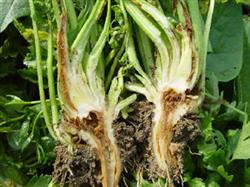
Spring marks the critical period for preventing and controlling celery heart rot
Celery heart rot is a common physiological disease in spring celery production. The tender tissue at the growing point of the celery turns black and dies. Subsequently, the root system and some stems and leaves of the celery also die one after another. The control methods are as follows: 1. Rational fertilization. Apply sufficient base fertilizer and increase the application of phosphorus, potassium and boron fertilizers to cultivate robust plants and improve disease resistance. Do not...
条件筛选