-

Causes of soft rot and nest rot in Gastrodia elata and prevention methods
Soft rot and nest rot in Gastrodia elata is one of the reasons for low and unstable yields in Gastrodia elata cultivation. In the small tubers, white tubers and arrow tubers affected by soft rot, the tuber skin turns yellow and withered, the central tissue decays, and a foul-smelling white milky fluid oozes from the cut surface of the tuber. In the rotting nests of Gastrodia elata and inside the tubers, the rhizomorphs of Armillaria mellea are luxuriant and dense. Gastrodia elata depends on Armillaria mellea for growth, so why does soft rot and nest rot occur, and why is the area beneath the tuber skin filled with Armillaria mellea mycelium? To explore this question, we should start with the nutritional ecology of Gastrodia elata. Gastrodia elata has no roots and no green leaves, its autotrophic organs are degenerated, and it relies on Armillaria mellea
-
Key Points and Detailed Operation Methods of Softwood Cutting Propagation of Goji Berry
Softwood cutting is a new technique that has emerged in recent years. Its biggest feature is a high propagation rate, saving cuttings and land. 200 cuttings can be planted per sq m, with a survival rate above 70%. Therefore, this propagation method is widely adopted in production. 1. Cutting time: In production, cuttings are mostly taken from May to July. Cuttings taken after August have a short growth period, and the seedlings are too small to leave the nursery that same year; they can be kept in the bed the following year and cultivated into large seedlings, and the side branches they produce are also very good cuttings. 2. Cutting collection: From excellent varieties or excellent individual plants
-
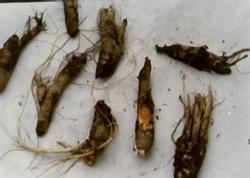
Detailed Explanation of Control Methods for Ginseng Bacterial Soft Rot
How to control ginseng bacterial soft rot? Please describe the symptoms of ginseng bacterial soft rot: it mainly affects the roots. The lesions appear as brown soft rot, with clear edges, round to irregular in shape, varying in size, often several merging together, and finally causing the entire ginseng root to become soft and rotten. When the lesion is squeezed by hand, white bacterial ooze overflows, with a strong pungent...
条件筛选