-

How to treat piglet yellow scours? Here are a few practical treatment recipes
Take 60 grams of hawthorn leaves and 50 grams of ginger, add 3 kg of water, bring to a boil, then simmer over low heat for 10-15 minutes, then add 60 grams of brown sugar, and once the brown sugar has completely dissolved, remove from the heat. When warm, mix into the feed and feed to the sow, 2 times a day, and the piglets' yellow scours will be cured.
-
Six practical ways to prevent chickens from wasting feed
1. Use complete compound feed to improve feed absorption and utilization. An incomplete nutrient profile in the diet means the chickens increase their feed intake to compensate, which is undoubtedly the greatest and least noticeable waste. Feed must be scientifically formulated according to the physiological characteristics and growth and development of the chickens (broilers and laying hens). 2. Feed should not be ground too fine. Feed that is too fine is not only unsuitable for eating but also increases dust, causing feed waste. 3. Improve the feeders to prevent feed waste. Provide feeders with a reasonable structure according to the age of the chickens.
-
How to Identify Adulterated Pig Feed? A Few Practical Methods to Teach You
(1) Observe with your eyes. Buy 1 magnifying glass, with a higher magnification. Sift the feed with a sieve, spread it into a thin 1 layer, and carefully observe the material on the sieve and below the sieve with the magnifying glass. The characteristics of some of these materials under the magnifying glass are as follows. 1. Fishmeal The main components of fishmeal are fish meat, fish bones, fish spines, fish scales, fish eyes, etc., and no other substances should be present. Under the magnifying glass are fish scales and fish eyes; the fish scales are covered with concentric circles, the fish bones from the head are flaky, the fish spines are tetrahedral, and the fish meat is composed of muscle fibers. 2. Blood meal The edges of the particles are sharp and reddish-brown; the black shell fragments are usually tightly curled, with a smooth surface and marks like needle pricks. Hard seed hilums can also be seen, oblong, yellow, brown, or black. 3. Rapeseed cake (meal) The rapeseed meal shell is brown or black, with a meat-like texture on the surface. 4. Cottonseed cake (meal) The cotton shell has two layers and does not separate; the outer layer is dark and the inner layer is light, and the outer shell is connected to the cotton lint; there are many fine hairs, appearing silvery under the lens. 5. @#@245@#@ Bran is mainly the outer skin of wheat; the bran flakes are flaky and contain many starch granules. 6. Bone meal is bone fragments, opaque, white, lusterless, with a rough surface and hard texture. 7. Shell meal is a white or gray powder, and some shells still have faint lines.
-
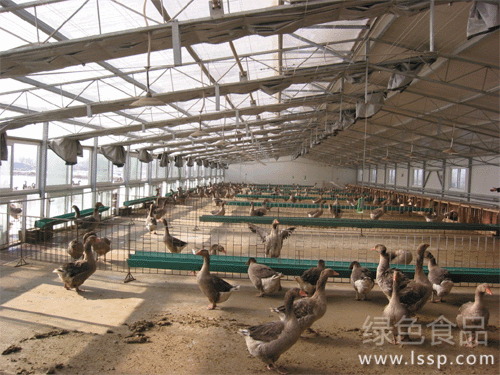
How to feed geese more economically and practically when fattening them in confinement
How to feed confined geese economically and practically for fattening
-
How to fertilize cotton reasonably? A detailed practical guide
Apply flower and boll fertilizer heavily. The flowering and boll stage is the most vigorous growth period in the entire life of cotton. Both the vegetative growth and reproductive growth of cotton reach their peaks, and nutrient demand is greatest. Timely fertilizer supplementation plays a key role in promoting cotton bolls, preventing premature senescence, setting more bolls on all three fruiting branches, and increasing boll weight. In fertilization, the cotton plants should be kept from excessive vegetative growth. For cotton fields with high fertility and vigorous plant growth, topdressing can be delayed until the full flowering stage when 1 to 2 large bolls have formed on the lower part of the plant; for cotton fields with low fertility and weak growth, flower and boll fertilizer should be applied early and heavily at the initial flowering stage. Generally, in mid-to-late July, apply urea per mu
-
How to Apply Fertilizer Skillfully to Cotton? A Explanation of Practical Technical Points
Fertilizer is the material basis for high cotton yields, and applying fertilizer according to need is the highest principle of cotton fertilization. Where conditions allow, soil testing and fertilizer recommendation should be carried out, and based on the available nutrient content of the soil and the needs for high cotton yields, the type and amount of fertilizer to apply should be determined. For most cotton fields in the north, the amount of potassium fertilizer should be increased, the amount of phosphorus fertilizer reduced, and nitrogen fertilizer mainly used for topdressing, or a formula fertilizer with "high potassium, low phosphorus, medium nitrogen" should be applied. If a compound fertilizer with equal amounts of nitrogen, phosphorus and potassium is used, the amount per mu should not exceed 25 kg, plus an additional 12.5 kg of potassium fertilizer
-
Sharing of High-Yield Cotton Cultivation Experience and Practical Techniques
I. Pre-Sowing Preparation First, purchase high-quality cotton seed. It is recommended to change seed every year. Never be tempted by cheap prices to use second- or third-generation cotton seed, because saved seed reduces yield by about 10% each year. Use about 1.5 kg of seed per mu. Sun the seed before sowing for a cumulative total of no less than 30 hours, turning it constantly. Be careful not to spread it directly on concrete, brick, or metal surfaces. Before sowing, build up soil moisture in good time and preserve it, so that sowing is done with adequate soil moisture. II. Scientific Fertilization Apply ample basal fertilizer. Generally, apply 3-4
-
How to Prevent Deformed Oyster Mushrooms? Detailed Practical Measures
During oyster mushroom production, inadequate management measures and unsuitable environmental conditions often easily lead to the formation of deformed mushrooms. In production, the causes of deformed mushroom formation should be identified, and effective prevention and control measures should be taken. 1. Spherical or flask-shaped: The stipe of the oyster mushroom is spherical or flask-shaped, the surface is uneven or twisted into a wavy shape, the cap cannot form, with only a very small point or obvious icicle-like stripes; this is caused by viral infection. It should be prevented and controlled by spraying or smearing Virus K, Virus A, or Xiao Jun Ling. 2. Cauliflower-shaped
-
How to prevent and control lily pests and diseases? A detailed guide to practical methods
1. Damping-off mainly causes damage at the seedling stage, causing plants to wilt. The disease is severe when ventilation is poor and water accumulates in the field. Control methods: (1) Practice reasonable crop rotation, and choose plots with good drainage and loose soil for planting; (2) Strengthen field management, open drainage ditches in time, and improve ventilation and light conditions; (3) Before sowing, soak the seed bulbs in a 1:500 thiram solution or 2% formalin for 15 minutes; (4) When the disease occurs, promptly remove diseased plants, and disinfect the affected area with 5% lime milk.
-
Detailed Explanation of Lily Pest and Disease Control Measures and Practical Methods
(1) Rotate crops with a 3-year break. When planting lilies along a slope, plant from the bottom upward to reduce the spread of pathogens. (2) Select bulbs free of disease, mites and mechanical injury as seed bulbs to reduce sources of bacteria and mites. (3) Burn dead branches and fallen leaves in the field and diseased and pest-infested plant residues to reduce sources of pests and diseases. Organic fertilizer should be composted and fermented until fully decomposed before being applied to the lower soil layer. (4) Use deep furrows and high beds, clear the furrows and drain water to control soil moisture content. (5) Soak for disinfection and mite elimination. Before sowing, use a 4000-fold dilution of 20% Saomanjing wettable powder plus a 70% Thiophanate-methyl wettable powder
条件筛选