-

Policy and Technology Are Key to Tackling Livestock Pollution
As awareness of ecological and environmental protection grows and the public demands a better living environment, the environmental pollution caused by livestock and poultry farming has drawn unprecedented public attention and concern. And this is clearly not a problem unique to our country, but a "
-
Soil Pollution Prevention and Control Urgently Needs a Legal Basis
Soil legislation that has long attracted outside attention has made new progress. Recently, the Department of Ecology of the Ministry of Environmental Protection held a symposium with soil remediation enterprises to solicit opinions for the drafting of the Soil Environmental Protection Law. A relevant official of the Department of Ecology of the Ministry of Environmental Protection said that the next step will be to strengthen soil legislation
-
Pollution control in livestock farming is urgent, and method and cost are key
Recently, Yan Junfang, chairman of Yangling Benxiang Agricultural Industry Group, has been deeply troubled. Due to issues left over from the past, a farm under the group that can hold 200,000 pigs at full capacity has run into a thorny environmental protection problem. It is reported that the farm is only 170 meters away from the nearest surrounding village at its closest point. In the hot summer, the stench from the pig farm directly affects the daily lives of the villagers.
-
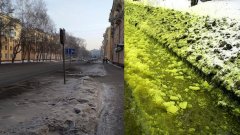
Green snow in Russia is a harm caused by environmental pollution
Have you ever seen green snow? Normally, the snow we see is white, but recently the Russian city of Pervouralsk has repeatedly seen green snowflakes, and this is caused by environmental pollution, which has deepened residents' concerns about pollution, poor waste management, and the possible effects of nearby factory activity
-
Detailed Explanation of Key Points for Pollution-Free Cultivation Techniques of White Radish
White radish is a common vegetable. As the saying goes, "Eat radish in winter and ginger in summer." It is also a nourishing food ingredient in winter, containing mustard oil, amylase and crude fiber, and has the effects of promoting digestion, enhancing appetite, accelerating gastrointestinal peristalsis, and relieving cough and resolving phlegm. So, what are the key points for pollution-free cultivation of white radish?
-
To master pollution-free vegetable cultivation techniques, you need to do these four things well
Food safety concerns people's health, and vegetables are something we often eat, so achieving pollution-free production in vegetable cultivation is very important. So, what are the cultivation techniques for pollution-free vegetables? These four things need to be done! 1. Choose the plot As a
-
Detailed Explanation of Key Points for Pollution-Free Cultivation Techniques of Navel Orange
Navel orange is now a project that many growers are willing to choose. It is not only limited to eating fresh; it can also be juiced, its peel can be soaked in water to drink, and its juice is also used by people as a seasoning for cooking. With so many functions, how should navel orange be grown? Below we will
-
Key Technical Points for Pollution-Free Cultivation of Garlic Chives (Blanched Garlic Leaves) in Winter
1. Variety Selection It is best to choose fast-growing varieties among the purple-skin garlic types or white-skin garlic types, such as purple-skin garlic, bamboo garlic, Baigong garlic, etc. Garlic chives produced from these garlic types grow robustly, are uniform and cold-tolerant, have strong disease resistance, and give relatively high yields. 2. Building Beds and Insulation Choose a
-
What are the cultivation techniques for pollution-free green peppers?
1. Seed treatment Use two parts boiling water to one part cold water, soak seeds in warm water at 55°C, with water being 5 times the volume of the seeds: pour in the seeds and stir constantly, keeping at a constant temperature for 10 minutes; when the water temperature drops to about 30°C, stop stirring and continue soaking for 12 hours, then skim off the shriveled seeds. Control the sprouting temperature at 20°C~
-
Four Fertilization Methods for Pollution-Free Cherry Cultivation
1. Radial trench or ring trench method: For the radial trench method, dig outward starting 50 cm from the trunk, narrow and shallow on the inside (30 cm) and wide and deep on the outside (40-50 cm), with the trench extending to 20 cm beyond the canopy projection, and dig 4-6 trenches per tree. For the ring trench, dig at the canopy projection, with a width of 50 cm
条件筛选