-
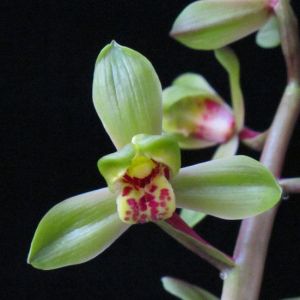
Introduction to the Characteristics and Care Methods of the Guanding Cymbidium Variety
Guanding, the "Second Master" among the red cymbidiums of the eight old cymbidium varieties. (The eight old cymbidium varieties are: Dayipin, Shanghai Mei, Pan Lu, Dangzi, Cheng Mei, Guanding, Yuanzi, Ranzi.) Why is it called the "Second Master"? Because it is old and ranks second. Guanding dates from the early period of the Qianlong era of the Qing Dynasty and originated from the Wanhe Hotel in Suzhou, so it is also known as "Wanhe Mei". By...
-
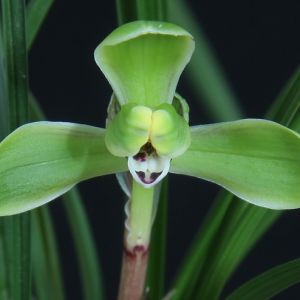
Introduction to the Characteristics and Care Methods of the Red Song Mei Cymbidium Variety
Red Song Mei, originally named "Red Yue Mei," was discovered in 1984 by Xu Hongyue of Tangdi, Shaoxing, at Yapu in Zhenhai. Red Song Mei has an obliquely upright leaf type, with rather firm and sturdy leaf texture, tight leaf stems, and the middle section of the basal leaves broadening into a wide belly. The leaf tips of Red Song Mei form a hood and curve upward in a dew-catching type, with pronounced narrowing and broadening, giving a sense of thickness and solidity. The central leaf is narrower than the other leaves, with a deep "V"-shaped groove. The midrib...
-
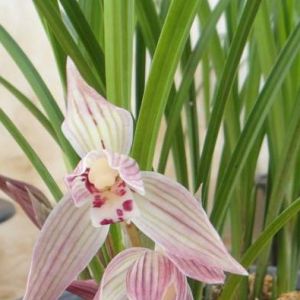
Variety Characteristics and Appreciation Methods of the Rouge Lotus-Orchid
Yanzhi He (Rouge Lotus), a variety of Cymbidium tortisepalum Fukiense, is named for its color, which resembles rouge staining, and its lotus-shaped petals. It was initially called Lotus-type Pale Pink Cymbidium tortisepalum Fukiense. It is produced in the secluded valleys of the Three Parallel Rivers region of the Jinsha River, Lancang River, and Nujiang River in northwestern Yunnan. Discovered in the spring of 2001, the Dali orchid expert Huang Guisheng purchased it back from the production area at a high price for introduction and cultivation. A clump of 4 seedlings is a rare variety among orchids. Orchids...
-
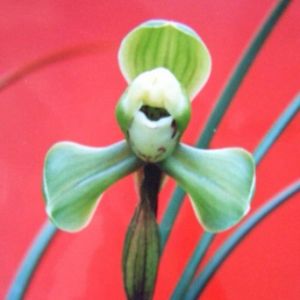
Variety Characteristics and Care Methods of Guanchun Chunlan (Cymbidium goeringii 'Guanchun')
In the 30th year of the Guangxu reign (1904), it was dug up from Siming Mountain by Feng Changsheng, later identified and named by Wu Enyuan, and cultivated under Wu. New shoots are purplish-red, leaves 20-28cm long, O.8cm wide, leaf color dark green without gloss. Leaf posture is slanted-upright. The flower scape is slender, equal in height to the leaf surface, the flower stalk is purplish-red; the bract shell is silver-red, marked with purple-red veins. Outer...
-
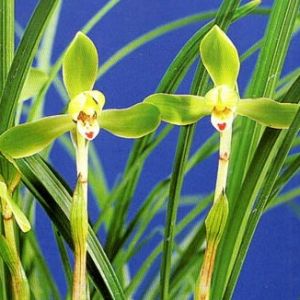
Introduction to the Characteristics and Care Methods of the Chun Yipin Cymbidium goeringii Variety
: Narcissus petal form. : Selected during the Bingyin year of the Tongzhi reign of the Qing Dynasty by a person surnamed Yao from Shanghai, hence it is also known as Yao's Chun Yipin. : The three outer petals have rounded heads with angled tips, slender stalks with contracted bases, level shoulders, deep soft Guanyin pocket-shaped petals, separated chambers, and a large round lip. The flower color is pretty and lovely; when in full bloom the three petals stand upright, and the flowering period is long. The bracts are deep purple; the leaves are obliquely upright, dark green in color, with slightly blunt leaf tips.
-
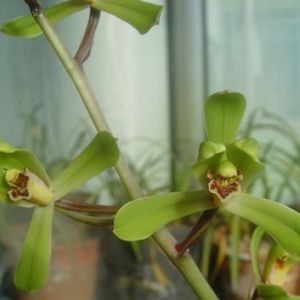
Introduction to the Characteristics and Appreciation Methods of the Zhenpin Huilan Variety
Also known as "Zhenpin Mei," it was selected in 1930 by He Gengquan of Wujin, Jiangsu, and named Gengquan Mei at the time; in 1941, after Mr. Xie Ruishan of Suzhou cultivated it and it bloomed again, because its flower shape and bearing were of a rare variety, it was given the new name "Zhenpin"; afterward the orchid world also called it "Dicui" (it shares the same name as but is a different plant from the "Dicui" that was lost by the end of the Qing dynasty...
-
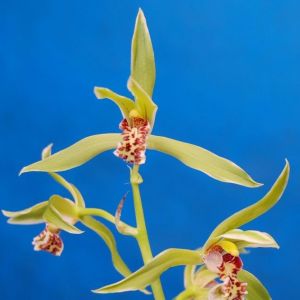
Introduction to the Characteristics and Care Methods of the Xianxia Cymbidium faberi Variety
Leaves 35-45cm long and 0.8cm wide, of a narrow, slender leaf shape, with a clear double margin along the leaf edges. The leaf posture is semi-pendant. The flower scape is slender, equal in height to the leaf frame, and the flower stem is emerald green; each scape bears 5-8 flowers. The three outer petals are narrow and long, with a contracted base and flared corners, and the two lateral sepals spread horizontally. The petals are upward-curling cat-ear-shaped columns, and the lip is a large rolled tongue, with bright and densely packed red spots on the tongue surface. The five petals are emerald green, and all petal edges have yellow-white borders.
-
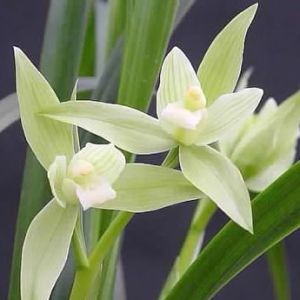
Characteristics and Care Methods of the Longchangsu Spring Sword Orchid Variety
"Longchangsu" belongs to the soft-leaf Spring Sword orchid variety (Chun Jian Su) of the genus Cymbidium in the orchid family. Its roots are thick and strong, its pseudobulbs are elliptical but not prominent, its buds are tender green with no mixed colors, and its leaves are herbaceous, lustrous green, with a fleshy texture. The leaf margins have fine serrations and are relatively soft, slightly curved in an arc. The midrib and lateral veins run parallel, dark green and prominent. The flowering period is from February to April, with late February being the early flowering stage, March...
-
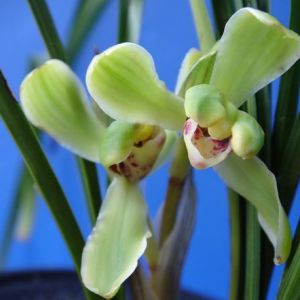
Does the Chunlan 'Lao Dai Mei' have fragrance, along with its photo characteristics and care methods
History: During the Daoguang period, it was selected by orchid traders in Ningbo, Zhejiang. Another account: during the Daoguang period of the Qing Dynasty, it was selected and bred by an orchid lover surnamed Wang in Ningbo, Zhejiang. Usually one scape bears two flowers, one above the other, like "two generations," hence the name "Dai Mei" (Mei of the generations); at present the orchid world generally calls it "Lao Dai Mei." Characteristics: the three outer petals have rounded tips and extremely fine bases; the two lateral sepals are long...
-
How long does it take for a Cymbidium goeringii bud to bloom? A detailed guide to care methods
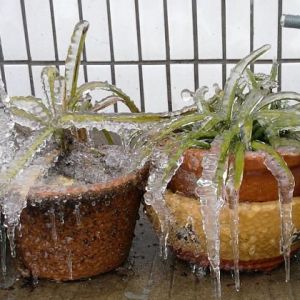
This is a picture from last year's vernalization. This year it has already been divided into three pots and even produced fruit. If it snows this year, I will vernalize it again using this method.
条件筛选