-

Where Can You Buy Chinese Hackberry Seeds? A Detailed Guide to Sowing and Raising Seedlings
The Chinese hackberry (Celtis sinensis) is a deciduous tree in the genus Celtis of the family Ulmaceae. Its crown is large and round, and when mature it forms a dense shade, giving it strong ornamental value. The Chinese hackberry is currently a main tree species for courtyards and parks; it can be planted as a specimen, in groups, or shaped into tree stumps and bonsai, and it is also
-
How to make a Chinese hackberry bonsai? A detailed guide to the latest methods
The Chinese hackberry has strong sprouting ability and roots easily; old stumps are mostly dug from the wild. In southern regions, digging is mostly chosen for February and March, when temperatures rise and humidity increases, so the dug stumps are less likely to dry out and are easier to keep alive. When digging, choose stumps that are old, have good tree form, short trunks,
-
Deciduous Tree Chinese Hackberry (Celtis sinensis) Sapling Prices, Planting Methods and Timing, and Bonsai Care
Chinese hackberry is also called Huangguo hackberry, white hemp seed, hackberry, hackberry elm, hackberry tree, and sand hackberry. It is a deciduous tree in the order Rosales, family Cannabaceae, genus Celtis, and can reach a height of 20 m. So how much does one Chinese hackberry sapling cost? When should it be planted? How is it planted? How is a bonsai cared for? From the Jiangsu nursery base
-
Is the Chinese hackberry an evergreen or a deciduous tree species?
The Chinese hackberry is a tree of economic value, with strong resistance to toxic gases such as sulfur dioxide and chlorine; its stem bark is a raw material for papermaking and artificial cotton; its fruit is pressed for oil to make lubricant; its wood is hard and can be used for industrial timber, so is the Chinese hackberry evergreen or deciduous?
-
-
-
-
Detailed Explanation of the Key Techniques for Pruning and Shaping Chinese Hackberry (Celtis sinensis) Bonsai
Chinese hackberry is commonly found growing wild beside hillside streams and valleys in the hilly and low-mountain areas of the Yangtze River basin and regions to its south. Ancient, curiously shaped old sprout-origin stumps that have been cut back for many years can be collected and grown on to develop their root system. Through pruning, root development is encouraged and new shoots are stimulated, after which the tree is shaped and cultivated; after 12 years, it is then potted up and worked on further.
-
What are the cultivation methods for Chinese hackberry (Celtis sinensis) bonsai?
Chinese hackberry (Celtis sinensis) is widely distributed across many regions nationwide, including the Huai River basin, the Yellow River basin, south of the Qinling Mountains, Guangdong, and Guangxi, and mostly grows scattered at village entrances, by riversides, at field corners, and on hillsides in plains and low mountain areas. Because Chinese hackberry material is widely available and highly adaptable, easy to propagate from seed, long-lived, with a rugged tree form, and aged, ancient, and uniquely elegant
-
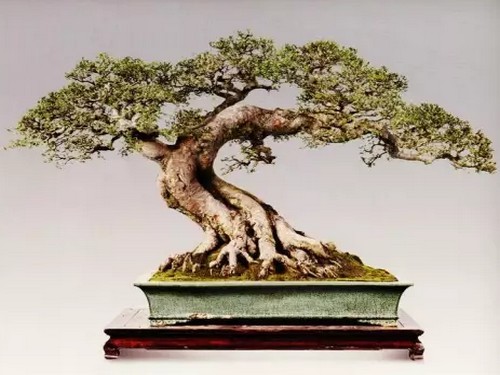
Sourcing Methods and Cultivation Techniques for Chinese Hackberry Bonsai
The Chinese hackberry (Celtis sinensis) has an elegantly antique and unrestrained posture, with rough, mottled bark that does not crack, a tall and straight trunk, and gracefully spreading branches. In spring, new leaves first emerge, covering the branches in tender green; in autumn, the foliage turns deep yellow, making it highly ornamental. In winter, when the leaves have almost entirely fallen, it can be appreciated as a bare tree. Taking its old stumps, with exposed roots and bent trunks, gnarled and antique, green leaves trailing along the branches, layered and towering in verdant beauty, it is richly evocative of wild mountain forests.
条件筛选