-
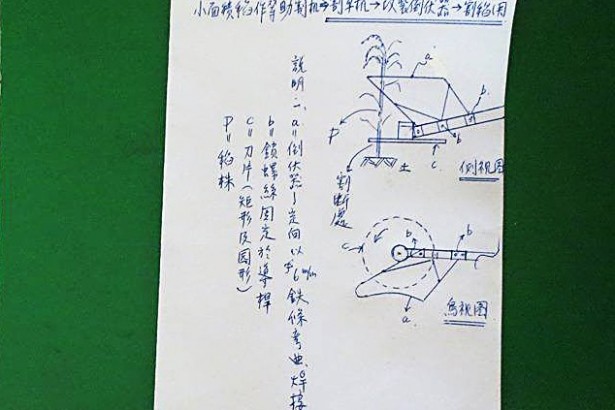
To avoid a shortage of rice harvesters, smallholder farmers build their own mini rice harvesters
To avoid a shortage of rice harvesters, smallholder farmers build their own mini rice harvesters
-

What are the main equipment and facilities in a deer barn building?
1. Feeding and watering equipment (1) Water supply equipment: water source, submersible pump, water tank, water pipes, drinking troughs, etc. (2) Drinking troughs: to allow deer to drink warm water in winter, a rectangular trough welded from iron plate or a large iron pot can be fixed on a stove base so it can be heated. The trough or water pot is best placed below the front wall, or at the lower end of the feed trough in the middle of the exercise yard; some also extend a small part into the corridor, so water can be added and heated directly from the corridor, saving time and labor and being safer. The trough is 2 m long (passing through the wall, for two pens), 0.6 m wide, and 0.35 m deep. The stove base must be solid, and the chimney 1.2-1.5 m high. Where conditions permit, it is best to use gravity-fed watering, with a tap water pipe and automatic switch installed above the trough or between the stove base and the edge of the water pot. (3) Feed troughs: generally wider and deeper cement troughs, wooden troughs, etc. are commonly used, with cement troughs being the most durable. Feed troughs are best placed below the iron-bar railing of the front wall, or fixed lengthwise in the middle of the exercise yard; some are placed inside the shed. When wooden feed troughs are used, they must be installed securely. General feed trough specifications: 4-5 m long, 0.6-0.8 m wide at the top, with a rounded bottom, 0.25-0.30 m deep, and the bottom of the trough 0.3-0.4 m above the ground. It can feed 10-15 adult deer or 20-30 young deer. Generally, at least two such feed troughs should be set up in each pen. The surface of the feed trough must be smooth and free of sharp edges.
-
Detailed explanation of the method for building a banded krait (Bungarus fasciatus) snake house
For artificial rearing of banded kraits, a snake garden or snake house can be used; for small-scale rearing, a snake box can be used. The snake garden and snake house for banded kraits should be built in a place that is sheltered from the wind and facing the sun, on high and dry ground, with dense soil, relatively close to a water source yet far from residential areas, and quiet. The snake garden should simulate the wild environmental conditions of the banded krait. The surrounding wall of the snake garden should be 2.5 m high, the inner surface of the wall should be smoothed with cement, the corners of the wall should be built into an arc shape, the wall foundation should extend 1.5 m underground, and at a depth of 1.5 m in the soil layer, lime-sand-clay mixture should be tamped solid to prevent rodents from burrowing and the snakes from escaping.
-
Building cozy foreign-style mushroom houses to achieve year-round mushroom production
Fengdu Town in Gutian County, Fujian Province, has taken breaking through the seasonal cultivation of mushrooms as a difficult problem to overcome in developing the edible fungi industry, increasing investment in science and technology, building European-style "foreign mushroom houses," changing traditional cultivation methods, and achieving off-season constant-temperature cultivation and year-round production. At the site, rows of distinctive European-style "foreign mushroom houses" can be seen; they are a newly built edible fungi production base of Gutian County "Gugu Yizu" Biotechnology Co., Ltd., covering an area of 20 mu, with a total of 24 modern specialized rooms, and each mushroom house is equipped with a large
-
Detailed Explanation of Key Techniques for Building a Goji Berry Garden-Protecting Fence
Goji berry (Lycium barbarum) is a perennial vine-like trailing plant with extremely strong adaptability. It can grow vigorously and flower and fruit normally in fertile soil, poor soil, sandy soil and saline-alkali soil (pH 4-10.5) across regions ranging from high temperatures of 40°C in the south to low temperatures of -43°C in the north. Its fruit is an important traditional Chinese medicinal material. The tender stems, leaves, flowers and fruits (dried for winter use) can be used in congee, soup, tea, wine or eaten dry without any side effects, making it a nourishing tonic suitable for all four seasons. It is of great significance for enhancing human immunity and promoting good health.
-
Key points and precautions for building a rooftop rice field eel pond
What should be noted when building a rooftop rice field eel pond? Considering the load-bearing capacity of the rooftop, it is recommended that all rooftop ponds be built with bricks laid upright (wall thickness 6 cm); except for breeding ponds, all should use soil-free culture. From the perspective of cooling, the wall that is often exposed to the sun should be built higher than the height of the culture pond, and then the pond should be started about 10 cm back from it, to prevent prolonged sunlight on that pond wall from causing the water temperature in that pond to rise abnormally compared with other ponds, resulting in an undetected high water temperature that causes the death of rice field eels.
-
What are the considerations for building a snake enclosure?
A good snake farm should have a spacious activity area set aside, that is, an exercise yard for the snakes. However, climbing vines such as Boston ivy cannot be planted in the exercise yard.
-
Fine Management Techniques for Cotton at the Seedling Stage to Build a Solid Foundation for High Yield
Cotton seedling-stage management is crucial, as it directly determines whether the cotton can build a good framework for high yield and whether the reasonable transition from vegetative growth to reproductive growth can be properly adjusted. The principles of seedling-stage management are: first ensure a full stand, and on this basis cultivate strong seedlings and promote early seedling development. The key points of seedling-stage management are: check the seedlings promptly after sowing, and if rotten sprouts or rotten seeds are found, reseed in time. Thinning and final thinning: thinning can be done in two rounds. The first is after the seedlings emerge evenly, keeping strong seedlings and pulling out weak and diseased ones. The second is at the 1-2 true leaf stage, and final thinning is at the three-leaf stage, when the base of the stem has already become lignified and its ability to resist adverse environments has increased. Intertillage: through intertillage, soil temperature can be raised, water evaporation reduced, root growth promoted, strong seedlings cultivated, and early development encouraged. At the seedling stage, intertillage is generally carried out 3 times. The first is at the cotyledon stage, together with thinning. Early intertillage can raise the soil temperature around the seedling roots, promote early root development and increase absorptive capacity, so that true leaves emerge earlier and seedling stress resistance is enhanced. It can also break up soil compaction and help preserve soil moisture. The depth of this intertillage is 4-5 cm. At this time it is already June, the temperature is rising, the root system is already relatively strong, and aboveground growth is accelerating. Deep intertillage can disperse surface soil moisture, promote roots to go deeper, and control internode length, which is even more important in relatively fertile cotton fields. Fertilization: growth at the seedling stage is relatively slow, and topdressing should be based on seedling condition, applied early, lightly, or not at all. Irrigation and drainage: in single-crop cotton fields in northern cotton regions, if enough pre-sowing moisture irrigation has been applied, do not water at the seedling stage; do a good job of intertillage and moisture conservation. If watering is truly needed, then water lightly with a small amount, irrigating every other furrow, and after watering carry out intertillage to conserve moisture, improve aeration, and raise soil temperature. At the seedling stage, the suitable field capacity of the soil is 55%-70%. Disease and pest control: the main diseases and pests of cotton at this stage are cotton Fusarium and Verticillium wilt, cotton aphids, cotton bugs, cotton bollworms, cotton red spiders, and so on.
-
Yingbuluo Nanguo Pear Builds Its Brand Through Scientific Management
1. Fruit tree pruning: Through winter pruning and spring pruning, the fruiting branches are spread out and an umbrella-shaped canopy is formed to achieve ventilation and light penetration. Pay special attention to summer pruning (mid-summer pruning), removing all water sprouts, back branches and new shoots from mature fruit trees, reducing waste of tree nutrients, maintaining the canopy in a moderate state, and ensuring that all nutrients produced by the leaves are effectively used for fruit growth and tree development. 2. Applying farmyard manure: Farmyard manure has a complete range of nutrients and is the most ideal fertilizer for improving fruit quality. Bao Dianhong's orchard applies farmyard manure once every two years, with 200-250 kg of fully decomposed farmyard manure per tree, plus some chemical fertilizer each year. He believes that doing so can both keep the tree vigorous and control excessive tree growth that causes canopy shading, ensuring fruit coloration and improving fruit quality.
-
Method for building a greenhouse for raising Schisandra chinensis seedlings in nutritional pots
Build a plastic greenhouse of a suitable size according to the number of seedlings to be raised (or use a solar greenhouse). For general vegetable (cucumber) cultivation, a plastic greenhouse is used, with a width of about 12 m, a length of 80-100 m per greenhouse, and a height of more than 2 m, with doors at the front and rear, welded from steel bars. A small shed can also be set up, using materials such as steel bars, bamboo strips or wooden poles. Building a simple shed costs little but has a short service life.
条件筛选