-
How to manage early-flowering mango trees? Understand the key management points in one article
Key management points for early-flowering mango trees
-

Four major misunderstandings in soil, fertilizer and water management for fruit trees, do you know them all?
Four common misunderstandings in soil, fertilizer and water management for fruit trees
-
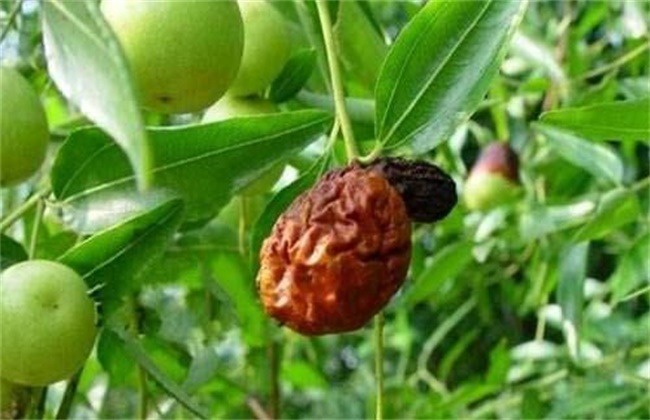
How to prevent and control winter jujube fruit shrink disease? Understand the key techniques in one article
Prevention and control techniques for winter jujube fruit shrink disease
-
How to prevent and control jujube fruit shrinkage disease? Understanding the occurrence pattern is key
Jujube fruit shrinkage disease, also known as jujube iron skin disease, jujube black rot, jujube dry waist fruit shrinkage disease, jujube wilt fruit disease, wu chao, wu luo tou, wu chao, tie jiao, etc., was first officially reported in China in the late 1970s. It is found throughout all major jujube-growing regions nationwide, and its damage is becoming increasingly severe, having already become a devastating disease in jujube production. In recent years, the disease has become increasingly serious in jujube-producing areas of Shanxi Province, becoming an important factor affecting jujube yield and commercial quality. However, current reports on the pathogen and control patterns of this disease are inconsistent, and no effective control method has been found
-
How to control the jujube bud weevil? Understanding its life habits is key
The jujube bud weevil belongs to the order Coleoptera, family Curculionidae. It occurs in Henan, Hebei, Shanxi, Liaoning and other famous jujube-producing areas, mainly harming jujube, apple, pear and other fruit trees. The jujube bud weevil emerges from the soil in early spring and first damages the young buds of jujube trees. It is the earliest pest to appear on jujube trees. When the population density is high, it can eat all the jujube leaves, causing a second flush of buds and resulting in reduced yield or total crop failure. The adult is dark gray or earth-yellow, with a black head, two curved elytra that are 2 times as long as wide, and a silvery-gray ventral surface. The eggs are milky white, turning brown later, oblong,
-
How to control the Japanese wax scale on goldenrain tree? First understand its occurrence pattern
The Japanese wax scale (Ceroplastes japonicus Gr.) belongs to the order Homoptera, family Coccidae. Also known as the Japanese wax scale and the jujube armored wax scale, commonly called the jujube louse. When it breaks out over large areas on goldenrain trees, in severe cases the entire tree's branches and leaves are covered with the insects, and female insects attached to the twigs look like snow from a distance. The nymphs suck sap on the leaves, and their excrement covers the whole tree, weakening the tree's vigor and seriously affecting the landscaping appearance. Through two years of investigation and study, the occurrence pattern of this pest was clarified, and a satisfactory control method was found. This pest
-
A Detailed Guide to Indian Jujube Processing Technology: Practical Methods You Understand at a Glance
On the premise of preserving the fruit's nutrients as much as possible, fully retain the inherent flavor of the Indian jujube, and according to the characteristics of this fruit, process it into a series of products such as canned goods, preserved fruit, jam, jelly, fruit leather, and juice beverages. Because Indian jujube fruit has a very high pectin content, no thickener needs to be added when making jelly, and the gelling effect is still quite good. 1. Processing of canned Indian jujube. 1. Processing technology: material selection -> peeling -> trimming -> pretreatment -> rinsing -> filling into cans -> exhausting -> sealing -> sterilization -> cool
-
Detailed Guide to Camellia sinensis Cultivation Techniques: Planting and Management Methods Made Easy to Understand
Seed collection. The fruit of Camellia sinensis matures from late October to early November. When the berry-like capsule turns from yellow-green to yellow-brown, the upper part slightly splits, the aril turns red, and the seed kernel is plump, collect it promptly. After the fruit is brought back, place it in a ventilated room and spread it out to air for 2-3 days to complete after-ripening. Then take it out to a concrete surface outdoors, tread on it with your feet to crack open the fruit shells, take out the seeds, soak them in clean water for 24 hours, rub off the red aril, float off the empty seeds, scoop them out and air-dry for 2-3 days. Sow immediately after collection or store in moist sand. When storing seeds, be careful that the sand is not too wet, so as to avoid seed rot.
-
Why Are Fragrant Pears So Precious? You'll Understand After Reading This
Korla fragrant pears have a history of more than 2000 years. Their shape is like a spindle, and the skin is bright and glossy, with a faint blush amid the emerald green, making them pleasing at first sight. Fragrant pears have thin skin and high water content, so great care must be taken during harvesting. If the picker's nails are long and slightly scratch the pear during picking, such pears cannot be sold as commercial pears. To avoid bruising more fragrant pears, ripe fragrant pears are best picked immediately. Before packaging, fragrant pears must also be graded. Special-grade pears are those above 120g, first-grade pears are those above lO
-

What are the precautions for growing pineapple? Read this article to understand
Precautions for growing pineapple
条件筛选