-

A Complete Guide to the Key Cultivation Techniques for National Day Chrysanthemums
I. Potting. The cuttings can be potted once they have 3 to 4 roots. When potting, spread the roots out, firm the potting soil, water thoroughly, and shade the plants; afterwards, spray water once each morning and evening. After they have established, gradually move them into sunlight. The pots should be placed on level ground with good drainage, with the pots kept more than 5 cm apart. During growth, generally do not move the pots, so the roots can penetrate the soil as much as possible to absorb nutrients. II. Pinching. Two weeks after potting, carry out the first pinching so the seedling height is level with or slightly above the rim of the pot. Afterwards, each time 4 to 5 leaves appear, keep 2 to 3 and pinch off the terminal bud. Finally
-
How to Make a Preliminary Judgment on the Quality of Pelleted Fish Feed
In recent years, along with the growing popularity of high-yield fish farming, the use of complete pelleted fish feed in fishery production has become very common. However, because there are many feed brands on the market and great differences exist in quality and grade, the vast number of farmers are unable to judge the merits of its quality. This article introduces a simple method for judging fish feed quality by sensory means. That is: "one look, two sniffs, three twists, four soaks, five chews," for everyone to use as reference when purchasing pelleted feed. 1. Look 1.1 Look at color: pelleted fish feed
-
What kind of fish is the scaled loach? Let's get to know this fish species
Common name: Scaled loach. Origin and season: Distributed in Thailand and the Lancang River system of China. Description: The anterior and posterior nostrils are closely adjacent. The cheeks bulge outward. The mouth opening is broad and arc-shaped. The upper and lower lips are thick, with no obvious wrinkles on the lip surface, and there is a deep notch in the center of the lower lip. The maxillary odontoid process is relatively well developed. The inner side of the first gill arch has 9-10 gill rakers. The base of the pelvic fin originates opposite to or slightly behind the origin of the dorsal fin. The sides of the body have no markings or indistinct vertical bars. A bottom-dwelling fish, living in river tributaries with gravel substrates; individuals are relatively large and it has certain economic
-
Detailed Explanation of Cold Protection and Warming Methods for Winter Piglets
The suitable temperature for piglet growth is: 34-30°C at 1-3 days of age, 30-28°C at 4-7 days of age, and 25-22°C at 15-30 days of age. Winter temperatures are low, so the following cold protection and warming measures should be taken for piglets. 1. The pen should be prepared for cold protection and insulation before winter, repair doors and windows in time, and fill in drafty holes and gaps. For open-style farmer pig pens, windbreak cloth curtains sewn from woven fabric or feed woven bags should be used to block the windward positions, minimizing ventilation as much as possible and preventing north wind and rain from directly penetrating from outside, so as to raise the temperature of the pig pen.
-
How is the peach variety Shuguang? Let's take a look at its characteristics
It was developed by the Zhengzhou Fruit Research Institute of the Chinese Academy of Agricultural Sciences through hybridization of Liguante × Ruiguang 2. The fruit is nearly round, with an average single-fruit weight of 90-100 grams and a maximum fruit weight of 150 grams; the appearance is showy, fully covered in deep red; the flesh is yellow, relatively melting, sweet in flavor, and aromatic; the soluble solids content is about 10%. Clingstone. The fruit ripens in early June, with a fruit development period of 65 days. This variety is an extremely early-ripening yellow-fleshed sweet nectarine. The appearance is showy, fully red type, and the flavor is sweet
-
How to grow foxtail millet? A full analysis of the key planting techniques
Foxtail millet prefers warmth and has strong adaptability; it withstands both drought and poor soil, and is not afraid of acid or alkaline conditions. It is grown in the arid and poor mountainous areas of both northern and southern China. Planting key points: (1) It should not be planted in continuous cropping; continuous cropping leads to severe disease and many weeds, so rational crop rotation is essential. (2) In spring, do a good job of harrowing, shallow plowing and rolling to preserve soil moisture, ensuring the water needed for foxtail millet germination and emergence. (3) Apply base fertilizer once before sowing in combination with plowing, mainly farmyard manure; the application rate per mu: for high-yield fields, 5000-7000 kg is suitable; for medium-yield fields, 1500-4000 kg; mix phosphate fertilizer
-
How to seize the golden time for mullet polyculture?
Aquaculture farmers in Chaoshan, Shenzhen, Dongguan and other areas of our province who let the four major Chinese carps and tilapia be polycultured with mullet in freshwater ponds mostly achieve relatively good economic returns. Polyculturing mullet in home fish ponds requires little investment and yields high profits, and is worth trying for farmers who raise the four major Chinese carps and tilapia. Mullet (scientific name Mugil cephalus), mainly produced along the southeastern coast of China, has wide adaptability: it can live in seawater and, through desalination, can also be farmed in a completely freshwater environment. Its fry, after being caught by hand and desalinated,
-
What dish is Double-Skin Knife Fish? Let us introduce you to this traditional famous dish
[Features] The fish keeps its whole shape, and it is boneless to eat. [Ingredients] Knife fish, minced cooked pork fatback, cooked ham slices, chopped cooked ham, spring bamboo shoot slices, soaked dried shiitake mushrooms, egg white, chopped cilantro, Shaoxing wine, fine salt, MSG, scallion knots, ginger slices, clear chicken broth, water starch, cooked lard. [Preparation] Scale the knife fish, remove the gills and fins, make a horizontal cut at the outside of the anus, insert a bamboo chopstick through the gill opening into the fish belly, twist out the innards, cut off the tip of the tail, wash clean, then one by one cut open along both sides of the backbone with a knife from the outside of the fish back, remove the backbone, fish skin
-
What causes oxygen depletion in pond fish in winter?
This is because when the air temperature drops, in deep-water ponds, fertile-water ponds and high-density cage aquaculture waters, the water temperature at the surface is lower than that of the lower layer, and the specific gravity of the water is greater than that of the lower layer. Thus the cold surface water sinks and the warm lower-layer water rises, forming vertical convection of the water body. The water in the deep layer is low in oxygen or even anoxic, and the low-oxygen and anoxic water rises, causing severe oxygen depletion in the upper water body. On the other hand, this vertical movement of the water body accelerates the oxidative decomposition of organic matter such as leftover feed and feces deposited at the bottom of the pond, increasing the oxygen consumption within the water body. On yet another hand, in winter there is
-
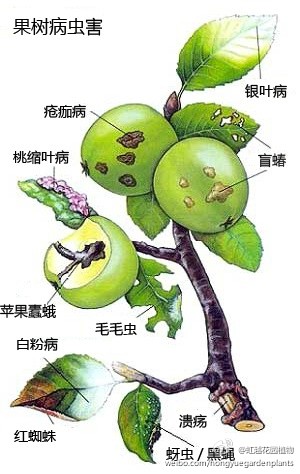
Complete Illustrated Guide to Flower Pests and Diseases: Quickly Identify Disease and Pest Symptoms
Pest and disease illustrations are always somewhat scattered. The few images below bring together illustrations of several dozen common flower pests and diseases, plus illustrations of fruit tree pests and diseases, rose pests and diseases, and tree pests and diseases.
条件筛选