Complete Illustrated Guide to Flower Pests and Diseases: Quickly Identify Disease and Pest Symptoms
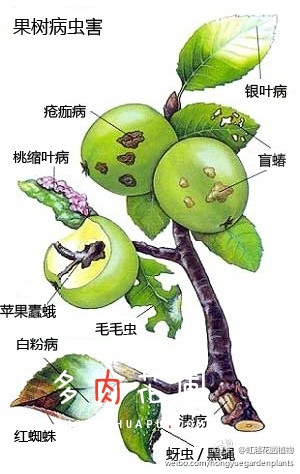
Pest and disease illustrations are always somewhat scattered. The few images below bring together illustrations of several dozen common flower pests and diseases, plus illustrations of fruit tree pests and diseases, rose pests and diseases, and tree pests and diseases. Well worth saving for flower lovers!
Introduction to Common Pests and Diseases of Geranium (Illustrated Guide)
Geranium, also known as zonal geranium, fish geranium, horseshoe geranium, and pelargonium, belongs to the Geraniaceae family and includes about 230 species of perennial succulent, subshrub, or shrub plants. Geranium prefers warm winters and cool summers. Indoors in winter, maintaining 10-15°C during the day and above 8°C at night allows it to bloom normally. However, the optimum temperature is 15-20°C. Geranium likes dryness and dislikes dampness, so watering should not be excessive in winter; water only when the soil is dry. Wet soil makes the stems soft and tender, which is unfavorable for the sprouting and opening of flower stems; prolonged excessive moisture causes leggy growth, the flower stem attachment point moves upward, and leaves gradually yellow and drop. Geranium needs ample sunlight during its growing period, so in winter it must be placed in a sunny spot. Insufficient light leads to leggy stems and leaves, thin and weak peduncles, and poor inflorescence development; flower buds under weak light often fail to open properly and wither prematurely. Geranium does not like heavy fertilization; too much fertilizer makes geranium grow excessively and hinders flowering.
Young geranium plants are succulent herbs, while older plants become semi-woody; in the West it is an excellent flower for decorating windowsills, and on the European continent, such as in Germany and Austria, it is especially common. If care is not taken during geranium maintenance, a series of pests and diseases can appear. Below is a detailed introduction.
Geranium pests and diseases fall mainly into two major categories. As the name suggests, pests and diseases means diseases and insect pests. In daily care, these situations basically all occur, and different treatment plans are adopted depending on the scale and degree of impact. Most are home garden plantings, so varieties are mixed. The probability of pests and diseases appearing is basically alternating infection! For example, common roses and geraniums are planted together, and with limited space, it is impossible to plant them separately in dedicated areas.
Common rose pests can spread to geraniums, such as aphids and red spider mites. These two are common pests. Aphids are easy to manage, while red spider mites are almost a persistent problem for most people. Therefore, for these pests and diseases that commonly occur in daily care, early prevention should be carried out, and when a small number appear, timely targeted treatment should be applied.
1. Geranium fungal leaf spot disease
Fungal leaf spot diseases of geranium mainly include black spot and brown spot. Black spot occurs mainly on the lower old leaves of the plant. Initially, small water-soaked spots appear, gradually expanding into necrotic spots. The lesions have concentric rings and bear a small amount of black mold. In severe cases, the lesions merge, and the leaves shrivel, turn black, and die. On leaves affected by brown spot, pinpoint yellow spots first appear, gradually developing into brown round spots. On the upper leaf surface, the lesion edges are slightly raised, while the corresponding area on the underside is slightly sunken. Severely affected leaves turn yellow and drop easily, and pale black mold appears on both sides.
1.1 Disease pattern: Black spot is caused by Alternaria fungi, and brown spot is caused by Cercospora geranii. Both pathogens belong to the Deuteromycotina. Under warm, shaded, and humid conditions, the disease is more severe.
1.2 Control methods: Strictly control watering frequency and amount, ventilate in a timely manner to reduce humidity, and improve light conditions. Promptly remove diseased leaves, clear diseased debris, and burn it in a centralized manner. Spray early with 50% carbendazim wettable powder at 1000 times dilution, or 75% chlorothalonil wettable powder at 800 times dilution, or 70% thiophanate-methyl wettable powder at 800-1000 times dilution, or 80% zineb wettable powder at 500 times dilution, or Bordeaux mixture at 1:1:100.
2. Geranium gray mold
It mainly causes flower blight, leaf spots, and cutting rot. When flowers are affected, the small central flowers are infected first, and the flowers wilt and drop prematurely. In wet weather, a gray mold layer grows on the diseased parts, and the rotting small flowers stick together. Irregular water-soaked brown spots appear on the leaves, which become soft and rot and grow a gray mold layer, later drying and shriveling. After the stems and petioles are affected, water-soaked brown spots with indistinct edges form, and rot occurs.
2.1 Disease pattern: Caused by Botrytis cinerea. It occurs more often in cool and humid environments. The most important trigger for this disease is frequent watering at low temperatures.
2.2 Control methods: Potting soil that has been used to grow infected flowers must be replaced or disinfected before use. Promptly remove diseased flowers and leaves, pull out severely diseased plants, and destroy them in a centralized manner to avoid spreading the infection. Apply sufficient base fertilizer when planting, appropriately increase phosphorus and potassium fertilizers, and control the amount of nitrogen fertilizer. Avoid watering on cloudy days and at night; it is best to water in the morning on sunny days, and ventilate after watering to reduce humidity. Do not water too much at one time, and try not to pour water on the leaf surface. In the early stage of the disease, foliar sprays may use 50% procymidone wettable powder at 2000 times dilution, or 50% iprodione wettable powder at 1500 times dilution, or 70% thiophanate-methyl wettable powder at 800-1000 times dilution, or 50% carbendazim wettable powder at 1000 times dilution, or 50% vinclozolin wettable powder at 1500 times dilution, or 65% metalaxyl wettable powder at 1500 times dilution. Spray once every two weeks, for 3-4 consecutive sprays. If conditions permit, 10% lüdi emulsifiable concentrate at 300-500 times dilution or 15% lüdi wettable powder at 500-700 times dilution may be used.
3. Geranium rust disease
On geraniums attacked by rust disease, reddish-brown blister spots appear on the leaves, petioles, and stems. In severe cases, the leaves lose their green color and drop.
3.1 Disease pattern: The pathogen is a species of Puccinia. The fungus survives as urediniospores attached to diseased parts and can survive for 6 months, infecting and causing disease when conditions are suitable.
3.2 Control methods: When the disease occurs, promptly remove diseased leaves, or even pull out diseased plants, and burn them thoroughly. In the early stage of the disease, promptly spray 15% triadimefon wettable powder at 1000 times dilution, or 40% oxadixyl wettable powder at 4000 times dilution, or 80% zineb wettable powder at 500-700 times dilution, or 30% triflumizole wettable powder at 2000 times dilution, or 20% carboxin emulsifiable concentrate at 500 times dilution, or 25% propiconazole emulsifiable concentrate at 3000 times dilution, or 40% flusilazole emulsifiable concentrate at 9000-10000 times dilution. Spray once every 10-15 days, for 3-4 consecutive sprays.
4. Geranium sclerotinia disease
This disease mainly occurs at the stem base of geranium. At the beginning of the disease, the lesions are light brown, water-soaked, and slightly sunken, then extend upward, and the diseased tissue rots. When humid, a white mold grows on the diseased part. In the later stage, the white mold inside the stem produces black, mouse-dropping-like sclerotia.
4.1 Disease pattern: The pathogen of geranium sclerotinia disease is Sclerotinia sclerotiorum. A temperature of around 20°C and relative humidity above 85% favor the growth and development of the pathogen. The pathogen overwinters as sclerotia in diseased tissue and soil. When conditions are suitable, the sclerotia germinate, and ascospores spread through wind and rain, and can also spread through mycelial growth. Heavy, sticky, and wet soil, excessive nitrogen fertilizer, overly dense plants, low temperatures, and excessive humidity can all aggravate the occurrence of the disease.
4.2 Control methods: Flower pots should not be placed too densely, in order to improve ventilation and light between plants. Strengthen fertilizer and water management, apply more fully decomposed organic fertilizer, increase phosphorus and potassium fertilizers, and do not apply excessive nitrogen fertilizer, so as to improve the disease resistance of the plants.
Before and in the early stage of the disease, apply plant ash and slaked lime mixed evenly at 4:1 and spread it on the soil surface at the middle and lower parts of the plants and at the stem base. In the early stage of the disease, spray as early as possible for control. The agents may be 40% carbendazim-sulfur suspension at 600-700 times dilution, or 70% thiophanate-methyl wettable powder at 500-600 times dilution, or 50% mixed sulfur suspension at 600 times dilution, or 40% dimethachlon wettable powder at 500 times dilution, or 50% benomyl wettable powder at 1500 times dilution, or 50% iprodione wettable powder at 1000-1500 times dilution.
5. Geranium bacterial leaf spot disease (different from the first fungal leaf spot disease)
Also called geranium bacterial blight, it mainly harms leaves, and also infects stems and branches. After leaves are infected, initially there are water-soaked brown small spots, which later expand into dark brown round or irregular lesions. In severe cases, the lesions merge into patches, and the leaves necrose and dry up. After stems and branches are affected, the vascular bundles turn brown or black, the stems and branches blacken and shrink, showing dry rot, the leaves on the stems wither and drop, and the dead spots are polygonal.
5.1 Disease pattern
This disease is caused by a species of Xanthomonas. Bacteria can spread through contact between cuttings, splashing water droplets, and the movement of insects. Plants cultivated too densely and those growing leggy are prone to the disease. High temperature and humidity and improper fertilization also favor the disease. Old leaves at the lower part of the plant are severely affected. Different varieties vary greatly in resistance to this disease. Pelargonium grandiflorum is highly resistant, while Pelargonium peltatum is highly susceptible.
5.2 Control methods
Flower pots can be soaked in 10% bleaching powder solution for 10-30 minutes; the soaking solution must be freshly prepared and used immediately, or 40% formalin can be mixed with water to make a 2% solution and used to soak flower pots for 10 minutes. Remove all diseased leaves and diseased branches, and plants must not be too dense. Temperature and humidity must be well controlled. The watering method and time should be reasonable; do not spray water directly onto the plants, so as to avoid spreading disease through splashing droplets. In the early stage of the disease, promptly spray 50% copper bis(dihydrogen phosphate) (DT) wettable powder at 500 times dilution; this product cannot be mixed with other products. Or 60% DTM wettable powder at 500 times dilution, or 77% copper hydroxide wettable powder at 400 times dilution, or 70% chlorothalonil wettable powder at 500-600 times dilution, or 72% streptomycin sulfate at 4000 times dilution, or zhixinmycin at 4000 times dilution, for foliar spraying, applying once every 7-10 days, for 3-4 consecutive sprays.
6. Geranium crown gall disease
Also called crown gall, it mainly occurs at the root crown of geranium, and some also occur on the stem and at branch points. In the early stage of infection, small tumor-like growths can be seen, which then gradually enlarge and harden, with a cracked and rough surface, grayish-white to flesh-colored, and varying in size. The tumor surface often grows many hair-like structures. Affected plants are stunted, the leaves produced are small and often chlorotic, flowering is reduced, the flowering period is short, and in severe cases it causes leaf drop and branch drying, or even death of the whole plant. This disease is caused by Agrobacterium tumefaciens. The pathogen survives on the surface of the tumors and in the soil, spreads via rainwater and irrigation water, and invades through wounds. The root crown area at the soil surface is easily infected. Continuous cropping and wounds at the root crown make the disease severe.
6.1 Control methods:
When the bacterial carrying rate of seedlings is high or diseased plants are found, soak the stem base of the seedlings in 1% copper sulfate for 5 minutes, then soak in 2% limewater for 1 minute. In the early stage of the disease, cut out the tumor with a knife, then apply lime-sulfur mixture or Bordeaux mixture at 1:1:100, 25% bismerthiazol at 400-500 times dilution, or 90% streptomycin at 2000-3000 times dilution to the wound. In addition, injecting penicillin and streptomycin is also very effective.
7. Geranium edema disease
Edema is a physiological disorder and occurs mostly in trailing series varieties. When the plant absorbs a large amount of water and cannot evaporate it promptly through the leaf surface, this symptom appears. At first, the symptom appears on the underside of the leaves, in the form of blisters. When the plant is stressed by water, light, pH, and other environmental conditions, the blisters burst. The symptoms are similar to those of damage caused by spider mites. During growth, the following operations can relatively effectively control the occurrence of this disease: ensure the plant does not lack water or dry out, especially when the ambient temperature is relatively high; in January and February, do not over-irrigate the plants; try not to use flower pot saucers; ensure sufficient air circulation; keep relative humidity below 75%; when humidity is high, apply heating and ventilation; provide shading to avoid sudden strong light exposure; keep pH between 5.6 and 5.7, with no iron deficiency in the substrate; choose early morning for irrigation; and regularly supplement calcium nitrate fertilizer.
Pests
1. Black-spotted silver Y moth
Larva: mature larva body length 32 mm. Head brown, with black spots on both cheeks; trunk yellow-green, with 8 pale longitudinal stripes on the back, spiracular line pale yellow; 3 pairs of thoracic legs, black; 2 pairs of prolegs; 1 pair of anal legs, yellow-green.
Adult: about 17 mm, wingspan 34 mm, dark brown, with brown hair patches on the metathorax and the backs of abdominal segments 1 and 3. The center of the forewing has conspicuous silver spots and a U-shaped silver mark; the hindwing is light brown, with a dark brown outer margin. Eggs hemispherical, yellow-green, with a surface network of longitudinal and transverse ridges.
Control methods
1.1 During the adult occurrence period, use blacklight lamps and similar methods to trap adults.
1.2 Spray 90% methomyl water-soluble concentrate at 4500 times dilution, or 75% methomyl at 4000 times dilution, 10% imidacloprid wettable powder at 2500 times dilution, 5% chlorfluazuron emulsifiable concentrate at 3000 times dilution, or 5.7% bifenthrin emulsifiable concentrate at 3000 times dilution.
2. Whitefly
It has piercing-sucking mouthparts. Adults and nymphs suck plant sap, causing affected leaves to lose green color, turn yellow, wilt, and even the whole plant to die. In addition, because of its strong reproductive capacity, fast reproduction speed, and huge population, it causes damage in groups and secretes large amounts of honeydew, seriously contaminating leaves and plants. Morphological characteristics: Adult body length about 0.9-1.4 mm, pale yellow-white or white, both males and females winged, the whole body covered with white waxy powder; females are larger than males, and their ovipositor is needle-shaped. Eggs long oval, about 0.2-0.25 mm long, pale yellow when first laid, later turning dark brown, with an egg stalk, laid on the underside of leaves. Larvae (or nymphs) oval, flat, pale yellow or dark green, with waxy filamentous protrusions of uneven length on the body surface. Pupa oval, about 0.7-0.8 mm long, slightly raised in the middle, yellow-brown, with 5-8 pairs of waxy filaments of uneven length on the back.
Control measures
2.1 Chemical control can be used, with agents such as 600-800 times jishijing, jijiaoshi 1+1, acetamiprid, 0.30% (matrine), thiamethoxam, nitenpyram, fenvalerate emulsifiable concentrate, cypermethrin zinc emulsifiable concentrate, fenpropathrin, cyhalothrin, or bifenthrin, etc.
3. Aphids
Plants infested by aphids show many different symptoms, such as reduced growth rate, leaf spots, yellowing, poor development, leaf curling, reduced yield, wilting, and death. Aphids' extraction of sap causes plants to lack vigor, and aphid saliva is also toxic to plants.
Control measures
Use imidacloprid series products according to the instructions; control is relatively easy.
Summary: The above is the relevant knowledge about geranium pests and diseases. We hope it is helpful to everyone.