Detailed Guide to Planting Methods and Care Techniques for Variegated Star Jasmine
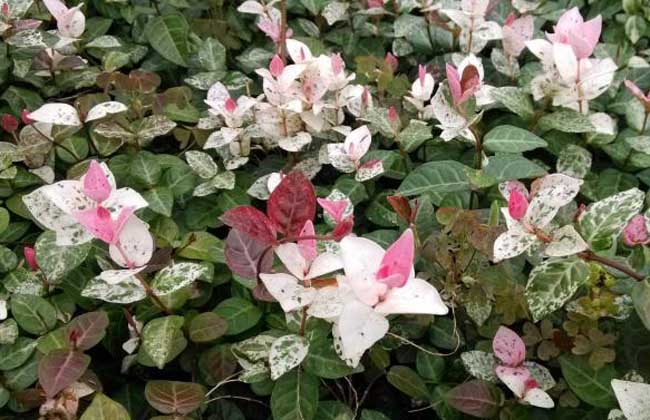
It is a light-loving, strongly shade-tolerant plant that prefers environments with high air humidity, and can be used as a year-round "flowering" plant for various flower border arrangements; it is also an excellent potted plant material.
Cultivation Methods:
1. Fertilizer: Variegated star jasmine likes fertilizer but is not demanding; various fertilizers can be used, and it can still bloom without fertilization for a year, though with fewer flowers. To make a potted variegated star jasmine bloom abundantly, apply more bone meal and phosphorus-potassium fertilizer, and use less nitrogen fertilizer. For plants grown in the ground, apply a nitrogen-phosphorus-potassium compound fertilizer once each in spring and autumn; do not fertilize in winter and summer.
2. Watering: Variegated star jasmine likes moisture; during the growing season the potting soil should be kept slightly moist. In spring and autumn, water once every two days; in summer, water once a day; in winter, water about once every half month, keeping the potting soil slightly moist but not dry; at no time should water accumulate. For potted variegated star jasmine placed on rooftop gardens or courtyards, pay attention to draining accumulated water during the rainy season. Ground-planted star jasmine should not be planted in low-lying areas, otherwise the roots are prone to rot. During the growing season, it is fine to water again once the soil is dry; for ground-planted plants in winter, watering may be omitted.
3. Pruning: Variegated star jasmine tolerates pruning and stays evergreen all year round; it can also be combined with golden privet and red-leaf barberry for color-band and color-block landscaping. By pruning to control vine length, branching can be promoted, which helps produce a full plant shape. For the first pruning, when the vine reaches 8 cm, leave about 6 cm and cut off the rest; afterward prune every 4-5 cm of growth; usually 2-3 prunings are enough for a good pot shape.
4. Light: Variegated star jasmine is a temperate-zone flower that likes warmth and light. For ground planting, it should be planted in a sunny spot; in shady places it grows poorly, with fewer flowers and weaker fragrance, or even no flowers. For potted plants, place them in full sunlight in spring, autumn and winter; in midsummer, if placed in a semi-shaded spot that receives sun in the morning or evening and avoids direct strong light at noon, it will bloom continuously. If it is too sunny at noon, flowers will be sparse or even absent. Star jasmine is relatively cold-tolerant; in the Yellow River basin and areas to its south, it can overwinter safely outdoors, while in the north it is better to move it into a low-temperature greenhouse for the winter.
5. Pests and diseases: The main diseases of variegated star jasmine include anthracnose and leaf spot, which can be controlled with a 600-800 times dilution of 50% thiophanate-methyl or an 800-1000 times dilution of 70% mancozeb wettable powder. For damage by red spider mites and other mites, and moth larvae, use a 1000-1500 times dilution of 15% pyridaben. For aphids, use a 1500 times dilution of 25% imidacloprid wettable powder or a 2000-3000 times dilution of 48% chlorpyrifos emulsifiable concentrate.
Landscape Applications of Variegated Star Jasmine
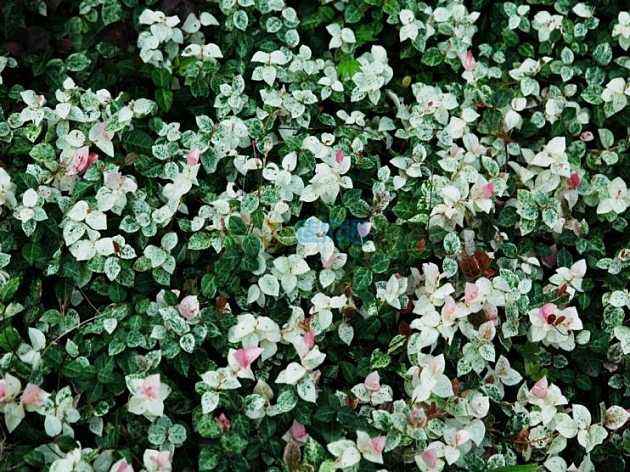
The ornamental value of variegated star jasmine mainly lies in the color-leaf clusters formed by three levels of leaf color, namely red - pink or pink with green dots, pure white or white with green dots - green leaves, resembling clusters of blooming flowers, colorful and brilliantly varied.
Variegated star jasmine can also be used as a year-round foliage plant for flower border arrangements, and can also replace flowerbed flowers and potted flowers for landscaping, to overcome the shortcomings of potted flowers such as short flowering periods, the need for frequent replacement, and high costs. In addition, variegated star jasmine is also an excellent household potted plant; because it is shade-tolerant, it can be cultivated indoors in all regions.