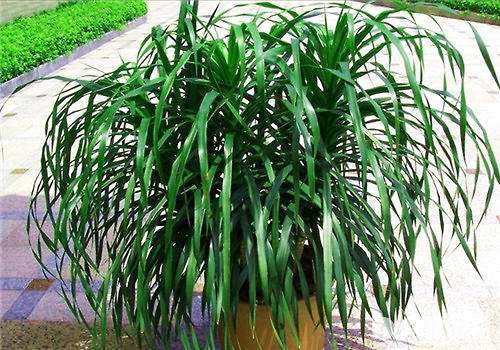
Dracaena fragrans belongs to the Asparagaceae family and the Dracaena genus; it is an evergreen tree-like or shrub-like plant, reaching a height of over 6 m, with a thick stem and grayish-brown or light brown bark, and broad leaves. The leaves are clustered at the top of the stem, long elliptic-lanceolate, and stalkless; the spike inflorescence bears small, yellow-green, fragrant flowers. This species prefers high temperatures, high humidity, and a well-ventilated environment; it likes light but also tolerates shade, fears intense sunlight, and dislikes dryness and drought; it prefers loose, well-drained sandy loam.
Propagation Methods
Cutting propagation is commonly used. From May to June, use mature and firm stems, cut them into 5 to 10 cm sections, place them on a sand bed, maintain a room temperature of 25-30°C and 80% air humidity; they root in about 30 to 40 days, and after 50 days the plants can be potted directly.
Stems with 3 to 4 leaves can also be cut into sections and inserted into a sand bed, maintaining high temperature and humidity; they root 30 days after insertion. It can also be propagated by water and air layering, but this must be done at 25°C or higher.
Cultivation Management
Before planting, sterilization and pest control are essential. Repot and change the soil once every spring. Place it in an environment of 18-25°C. In spring, autumn, and winter, it should receive plenty of sunlight; in summer, it should be shaded or placed in a well-ventilated indoor spot. During the growing season, apply a nitrogen-phosphorus-potassium compound fertilizer once every half month or water with a dilute organic liquid fertilizer. Variegated cultivars should avoid fertilizers with too high a nitrogen content. If the color of the leaf variegation fades during cultivation, this is often caused by excessive shading at the cultivation site or excessive application of nitrogen fertilizer. During the growing season, water thoroughly; if the potting soil is too dry, growth will be poor, especially in the vigorously growing summer, when water must not be lacking. The water quality should be clean to prevent trunk rot. However, the soil must not be kept overly wet for long periods. When watering and fertilizing, be careful not to get them into the leaf rosette.
For household potted plants, water alternately between dry and wet, and appropriately reduce watering when the temperature is low. In dry seasons, spray water on the leaves frequently to keep them moist and prevent the leaf tips from drying out and curling. When caring for it indoors, pay attention to ventilation and frequently sprinkle water around the environment to increase humidity; if the humidity is too low, the leaves easily lose their luster and become dull and lifeless. If there is little scattered indoor light, move it every 7-10 days to a place with ample light for 3-4 days and then move it back; for variegated cultivars, pay even more attention to sufficient light and avoid an excessively high proportion of nitrogen fertilizer when fertilizing, otherwise the variegation easily fades.
To keep the leaves upright and vigorous, during the growing season you may spray the leaves with a 0.1%-0.5% solution of potassium dihydrogen phosphate. After autumn begins, watering should be controlled. In winter, place it in a sunny indoor spot and maintain the temperature at 5-10°C.