Detailed Explanation of Mulberry Planting Methods and Technical Key Points
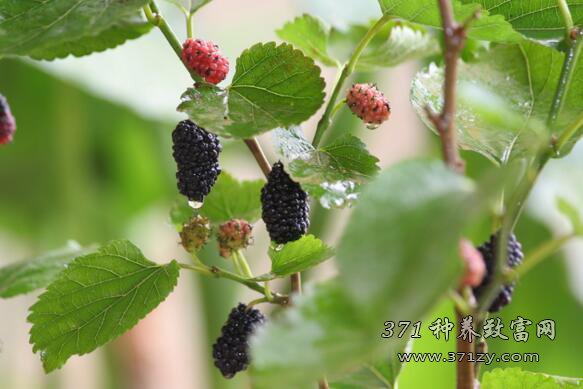
Mulberry belongs to the Moraceae family, genus Morus, and is a deciduous tree or shrub, reaching a height of up to 15 m. The tree is rich in milky sap, and the bark is yellowish-brown. The leaves are ovate to broadly ovate, with pointed tips and rounded or slightly heart-shaped bases, with coarse serrated edges, sometimes with irregular lobes. The upper leaf surface is hairless and glossy, while the veins on the underside bear sparse hairs. It is dioecious, flowering in May with catkins. The fruit ripens from June to July; the syncarp is ovate or cylindrical, dark purple or white. It is light-loving, tolerating slight shade when young. It prefers a warm, humid climate and is cold-tolerant. It is drought-tolerant and highly tolerant of waterlogging.
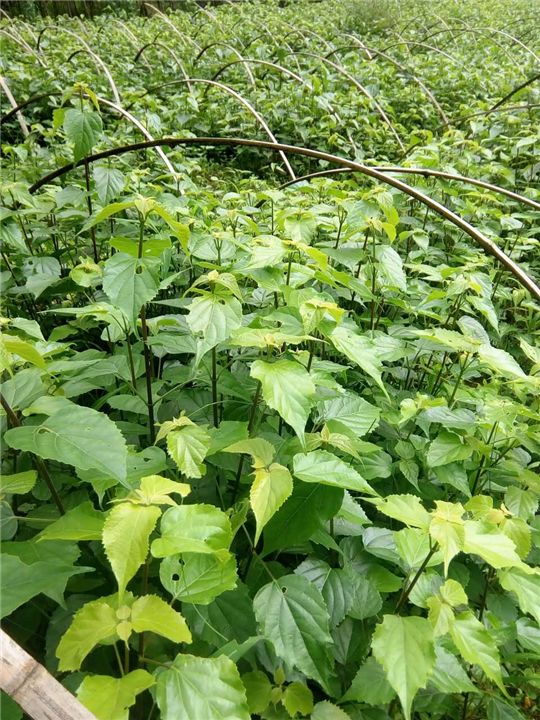
1. Sowing method
Selecting and preparing the seedling site well is the first hurdle. It is advisable to choose fertile, loose sandy loam with convenient drainage as the nursery. 4-6 days before sowing, it is best to spray a herbicide over the entire area; for each mu of land, 2-3 jin of chlordane powder pesticide may also be spread, then the soil should be raked lengthwise and crosswise. Depending on drainage conditions, beds are generally made 4 cun high and 4 chi wide, and the bed surface should preferably be fine, crumbly and level.
Mulberry seeds should be sown as soon as possible after purchase. Mix each portion of seed with five portions of fine soil (if no pesticide was spread on the land, pesticide should also be mixed in). Divide by bed in jin; the thickness should be such that the bed soil is faintly visible. After covering, carry out the first watering immediately. If conditions permit, germination can be promoted before sowing: soak the mulberry seeds in clean water for 24 hours, take them out and spread them in a shallow tray, with a thickness not exceeding 1 cun, cover with a wet cloth, and place in a relatively warm place (23-30°C) to promote germination. Sprinkle water and turn them once or twice a day, keeping them constantly moist. Sow after most of the mulberry seeds have sprouted white (that is, the young roots are exposed). Do not let the mulberry sprouts grow too long, so as to avoid damage during sowing.
After sowing, moisture is the lifeline, especially for germinated seeds. Within the first half month after sowing, water every morning and evening to keep the soil surface constantly moist. Post-sowing management is the key to full and strong seedlings. When the mulberry seedlings are about 1 cun tall, remove the overcrowded ones, with a plant spacing of 1 cun. When the seedlings are 2-3 cun, use the thinned seedlings to fill gaps, with a plant spacing of 1-1.5 cun. Thinning and filling in seedlings is best done after rain or after watering, ensuring about 80,000 to 150,000 seedlings per mu. As the mulberry seedlings grow, remove the grass cover as appropriate.
2. Grafting for seedling propagation
Generally, seedlings grown from seeds of local mulberry varieties are used as rootstock, and branches of excellent mulberry varieties with high yield and good leaf quality are used as scions. Check whether they have survived 10 to 15 days after grafting; those that have not survived need to be regrafted. Also pay attention to disease and pest prevention, remove rootstock sprouts, and water and fertilize in time to promote new shoot growth.
3. Cutting propagation
Hardwood cutting uses new shoots cut during spring pruning as cuttings, inserted in early April. Greenwood cutting uses new shoots cut during summer pruning as cuttings, inserted in late May. Before cutting, cut the branches into 16-20 cm lengths. The upper cut of each branch should be a cross-section, with a plump bud 1 cm from the cut. The lower cut should be close to the leaf scar and cut into a smooth slant. Then store them in sand indoors for 15-20 days. The specific method is: bundle the sand-stored branches into a bundle, soak them in a 50 ppm ABT rooting powder solution for 35 hours, then bury them upside down in an open-air rooting bed made of fine sand, cover with 15 cm of sand, and then cover with nylon film. After a few days, take out the branches and plant them in the seedling bed, without exposing the buds after planting.
Daily management methods
1. Water
Meeting the mulberry tree's water requirements is an important measure for increasing yield and improving leaf quality. Water management in the mulberry field must grasp two points well:
(1) Prevent waterlogging. After waterlogging in a mulberry field, the soil lacks air, root respiration becomes difficult, affecting the roots' absorption of nutrients, photosynthetic products decrease, and mulberry leaves wilt, turn yellow and drop; at the same time, toxic substances are produced and the mulberry roots rot. Therefore, drainage and irrigation ditches should be properly opened in the mulberry field to lower the groundwater level and prevent waterlogging.
(2) Ensure the mulberry tree's water supply during the bud break and leaf-opening stage and the summer-autumn stage. These two periods have high water demand; if water is lacking, mulberry growth will be affected and leaf quality will be reduced. During these two periods, running water can be let through the drainage and irrigation ditches to meet the mulberry tree's water requirements.
2. Fertilization methods
We can carry out fertilization work according to the fertilization principle of "apply heavy fertilizer for the first three crops, apply heavy spring bud fertilizer, and apply both fertilizer and water for the last three crops," and fertilize for each mulberry crop. In the fertilization measures of "apply heavy fertilizer for the first three crops, apply heavy spring bud fertilizer, and apply both fertilizer and water for the last three crops," the amount applied for the first three crops should account for 70% of the total. The specific fertilization methods are as follows:
(1) Winter fertilizer: Winter fertilizer is the basic fertilizer for the mulberry field, applied in furrows during the mulberry tree's dormant period. Its main role is to improve the soil and raise soil fertility. Winter fertilizer is mainly composed of decomposed livestock manure and miscellaneous organic fertilizer.
(2) Spring fertilizer: In spring, the mulberry tree sprouts and its branches and leaves grow, requiring large amounts of nutrients. Therefore, when new shoots grow to 5-10 cm, apply quick-acting fertilizer heavily in time, with 200 jin of compound fertilizer + 100 jin of urea + 50 jin of bran fertilizer per mu.
(3) Fertilization for each mulberry crop: For the 2nd-3rd crops, apply 200 jin of compound fertilizer + 50 jin of urea per mu; for the 4th-6th crops, apply 200 jin of compound fertilizer per mu.
3. Intertillage and weeding in the mulberry field
Intertillage and weeding in the mulberry field are carried out four times a year, in spring, summer, autumn and winter, with winter and summer being more important. Generally, intertillage and weeding are combined with fertilization. Winter plowing is the foundation for high mulberry yields the following year, requiring a winter plowing depth of 15-20 cm; the spring, summer and autumn plowing depth should preferably be 5-10 cm.