Introduction to the New Taiwan Peanut Variety Tainan No. 12 and the Characteristics and Disease Resistance of Tainan No. 11
Currently, the variety with the largest peanut planting area is "Tainan No. 11". This is not the new rice variety Tainan No. 11, but "Tainan No. 11", which was bred and promoted by the Tainan Station in the 75th year of the Republic of China. It has characteristics such as high yield, large pods and seeds, and being relatively easy to harvest manually. In addition
Currently, the variety with the largest peanut planting area is "Tainan No. 11". This is not the new rice variety Tainan No. 11, but "Tainan No. 11", which was bred and promoted by the Tainan Station in the 75th year of the Republic of China. It has characteristics such as high yield, large pods and seeds, and being relatively easy to harvest manually. In addition, "Tainan Selection No. 9", bred and promoted by the Tainan Station in the 55th year of the Republic of China, has a roasted in-shell processed product whose flavor is superior to "Tainan No. 11", and it is still well received by the consumer market. However, "Tainan Selection No. 9" has lower yield, its pods are not concentrated in their bearing position, and its pegs are relatively tough, so manual harvesting requires more labor hours, resulting in higher production costs per unit of product. Although peanut processing operators are willing to purchase "Tainan Selection No. 9" at a higher price. Using pods as raw material, but under the current situation of labor shortage in rural areas, farmers are not highly willing to grow peanut varieties that have low yield and are not easy to harvest.
To take into account both the needs of the consumer market and farmers, the Tainan Station bred the new peanut variety "Tainan No. 12" in December of the 82nd year of the Republic of China. Compared with the varieties currently widely planted by farmers, "Tainan No. 12", in addition to having higher yield, should also inherit the good processing characteristics of "Tainan Selection No. 9" because both of its parents have the genetic background of "Tainan Selection No. 9". The breeding process, main agronomic traits, and matters needing attention in cultivation of "Tainan No. 12" are described as follows:
1. Tainan No. 12 was bred by selecting suitable parents and using the hybridization breeding method. The female parent, Nan Gai Xi No. 128, was selected from the hybrid progeny of "Tainan Selection No. 9" and the American large-seeded variety "Florigiant". The male parent was 75(2)-3-21, selected from the hybrid progeny of 74(4)-1-(F3) and "Tainan Selection No. 9". Artificial hybridization was carried out in the spring crop of the 72nd year of the Republic of China. From the autumn crop of the 72nd year of the Republic of China to the autumn crop of the 74th year of the Republic of China, the bulk method was used for segregation and cultivation of hybrid progeny. From the spring crop of the 75th year of the Republic of China to the autumn crop of the 78th year of the Republic of China, line tests were conducted. From the spring crop of the 79th year of the Republic of China to the autumn crop of the 80th year of the Republic of China, regional tests were conducted at ten locations across the province.
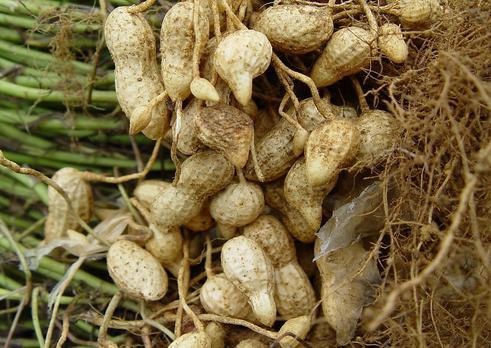
2. "Tainan No. 12" has the characteristic of high and stable yield. According to the results of two-year regional tests at ten test sites across the province, the average pod yield per hectare was 2,905 kg in the spring crop and 2,485 kg in the autumn crop, increasing yield by 7.3 and 7.4% respectively compared with the variety currently mainly planted by farmers, "Tainan No. 11"; and by 11.8 and 14.5% respectively compared with "Tainan Selection No. 9". The 100-pod weight of "Tainan No. 12" is about 127-140 grams, and the 1,000-seed weight is about 530-597 grams, both lower than "Tainan No. 11", but higher than "Tainan Selection No. 9". In addition, "Tainan No. 12" also has characteristics such as a higher shelling rate, better resistance to leaf spot disease and rust, upright plants with a height suitable for mechanical harvesting, seeds without dormancy, and pegs that are not easily separated from the pods.
3. The cultivation method of "Tainan No. 12" is similar to that of varieties such as "Tainan No. 11" and "Tainan Selection No. 9". Although peanuts can be planted in the spring crop or autumn crop in the Taiwan region, the stability of pod and seed yield of "Tainan No. 12" is higher in the autumn crop than in the spring crop, so "Tainan No. 12" is more suitable for autumn crop planting in the Yunlin and Changhua areas. Although "Tainan No. 12" suffers from leaf spot disease and rust slightly less than "Tainan No. 11", if pests and diseases occur during the growth period, control work still needs to be carried out according to the recommended pesticides and control methods in the "Plant Protection Manual" compiled and printed by the Department of Agriculture and Forestry that year; during the growth period, 1-3 irrigations should be carried out depending on the soil moisture content to maintain appropriate soil moisture and ensure its high-yield potential and excellent quality. The seeds of Tainan No. 12 do not have dormancy, so if continuous rainfall occurs during the harvest period, attention should be paid to drainage; otherwise, the seeds inside the pods are likely to germinate, reducing quality.
In order to promote the new peanut variety "Tainan No. 12" to farmers for planting, the Tainan Station, with funding subsidies from the Council of Agriculture, Executive Yuan, and the Department of Agriculture and Forestry of the Taiwan Provincial Government, began seed propagation in the spring crop of the 83rd year of the Republic of China, and selected Huwei Township, Yuanchang Township, and Lunbei Township in Yunlin County to carry out 1.2 hectares of foundation seed propagation work. It is estimated that more seeds can be produced and provided to farmers for planting in the autumn crop of the 83rd year.