Variety Characteristics and Cultivation Points of the New Japanese Peanut Variety Chiba P114
Do you know which peanut varieties there are? The peanut cultivation method is relatively simple, and they are generally grown. Do you know about Japanese peanut varieties? Let's take a look at the Chiba P114 variety! This variety is a new variety registered in 2015 and is planned to go on full sale from 2020.
Do you know which peanut varieties there are? The peanut cultivation method is relatively simple, and they are generally grown. Do you know about Japanese peanut varieties? Let's take a look at the “Chiba P114” variety! This variety is a new variety registered in 2015 and is planned to go on full sale from 2020. Here, we will introduce the variety characteristics and cultivation points of “Chiba P114”.
1. Main Characteristics
(1) The sucrose content of the kernels is higher than that of “Nacate Yutaka”, it has a sweet taste, and the flavor when roasted is excellent.
(2) The late-stage maturity trait is “slightly early”, and the optimal harvest time is roughly the same as that of “Nacate Yutaka”.
(3) The plant type is “determinate”, and the branch length is longer than that of “Nacate Yutaka”.
(4) The appearance quality of the vines is beautiful, and the yield is as high as that of “Nacate Yutaka”.
(5) The incidence of sprouting browning disease is low, and the seed emergence rate is high.
Cultivation History
(1) Fertilize according to established practice standards.
The application rate is the same as for “Nakaute Yutaka”. Nitrogen, phosphoric acid and potassium are 3 kg, 12 kg and 12 kg respectively, per 10 are. Lime is slaked lime, with a standard of 60 kg per 10 are.
(2) The planting method is 2-row planting with 30 cm between populations, assuming single-seed planting.
The 9230 mulch (width 95 cm, 2 rows, 45 cm between rows, 30 cm between plants) is most suitable. If the space between plants becomes narrower, the plants may become awkward and the workability at harvest may deteriorate.
Seeding is based on single-seed sowing. Having two plants per hill makes the plants grow poorly.
(3) The appropriate period is from mid-May to mid-June.
Seeds sown before mid-May tend to have a low sucrose content. We recommend using Kichigen R-2 floats as a measure against crows.
(4) Watering should be done about 20 days after the flowering period.
Irrigation 20 days after the flowering stage will increase the yield. If it continues to dry after the first watering, do it again one week later. Irrigation 40 days after the flowering period suppresses the occurrence of sprouting browning, but may reduce the sucrose content in the kernels. Therefore, in the case of seed cultivation, it is recommended to irrigate about 40 days after the flowering period, but in general cultivation, do not irrigate after 40 days after the flowering period so as not to reduce sucrose.
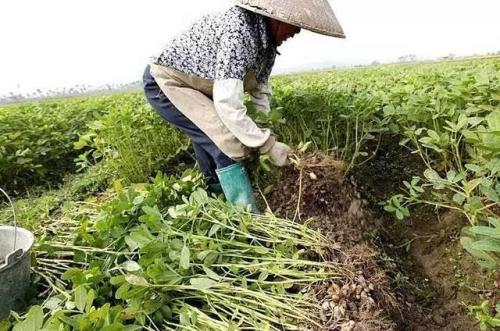
(5) The appropriate harvest period is about 80 days after the flowering period.
Beyond 85 days after the flowering period, over-ripening increases defective kernels, and depending on the year, the number of false drops increases. Let us be careful of delayed digging. Because the ripening speed differs depending on the year, trial digging is appropriately carried out about 70 days after the flowering period, and maturity is checked by observing the back of the husk according to the figure below, and harvesting is done at the appropriate maturity stage.