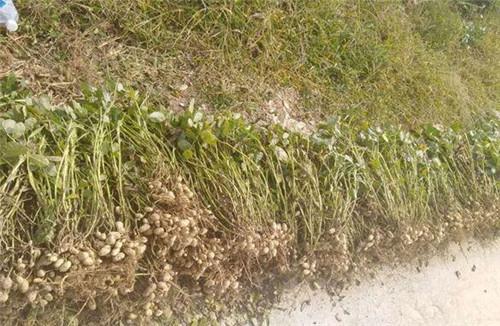
Wanhua No. 2 Peanut: Characteristics and Key Cultivation Techniques for a Yield of 2000 jin per mu
There are quite a few peanut varieties, peanut planting time and planting methods introduction; thisWanhua No. 2 peanut variety, if you are not familiar with it, then let us take a look together!
Variety name: Wanhua No. 2
Characteristics: It belongs to the erect, sparse-branching type, with a summer-sowing growth period of 112 days. The main stem is generally 40.0 cm tall, the lateral branches are 43.3 cm long, with 8.9 total branches, 7.1 bearing branches, and 12.8 filled pods per plant; the leaves are yellow-green, long-elliptical, and medium in size; the pods are cocoon-shaped, with a blunt, inconspicuous beak, fine and slightly deep reticulation, and shallow constriction, with a 100-pod weight of 160.8 g; the kernels are peach-shaped, with pink seed coats, a 100-kernel weight of 68.4 g, and a shelling percentage of 75.0%.
Disease resistance identification: Identified in 2009 and 2010 by the Institute of Plant Protection, Henan Academy of Agricultural Sciences: in 2009, resistant to net blotch (grade 2), susceptible to leaf spot (grade 7), moderately resistant to rust (grade 5), moderately resistant to virus disease (incidence rate 23%), susceptible to root rot (incidence rate 24%); in 2010, resistant to net blotch (grade 2), susceptible to leaf spot (grade 6), moderately resistant to virus disease (incidence rate 25%), susceptible to root rot (incidence rate 22%).
Quality analysis: Tested in 2009/2010 by the Ministry of Agriculture Agricultural Product Quality Supervision and Inspection Testing Center (Zhengzhou): protein content 26.99%/26.61%, crude fat content 48.65%/49.58%, oleic acid content 37.94%/40.8%, linoleic acid content 39.05%/37.2%, oleic/linoleic ratio (O/L) 0.97/1.1.
Yield performance: In the 2009 provincial regional trial of pearl-seed-coat-type peanut varieties, summarized from 9 sites, pods increased at 7 and decreased at 2, with an average pod yield of 298.7 kg per mu and kernel yield of 224.5 kg, respectively 5.8% and 6.5% higher than the control Yuhua No. 14, ranking 10th and 9th among the 12 tested varieties, and the pod increase over the control reached a significant level; in the 2010 continued trial, summarized from 7 sites, all pods increased, with an average pod yield of 302.2 kg per mu and kernel yield of 226.4 kg, respectively 14.4% and 13.7% higher than the control Yuhua No. 14, ranking 3rd and 1st among the 13 tested varieties, and the pod increase over the control reached an extremely significant level.
In the 2011 provincial production trial, summarized from 7 sites, all pods increased, with an average pod yield of 298.5 kg per mu and kernel yield of 226.9 kg, respectively 13.6% and 14.6% higher than the control Yuanza 9102, ranking 2nd and 1st among the 6 tested varieties.
Suitable areas: Spring and summer sowing cultivation throughout Henan.
Key cultivation techniques:
(1) Sowing time and density: mid-April to early June, not too early or too late; with plastic film mulching, sowing can be done around April 10. For spring sowing, 8000-10000 hills per mu; for summer sowing, 10000-12000 hills per mu, with two seeds per hill; sowing should not be too deep, with 3 cm being appropriate.
(2) Field management: Apply about 40 kg per mu of three-element peanut special fertilizer, or 30-40 kg of three-element compound fertilizer (15-15-15) plus 10 kg of potassium chloride. During the growth period, adopt the Fuda peanut package management of promoting early, controlling mid, and protecting late, pay attention to preventing and controlling diseases and insect pests, and achieve high and stable yield, high quality, and high efficiency.