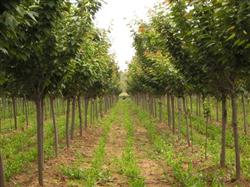
The difference between Chinese arborvitae and false cypress lies mainly in the form of the branches and leaves and in their growth habits
Ce Bai, or Chinese arborvitae (Platycladus orientalis), is also written with an alternative form of the character for bai. It and the false cypress are both evergreen trees of the cypress family, and they look somewhat similar in appearance, yet they do not belong to the same type of tree. The Chinese arborvitae is a plant of the genus Platycladus and a tree species native to China, widely cultivated in many places; the false cypress generally refers to ornamental tree species in the genus Chamaecyparis, most of which were introduced from Japan and are used fairly often in landscaping.
The most obvious difference between the two lies in the branches and leaves. The branchlets of the Chinese arborvitae are flat and upright, neatly arranged in a single plane, with tiny scale-like leaves that grow pressed close to the branches, giving the whole tree a compact and upright look; the branchlets of the false cypress are also flat, but mostly spread out horizontally or droop slightly, and the backs of the scale leaves have distinct white stomatal lines, so the foliage appears to have flecks of color and looks delicate and soft. The false cypress also has a fairly rich range of cultivars, with great variation in leaf color and plant shape, making it more outstanding ornamentally.
There are also differences in the cones and habits. The cones of the Chinese arborvitae mature in the same year, with the tips of the cone scales curving outward and backward, and the seeds usually have no wings; the cone scales of the false cypress are shield-shaped, and the seeds usually have narrow wings on both sides. As for habits, the Chinese arborvitae is tolerant of drought and poor, thin soil and can also withstand a certain degree of salinity and alkalinity, giving it strong adaptability; the false cypress, by contrast, prefers a cool and humid climate and has relatively higher requirements for soil moisture and fertility.
In terms of use, the two have different emphases. The Chinese arborvitae is long-lived and tolerant of pruning, and is commonly seen in barren-hill greening, hedges, street trees and bonsai making; the false cypress is valued for its ornamental qualities and is mostly planted as a specimen or in rows in courtyards and parks to accent the landscape. When identifying them, as long as you remember that the Chinese arborvitae has branches and leaves that stand upright in a plane, while the false cypress has branches and leaves that spread out horizontally and bear white stomatal lines, you can generally tell the two apart.
Related reading