Characteristics of the Nyctaginaceae Family and an Introduction to Common Ornamental Varieties
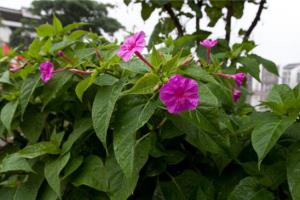
Nyctaginaceae is a family of angiosperms whose members are mostly herbaceous plants, shrubs, or vines, with a few small trees. They are mainly distributed in tropical and subtropical regions, with the greatest species richness in the Americas. The family name comes from its most common member, the four o'clock flower (Mirabilis jalapa), an herbaceous ornamental that often blooms in the evening.
The flowers of plants in this family are usually apetalous, with the perianth united into a funnel shape or a salverform shape, brightly colored and looking much like a corolla. In many species, the base of the inflorescence also has an involucre made up of bracts. The most typical example is the bougainvillea: the colorful part we admire is actually the bracts, while the small trumpet in the center is the true flower. The fruit is mostly achene-like and is often enclosed by the persistent perianth.
The most representative genera in the family are Mirabilis and Bougainvillea. Mirabilis jalapa, also known as the four o'clock flower or "bath flower," has flower colors ranging from red, pink, and yellow to white and more. It is highly adaptable, not demanding about soil, and easy to manage, making it suitable for courtyards and roadside planting. Bougainvillea, that is, paperflower, has brilliantly colored bracts and a long flowering period. In the south it is often used for hedges and trellis shaping, and it is also a very popular potted ornamental plant.
It should be noted that plants with "jasmine" in their name do not necessarily belong to Nyctaginaceae. When identifying them, it is best to make a comprehensive judgment based on flower structure and plant form. In addition, the thick fleshy root of Mirabilis jalapa is often mistakenly taken in folk practice as a tonic medicinal herb. It is not the same kind of plant as common tonic herbs, and consuming it blindly carries risks, so it should be treated with caution.