What plant is the four o'clock flower? Introduction to its herbaceous characteristics
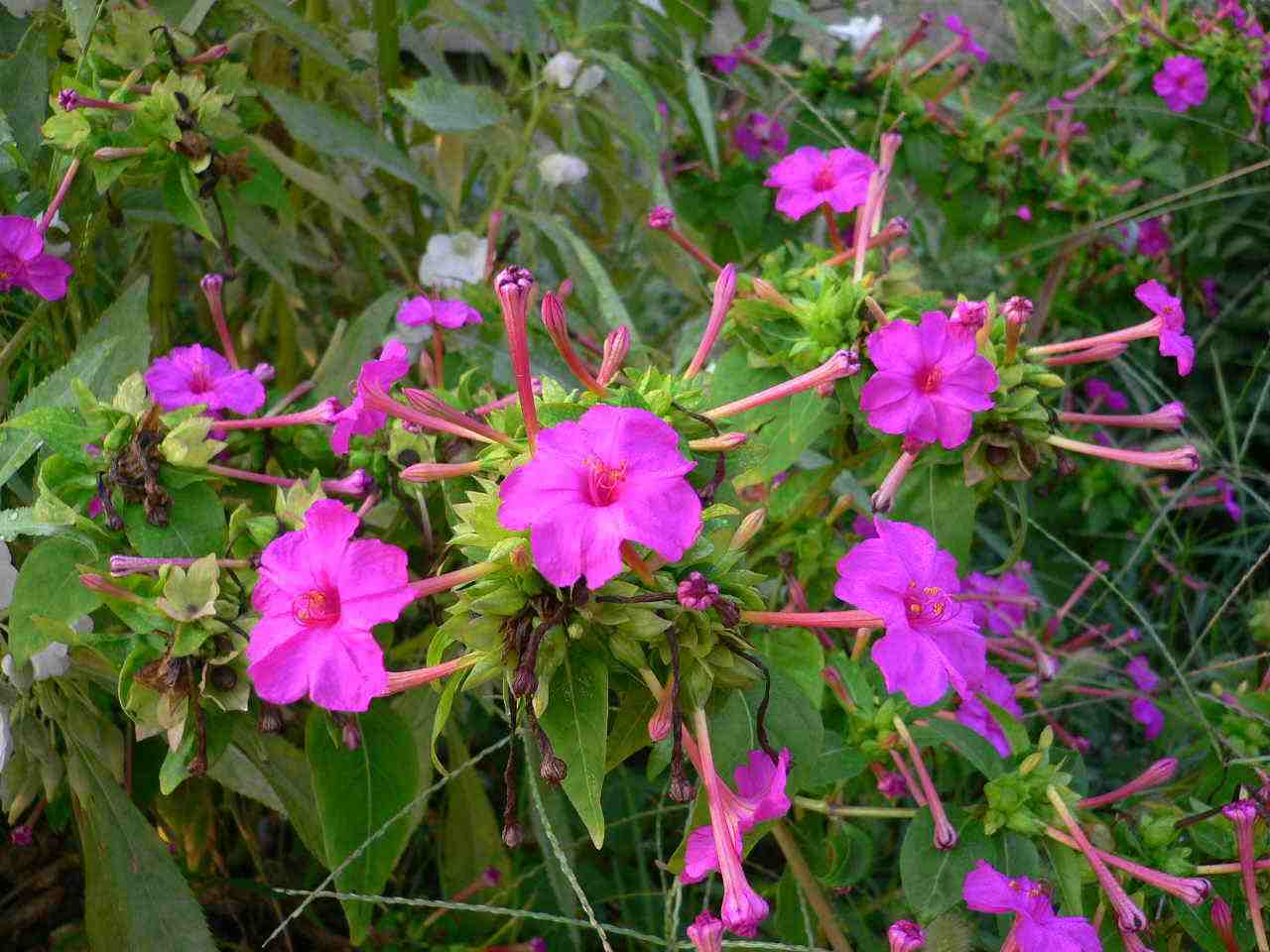
Four o'clock flower: herbaceous, up to 1 m tall. Root thick and fleshy, obconical, black or blackish brown. Stem erect, cylindrical, much branched, glabrous or sparsely covered with fine soft hairs, nodes slightly swollen. Leaf blades ovate or ovate-triangular, entire, glabrous on both surfaces, veins raised. Flowers usually several clustered at the branch tips; involucre campanulate, about 1 cm long, 5-lobed, lobes triangular-ovate; perianth purple-red, yellow, white or variegated, salverform, tube 2-6 cm long, limb 2.5-3 cm in diameter, 5-lobed shallowly; flowers open in the afternoon, fragrant, withering before noon the next day. Achene globose, 5-8 mm in diameter, leathery, black, wrinkled on the surface; seed endosperm farinaceous white. Flowering period June-October, fruiting period August-November.
Four o'clock flower
Native to tropical America. Often cultivated throughout northern and southern China as an ornamental flower, sometimes escaping to the wild. The roots and leaves can be used medicinally, with effects of clearing heat and detoxifying, invigorating blood and regulating menstruation, and tonifying. The white powder of the seeds can remove facial spots, moles and acne.
Four o'clock flower
It prefers mild and humid climatic conditions and is not cold-tolerant; the aboveground parts die in winter, while in the Jiangnan region the underground parts can overwinter safely and become a perennial herbaceous flower, sending up new plants the following spring. Open-ground cultivation requires deep, loose and fertile loam; for pot cultivation, general flower potting soil can be used. It grows even better in slightly shaded places. The flowers open from evening to early morning and close under strong light; if there is shade in summer, it grows and blooms well, while under intense midsummer sun it often sheds leaves. It likes a well-ventilated environment and has a mosquito-repellent effect in summer.
Four o'clock flower
Blue jasmine and the four o'clock flower do not belong to the same family or genus as jasmine. Jasmine belongs to the Oleaceae family, genus Jasminum, and is an evergreen shrub or vine; blue jasmine belongs to the Plumbaginaceae family, genus Plumbago, and is an evergreen semi-climbing or upright shrub; the four o'clock flower, however, belongs to the Nyctaginaceae family, genus Mirabilis, and is a perennial herb.
Plant culture:
Four o'clock flower language: chastity, simplicity, delicacy, conjecture, suspicion, mature beauty, timidity, cowardice.