Cultivation Methods and Price Guide for Four O'Clock Flowers
The four o'clock flower is commonly known as the rouge flower, also called wild jasmine. In fact, the four o'clock flower does not look like jasmine at all, but it has a faint jasmine fragrance, and the word "wild" is well deserved, because if you casually toss a few seeds into the soil, the four o'clock flower will grow vigorously into a large clump and expand its territory year after year. So, how much does a four o'clock flower cost?
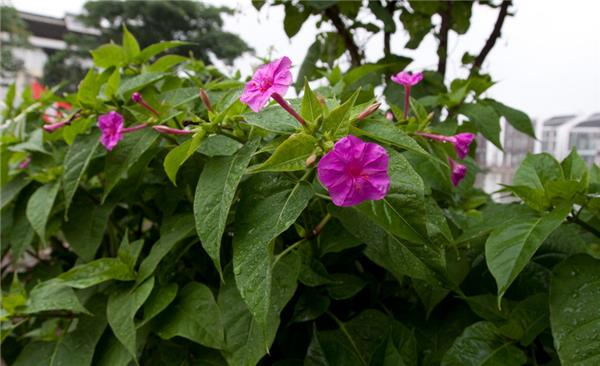
I. Introduction to the Four O'Clock Flower
The four o'clock flower, also called grass jasmine, rouge flower, landmine flower, and pink bean flower, is a perennial herbaceous flower of the Nyctaginaceae family, genus Mirabilis, named for its purple-red flowers and jasmine-like fragrance; it is a common ornamental flower. The four o'clock flower gets its name from its purple-red blooms, but its flower colors are rich and varied, with common ones being red, yellow, white, and mixed colors; when it blooms in summer, a single plant is covered densely with many four o'clock flowers of different colors, very lovely and beautiful. The four o'clock flower has delicate, charming blooms and a pleasant light fragrance, and is often planted in flower beds and along roadsides for ornamental use, or made into bonsai for display at home.
The four o'clock flower grows robustly and is extremely easy to keep alive. It also has resistance to sulfur dioxide, so it can be planted whether on residential balconies or in industrial and mining pollution areas. When growing it at home, if you occasionally water it with water used to wash meat or fish, or with water from rinsing rice, the flowers will bloom more vigorously and the colors will be more vivid. The rouge flower is not only fragrant; its seeds and leaves also have beauty-enhancing, heat-clearing, and detoxifying effects. When the seeds mature, they look black and spherical on the outside and white on the inside. For beauty purposes, you can take several mature seeds, grind them into powder, remove the outer skin, and apply the powder to the face, which can remove facial spots and make the face smooth and fair, achieving a beautifying effect.
II. Growth Habits of the Four O'Clock Flower
It likes mild and humid climate conditions and is not cold-tolerant; in winter the aboveground parts die back, and in the Jiangnan region the underground parts can safely overwinter and become a perennial herbaceous flower, sending up new plants again in spring the following year. For open-field cultivation, it requires deep, loose, fertile loam; for pot cultivation, ordinary flower potting soil can be used. It grows even better in slightly shaded places. The flowers open from evening to early morning and close under strong light. In summer, if there is tree shade, it grows and blooms well; under intense midsummer sun it often sheds leaves. It likes a well-ventilated environment, and in summer it also has a mosquito-repelling effect. The four o'clock flower has rich flower colors and strong resistance, and can self-sow and reproduce. Its flowers open at night and close during the day, and when blooming they are fragrant, making it suitable for placement in spots used for cooling off in the evening or at night, adding much charm.
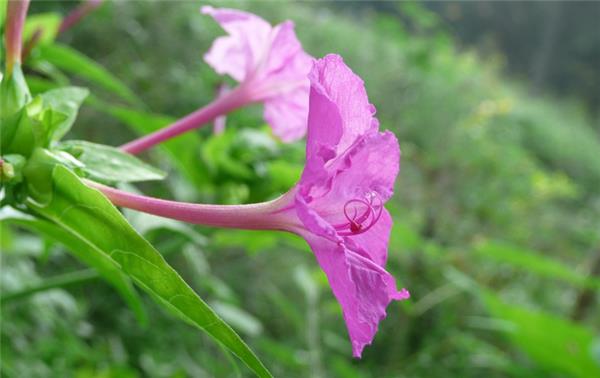
The four o'clock flower is not tall; if the temperature is suitable, it can bloom year-round. It is a perennial plant with flowers shaped like morning glories, and the calyx is the most beautiful part, being corolla-like. Because its fragrance is light and elegant and resembles that of jasmine, and because its color is purple, it is called the four o'clock flower. However, its flower color is not necessarily fixed; the common color is purple, and there are also many other colors, such as white and yellow. There is also a type whose color is red and, because its petals are double, is called "lou shang lou," with high ornamental value. As a plant that is relatively easy to keep alive in the south, the four o'clock flower is also planted by many people in courtyards or flower pots for ornamental purposes. But growing the four o'clock flower also requires certain skills; before growing it, only by understanding its habits can you cultivate it better.
III. Price of the Four O'Clock Flower
The four o'clock flower is native to tropical America. It likes a warm and humid climate, is not choosy about soil, and is not cold-tolerant. In North China it is cultivated as an annual, while south of the Yangtze River it is a perennial. It likes light, and grows better in slightly shaded places. The four o'clock flower is robust, grows quickly, and is simple to manage, suitable for clump planting in front of and behind houses, beside hedges and fences, and next to sparse woods. Its seed endosperm can be made into cosmetic face powder. Because regions and varieties differ, their prices also vary. Potted courtyard ornamental plant flower landmine flower seeds are 0.5 yuan, multicolored fragrant four o'clock flower seeds are 1.5 yuan, South American four o'clock flower is 9 yuan, and white double-petaled fragrant jasmine-scented potted four o'clock flower is 7.5 yuan.
Finally, in addition to ornamental use, the roots, leaves, and flowers of the four o'clock flower can be used as medicine to treat diarrhea. The leaves and endosperm can be made into cosmetic face powder. The roots and leaves can be used medicinally and have the effects of clearing heat and detoxifying, promoting blood circulation and regulating menstruation, and nourishing. The white powder from the seeds can remove facial spots, moles, and acne. So no matter how expensive it is, the price is reasonable.