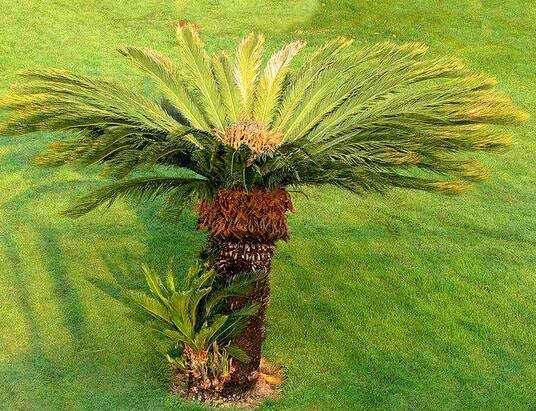
Cycadaceae is an ancient group of gymnosperms, and the common cycad is well suited to being trained as a bonsai.
Cycadaceae is an ancient group within the gymnosperms and one of the most primitive families among living seed plants, often called a living fossil of the plant world. Plants in this family are mostly evergreen woody plants with thick, upright stems that look somewhat like palm trees, so they are often mistaken for them.
In terms of morphological features, the large pinnate compound leaves of Cycadaceae grow clustered at the top of the stem, and the leaflets are leathery and hard, with edges that often curl slightly downward. They are dioecious: male plants produce cylindrical male cones, while the megasporophylls of female plants are pinnately divided, and the seeds, when mature, usually have a bright red or orange-red outer coat that is very striking.
Cycadaceae currently consists mainly of the genus Cycas, with about more than one hundred species worldwide, most of them distributed in tropical and subtropical regions. In China, several wild cycads also occur in the south and southwest, among which the cycad commonly known as the sago palm is the most widely cultivated; it can be planted in the ground in courtyards and is also suitable for pruning and shaping into bonsai. When caring for it, give it plenty of sunlight, choose loose, well-drained soil, and do not water too frequently, so as to avoid root rot.
It should be noted that although the name of the cycad fern contains the word "cycad", it belongs to the ferns and is not included in Cycadaceae; the two differ clearly in their methods of reproduction and plant structure. In addition, cycads grow slowly and live a very long time, and their seeds and young leaves are somewhat toxic, so when growing them at home, children and pets should be kept from eating them by mistake.