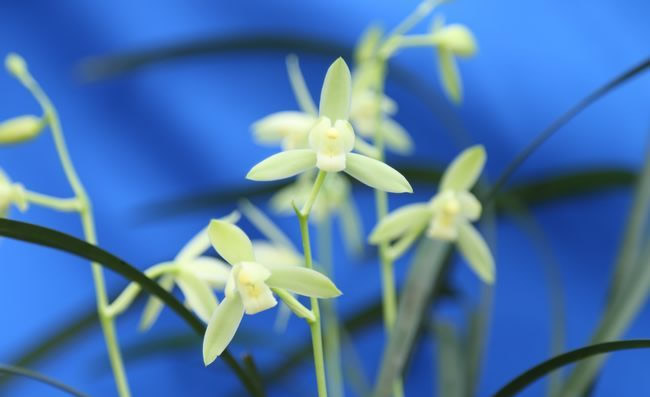
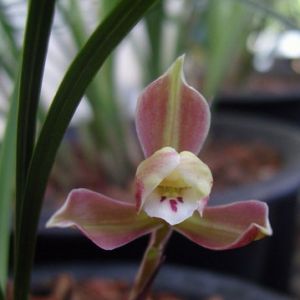
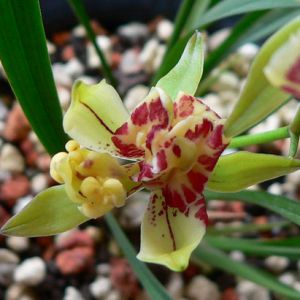
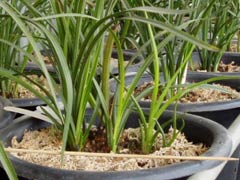
Tiger stripe is a type of variegated leaf pattern in orchids that resembles tiger skin.
Tiger stripe is a type of variegation pattern in orchid leaf variegation, usually referring to yellow-white patches of varying size and intermingled shades distributed across the leaves, resembling tiger skin markings, hence the name. This type of variegation is mostly seen in orchid species such as Cymbidium goeringii (spring orchid) and Cymbidium ensifolium (four-season orchid). Some come from natural mutations of wild-collected orchids, while others have been bred through artificial selection, and once the variegation direction is relatively stable, they enter market circulation.
Unlike variegation types such as line variegation and marginal variegation, tiger stripe patches mostly appear as blocky or irregular thick stripes, inlaid among the green leaves with striking contrast, giving a strong sense of volume and wild charm. The distribution of markings differs on every orchid plant; some are densely covered over the entire plant, while others show only on some of the new shoots, and this uncertainty is precisely why many orchid enthusiasts love variegated orchids.
In terms of care, orchid plants with leaf variegation are relatively sensitive to light. Too strong light easily scorches the leaves, causing the patches to turn yellow and burnt, while an environment that is too shady may cause the variegation color to fade, so bright diffused light is generally preferable. Daily management should use light fertilizer and few applications, avoiding heavy watering and heavy fertilizing. When watering, do not let water accumulate in the leaf center for long periods, so as to keep the leaf markings clear and the plant robust.
It should be noted that tiger stripe-type markings are sometimes easily confused with pesticide damage spots and disease spots. When distinguishing them, pay attention to whether the patch edges are natural and whether there are abnormalities on the underside of the leaves. In addition, leaf variegation may degrade or change, so when introducing plants it is advisable to choose orchid plants with stable variegation direction and robust growth, which will give more reliable ornamental results later on.
Related Reading