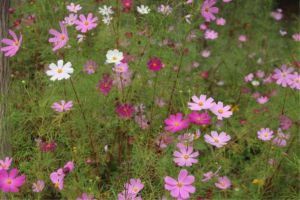
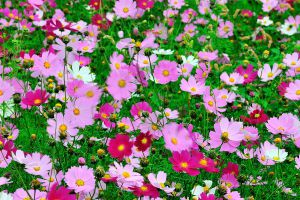
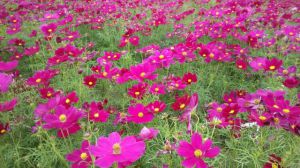
Cosmos is light-loving, drought-tolerant and easy to grow, and is a common flower in flower fields and flower beds.
Cosmos, also known as autumn cherry and large cosmos, is an annual or perennial herbaceous flower of the genus Cosmos in the Asteraceae family, and is often grown as an annual. It is native to the Americas, and today it is widely planted across both northern and southern parts of China, commonly seen in flower fields, flower beds and roadside green spaces.
The cosmos plant has a slender, airy form, with thin, long stems and finely divided pinnate leaves, and its flowers are light and butterfly-like. The flower colors are rich, commonly including pink, white, red and purple, and there are also single-petaled and double-petaled types; dwarf varieties are also suitable for container growing.
It is robust by nature, preferring sunny and warm environments, and is tolerant of drought and poor soil; when fertilizer and water are excessive, it tends to grow leggy and produce fewer flowers. Planting should choose a sunny spot with good drainage, sowing after temperatures warm up in spring, and the flowering period can last from summer into autumn; appropriate water and fertilizer control during the growing period, combined with pinching, can make the plant more compact and produce more flowers.
Many places customarily call cosmos Gesang flowers, but in Tibetan culture Gesang flowers generally refer to beautiful flowers, and the two are not completely equivalent, so it is best to pay attention to the distinction when buying seeds. It has strong self-seeding ability, and in places where it has been planted once, small seedlings often grow on their own the following year.
Cosmos is extensively managed and low in maintenance cost, and when planted in masses its landscape effect is very striking, so it is often used for creating flower fields, road greening and courtyard accents, and is also one of the herbaceous flowers suitable for beginners.