What Is Angelica Sinensis? Understanding the History of Angelica Sinensis Essential Oil in One Article
Historical records of angelica sinensis essential oil and its development and changes - do you know about them? Let's take a look together.
History of angelica sinensis essential oil:
Origin of the name
3. Derived from a place name: the main production area of angelica sinensis was originally in Min County, Gansu. During the Tang Dynasty, the area near Min County was called "Dangzhou," because before the Tang Dynasty this area was inhabited by the "Shaodang Qiang" people. A local specialty was a fragrant herb called "qi" (qi), which was angelica sinensis; in ancient times, "qi" and "gui" had rhyming and identical pronunciations, so it was called angelica sinensis.
Cultural stories
After Jiang Wei received the letter, he understood its meaning. But he distinguished clearly between public and private matters and thought it over repeatedly, believing that Shu was the legitimate line of the Han imperial house, and that Zhuge Liang trusted and valued him greatly. He thought that when the Central Plains were unified, that would be the day mother and son could reunite; by then he could resign office and return to his hometown to serve his aged mother, achieving both loyalty and filial piety - would that not be even better? So he replied to his mother, enclosing some medicinal herbs to express his aspiration: "A hundred qing of fine fields do not lie in one mu (mother); but with lofty aspirations, one does not lie in angelica sinensis." No one knows a son better than his mother. When Mother Jiang received her son's letter, she understood very well and said: "My son has lofty aspirations; your mother seeks nothing else."
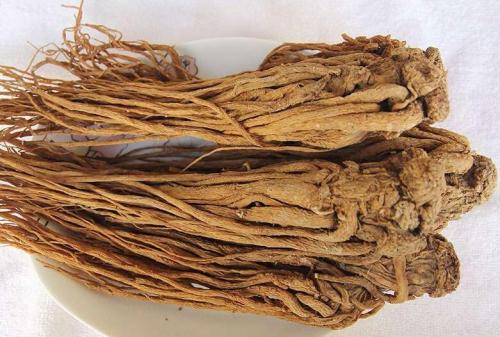
What is angelica sinensis
A perennial herbaceous plant of the genus Angelica in the family Apiaceae, with leaves as several times whorled compound leaves, white flowers, compound umbels, and a thick root used as medicine, produced in China.
A perennial herbaceous plant with pinnate compound leaves, bearing small white flowers between summer and autumn, and with fragrant stems and leaves. The root is used as medicine and has effects such as sedation, blood enrichment, and menstrual regulation. Erya: Explaining Plants: "Bi, shan qi" - Jin Dynasty Guo Pu annotated: "Guangya says: 'Shan qi is angelica sinensis.'" Xing Bing further explained: "It is today's medicinal herb angelica sinensis." Yuan Dynasty Wang Shifu, Romance of the Western Chamber, Book Three, Act Four: "Osmanthus is warm in nature, angelica sinensis invigorates blood - how should it be prepared?" Ming Dynasty Li Shizhen, Compendium of Materia Medica: Plants Three: Angelica Sinensis: "In ancient times, people married to continue the family line; angelica sinensis regulates blood and is an essential medicine for women, carrying the meaning of longing for one's husband, hence the name angelica sinensis."