Production and Processing Flow of Qiai Essential Oil and the Difference Between Qiai and Mugwort
An introduction to the production and processing flow and technical key points of Qiai essential oil, and the difference between Qiai and mugwort. If you do not know them, take a look together.
A preparation process for Qiai essential oil, comprising the following steps:
(1) Crush Qiai, pass through a 40-mesh sieve, and obtain mugwort leaf powder;
(2) Add distilled water to the powder obtained in step (1), soak at 30-40°C for 10-30min, then stir in a biological enzyme at 0.4-1.0% of the weight of the Qiai powder, treat for 40-60min, and filter to obtain filtrate A and mugwort leaf residue;
(3) Subject filtrate A obtained in step (2) to steam distillation, distill and extract for 20-40min, let stand, and separate to obtain an extract;
(4) Add an extraction agent at 2-5 times the weight of the Qiai residue to the mugwort leaf residue obtained in step (2), soak for 20-30min, perform ultrasonic extraction for 30-60min, and filter to obtain filtrate B;
(5) Combine the extract obtained in step (3) with filtrate B obtained in step (4) to obtain mixed liquid C;
(6) Dry mixed liquid C obtained in step (5) with anhydrous sodium sulfate, filter, and concentrate at 60°C under normal pressure to obtain the product. The present invention destroys the cell walls of Qiai through biological enzymes, thereby increasing the extraction rate of its volatile oil; by extracting the filter residue with a mixture of 30-60°C petroleum ether and dichloromethane, the extraction rate of the volatile oil is effectively improved. The 30-60°C petroleum ether was purchased from Jinan Shiji Tongda Chemical Co., Ltd. Further, in step (2), the biological enzyme consists of cellulase and pectinase in a weight ratio of 3:1.
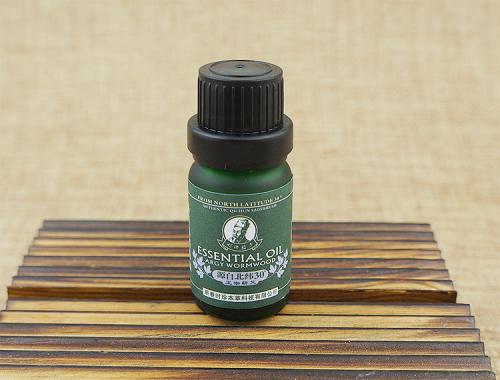
The difference between Qiai and mugwort
Qiai is a type of mugwort, named because it is produced in Qizhou (the old name of Qichun County). Therefore, Qiai sticks are a specialty of Qichun County, the hometown of Li Shizhen. Qiai contains 17 known compounds, and its volatile oil content, total flavonoid content, combustion heat value, and other properties are clearly superior to mugwort sticks produced in other regions. The moxibustion effect of using Qiai sticks is far better than that of ordinary mugwort sticks. Qiai is named after its place of origin. The leaves of Qiai are large and thick, and the seven-tip form is the genuine medicinal material. The Qiai plant can reach a height of more than 2.5 m. The moxa wool pounded from its Dragon Boat Festival mugwort leaves is grayish brown, while the moxa wool pounded at other times is earthy yellow, which indicates the genuine product. Qiai leaves picked in autumn are not suitable for moxibustion. Qiai is picked around the Dragon Boat Festival, when its medicinal value is the highest, the curative effect is the best, and the moxibustion sensation is the strongest. Medicinal materials emphasize regional authenticity, and mugwort produced in different places has different effects. The best place of origin for mugwort is Qichun, Hubei, followed by Hubei, Jiangsu, Zhejiang, Henan, and so on.