Sunflower Planting Methods and Key Technical Points
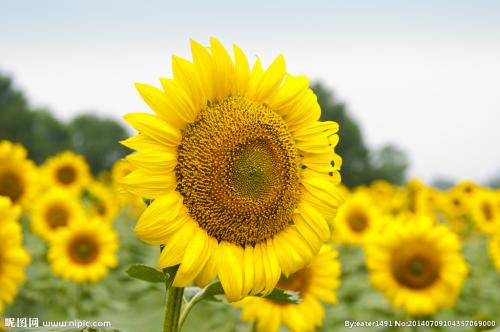
Sunflower (Latin: Helianthus annuusL.) is an annual herbaceous plant of the class Magnoliopsida, order Asterales, family Asteraceae, genus Helianthus. It grows 1 to 3.5 m tall. The stem is upright, round with many ridges, hard in texture and covered with white coarse stiff hairs. The broadly ovate leaves are usually alternate, with a sharply protruding or gradually pointed tip, 3 basal veins, and coarsely serrated edges; both surfaces are rough, covered with hairs, and have long petioles. The capitulum (flower head) is 10 to 30 cm in diameter and is borne singly at the top of the stem or at the ends of branches.

I. Planting Conditions
1. Temperature: Sunflower has a very strong ability to adapt to temperature. When the soil temperature reaches above 3 degrees, the seeds begin to germinate; when the temperature reaches 6 degrees, they begin to take root and sprout. At every stage of sunflower growth, as long as the temperature is above 11 degrees, the sunflower can grow normally.
2. Water: Because the sunflower plant is tall and has many leaves, the water it needs during growth is 1.75 times that of corn. However, the water requirement differs at each stage, so watering must be done reasonably.
3. Light: Sunflower likes sunlight very much. During the seedling stage, the flower head and leaves are strongly phototropic. When there is plenty of sunlight, the seedlings grow very robustly and will not become leggy. During growth, if there is plenty of sunlight, the stems and leaves grow very vigorously, which raises the seed-setting rate. In the later stage, if there is plenty of sunlight, the seeds will be very plump.
4. Soil: Basically any type of soil can be used. Because the sunflower's root system is very well developed, it has strong drought resistance; the roots and stems have very good aeration, so it can also be planted in waterlogged places.
II. Planting Methods
1. Choosing and preparing the land: It is best to choose level land with moderate fertility, and preferably not to plant on the same land repeatedly. First till the field finely, then at sowing time stir and mix with the new high-fat film, which can prevent damage from underground pests and give a higher germination rate.
2. Sowing at the right time: Sunflowers are mostly sown in March to April, with 19 to 26 degrees being most suitable, and they basically sprout 6 to 8 days after sowing. It mainly depends on the variety whether to sow in spring or in summer.
3. Checking the field and filling in seedlings: Sunflower is a dicotyledonous crop, so when it pushes through the soil to emerge, it does not come up easily; soil is then covered over the seeds, and if there is continuous rainy weather, the soil tends to crust, so gaps can easily appear in some places. To keep the seedlings complete in the field, it is necessary to check frequently and then fill in seedlings where they are missing.
4. Thinning and final thinning: To prevent the seedlings from being too dense and shading each other, which would affect how robustly they grow, thinning should be done in good time. At the same time, final thinning should be carried out, which is very beneficial for cultivating strong seedlings and lets the flower head develop better. Once 2 pairs of true leaves have grown, final thinning can be carried out.
5. Cultivating and weeding: Throughout the entire growth period, cultivating and weeding are mostly done 3 times, mainly to prevent the field from crusting, and to earth up and loosen the soil, etc. Once 2 pairs of true leaves have grown, the first should be done, along with thinning and final thinning; 7 days after final thinning, the second should be done; before the rows close, the third should be done, along with fertilizing, earthing up and furrowing.
6. Furrowing and topdressing: This is generally done at the same time as the third cultivation, mainly with nitrogen and phosphorus fertilizer; about 5.1 kg of diammonium phosphate and 10.1 kg of urea are used per 1 mu, then stirred evenly and scattered into the field.
7. Watering at the right time: For varieties with a plant height of 1.6 m, water once at the bud stage, a second time at the early flowering stage, and a third time at the grain-filling stage. For varieties with a plant height of 2.1 m, water the first time 5 days before flowering, the second time 7 days after the first watering, and the third time at the grain-filling stage.