Green Calyx Plum (scientific name: Armeniaca mume Sieb. f. viridicalyx (Makino) T. Y. Chen): a
small tree, 4-10 m tall; bark light gray or greenish, smooth; branchlets green, smooth and hairless. Leaves ovate or elliptic, margins usually with small sharp serrations, grayish green. Flowers solitary or sometimes 2 together in one bud, strongly fragrant, opening before the leaves; pedicels short,
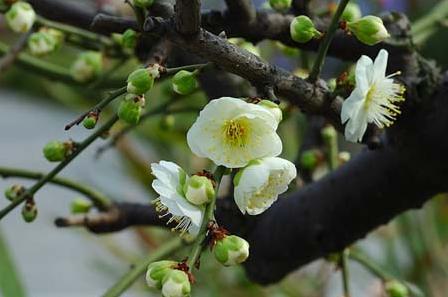
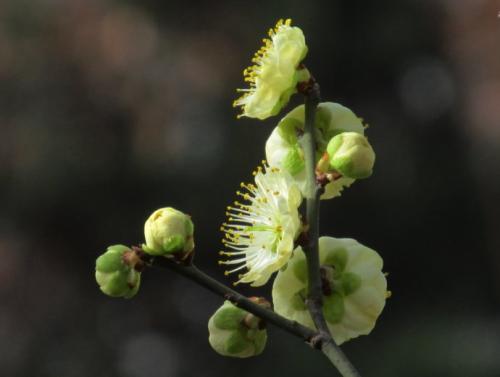
calyx green; petals saucer-shaped, pure white, richly fragrant, in single, double and semi-double forms; calyx green, calyx tube broadly campanulate, sepals ovate or suborbicular, apex rounded and obtuse.
It is a famous plum blossom cultivar and the plum blossom with the most noble character. There are already dozens of cultivars, such as Large-flowered Green Calyx, Single-flowered Green Calyx, Variegated-leaf Green Calyx and others. Fruit nearly spherical. Flowering in winter and spring, fruiting from May to June. Mostly used for garden ornament, and also used as Chinese medicinal material.
Cultivation Techniques:
Soil
In the south it can be planted in the ground, while in cold northern regions it should be grown in pots and overwintered indoors. Planting can be done from after leaf fall to before spring bud break. To improve the survival rate, avoid damaging the root system and transplant with a soil ball. For ground planting, choose a wind-sheltered, sunny spot. For pot culture, use a growing medium uniformly mixed from 3 parts leaf mold, 3 parts garden soil, 2 parts river sand and 2 parts decomposed barnyard manure. After planting, water once thoroughly. Keep it in a shaded place for care, and after it resumes growth move it into sunlight for normal management.
Temperature
Light and temperature: it prefers warmth and ample light. Except for apricot-plum cultivars, which can withstand low temperatures of -25°C, it generally withstands -10°C. It tolerates high temperatures and can also grow at 40°C. It grows and develops best in areas with an annual average temperature of 16-23°C. It is very sensitive to temperature and blooms when the early-spring average temperature reaches -5-7°C.
Water and Fertilizer
Watering and fertilizing: during the growing season, pay attention to watering and keep the potting soil often moist with a tendency to dryness. It must neither become waterlogged nor be too wet or too dry; follow the principle of watering when dry and stopping when wet. Generally water less on cloudy days and at low temperatures, and more otherwise. In summer, water twice a day; in spring and autumn, once a day; in winter, water thoroughly only after the soil has dried through. Fertilizing should also be reasonable: apply base fertilizer well before planting and mix in a small amount of
monopotassium phosphate, apply monopotassium phosphate once more before flowering, and apply decomposed
cake fertilizer once at flowering to supplement nutrients. In June, a compound fertilizer can also be applied once to promote flower bud differentiation. After leaf fall in autumn, apply an organic fertilizer once, such as decomposed manure.
Pruning
Shaping and pruning: for ground-planted plum, shaping and pruning can be done within 20 days after flowering. Focus on a natural tree shape, cutting out crossing branches, upright branches, dead branches and overly dense branches, and shortening side branches to promote abundant flowers and lush foliage. After potted plum is potted up, heavy pruning should be carried out to lay the foundation for making bonsai. Usually plum stumps are used as the setting and grafted with plum blossoms of various forms. Maintain a certain temperature, and plum blossoms can be seen in full bloom at Spring Festival. If you want it to bloom around May 1, keep it at 0-5°C in a moist environment, move it outdoors in early April, and care for it in a place with ample sunlight and good ventilation, and it can bloom around May 1.
Flowering Control
Flowering-period control: potted plum is generally for family ornament. After leaf fall in winter, place it indoors, keep the temperature at 0-5°C, gradually raise it to 5-10°C after New Year's Day, give it full sunlight daily, and frequently spray water on the branches, with the water temperature close to room temperature.
Medicinal Use:
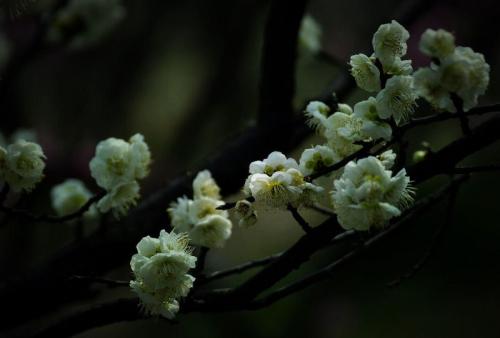
Dried flower buds, spherical, 4-8 mm in diameter, often with a small stalk at the base. Bracts in 3-4 layers, brown scale-like. Inside the bracts are 5 sepals, pale yellowish brown, slightly greenish, ovate, imbricate, basally fused with the receptacle. Petals 5 or numerous, white or yellowish white, tightly closed together. Within the petals are many yellow filamentous stamens. In the center is one pistil, the ovary ovate with a slender style. Light in weight. Fragrant in odor, bland and astringent in taste. Those with uniform, complete flowers, still unopened buds, green calyx and white flowers, and a fresh fragrant odor are considered best. Mainly produced in Jiangsu, Zhejiang and other places. Those with red corollas are called red plum blossoms; their form is similar to white plum blossoms but slightly larger, with a pale red corolla, double petals, and red-brown calyx. For medicinal use, however, white plum blossoms are mainly used, while red plum blossoms are used less.